
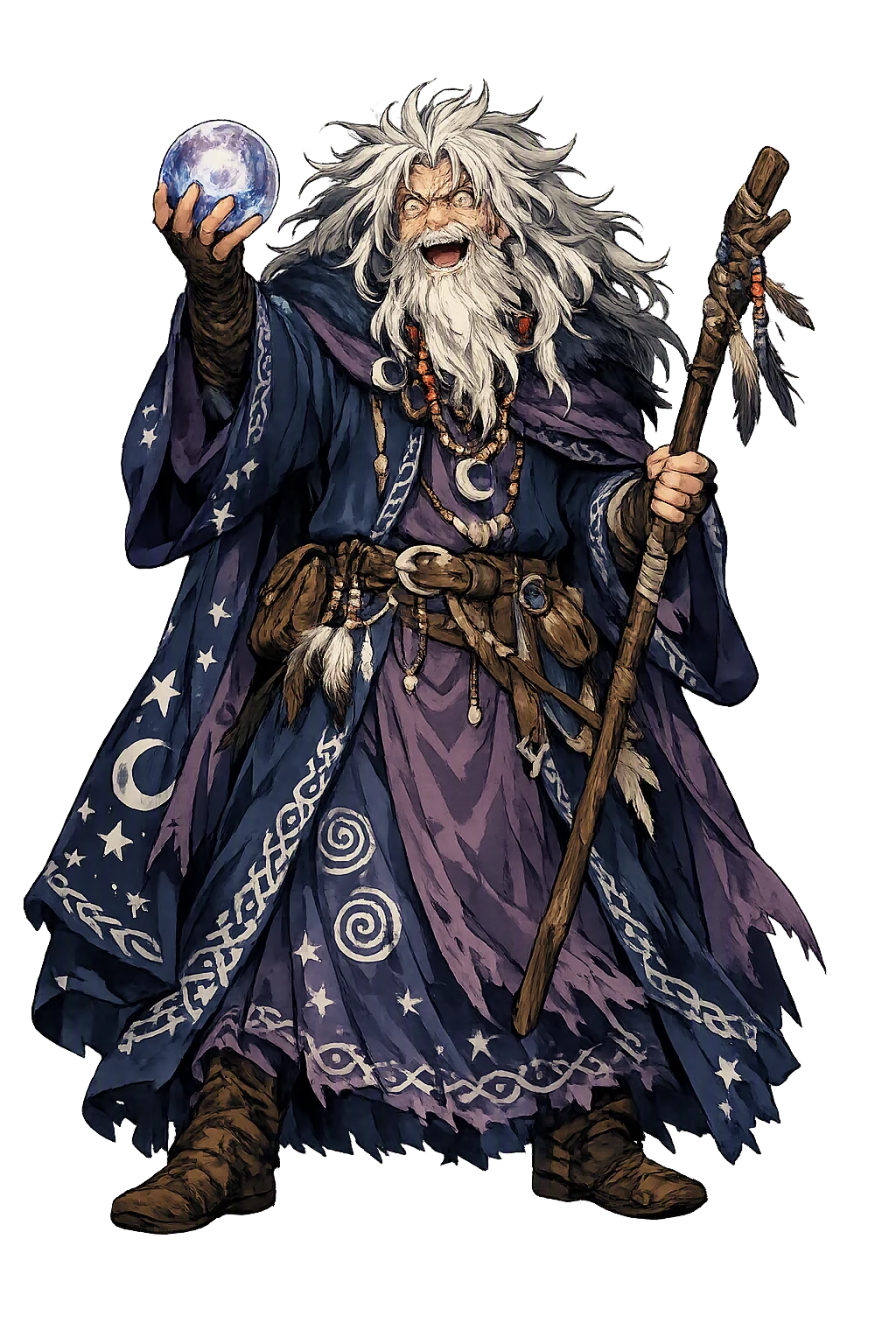
Why Myrddin belongs in your address bar
Every address bar is a choice. When you type Myrddin, you are not typing a novelty; you are restoring a name that the early DNS, built for English typewriters, could not carry. The plain ASCII form myrddin is a leftover of that constraint, not the name itself. This post is the long version of the restoration: where the name comes from, how the Celtic transcription tradition wrote it, how it is pronounced, what the myths and the material record preserve, and why its Unicode form now lives as a working domain. The claim throughout is simple — the original spelling is not decoration. It is the name.
At a Glance
- Restored name: Myrddin
- ASCII form: myrddin
- Meaning: "Merlin"
- Domain of influence: Seer, Wild Man
- Pantheon: Celtic
- Classification: Tier 2
Overview
Myrddin (myrddin) — Seer, Wild Man · Merlin — is the original Welsh form of the name the world knows as Merlin: the prophet of the British Old North who went mad at the battle of Arfderydd in 573, fled into Coed Celyddon, the Caledonian forest, and lived there as a wild man, lamenting his dead lord Gwenddolau and uttering the prophecies that made him the canonical voice of Welsh vaticination.
The Welsh sources give him a family and a grief: he is Myrddin son of Morfryn in the Triads, brother of Gwenddydd — wife of Rhydderch — and the speaker of the Black Book of Carmarthen's great laments, the Afallennau and the Oianau, addressed from hiding to the apple tree that shelters him. Geoffrey of Monmouth carried him into Latin as Merlinus: the Historia Regum Britanniae (c. 1136) made him the boy prophet of Vortigern's tower and the dragons, and the Vita Merlini (c. 1150) gave the wild man his fullest biography — the forest life, the threefold death foretold to a boy, the stag he rides to court, the long discourse with Taliesin, and the sister Ganieda who succeeds him in prophecy.
PuniCodex restores the name as Myrddin — identical to the ASCII input, because normalized Middle Welsh writes no diacritic in this name. The mechanical rule therefore places it in Tier 2: nothing distinctive is lost in transit, a statement about orthography and never about the prophet. No domain is claimed: the plain-ASCII myrddin.com is registered to a third party outside the collection and is watched for release.
The Name
The name is attested in Middle Welsh as Myrddin, the form underlying Geoffrey of Monmouth's Latin Merlinus — the spelling that carried the figure into French, English, and world literature. The scholarly account of the name's origin reverses the folk etymology Geoffrey loved. Geoffrey connects his Merlin with Carmarthen — Kaermerdin, the 'city of Merlin' — but the direction of naming runs the other way: the personal name derives from the place-name Caerfyrddin, and Caerfyrddin descends from the Roman name of the fort at Carmarthen, Moridunum, 'sea-fort' (mori- 'sea' + dūnon 'fort'), attested in the Antonine Itinerary. On Jackson's and Jarman's account the prophet is, at bottom, 'the man of Moridunum' — a fortress remembered as a person.
The medieval tradition itself split the name's bearer in two. Gerald of Wales, writing around 1191, distinguishes Merlinus Ambrosius — the boy prophet of Vortigern's tower, whose story Geoffrey took from the fatherless Ambrosius of the Historia Brittonum — from Merlinus Celidonius or Sylvester, 'the Caledonian' and 'the man of the woods', the northern prophet who went mad after battle. Welsh preserves the same doubleness in the by-forms Myrddin Emrys (the Ambrosian) and Myrddin Wyllt (the Wild).
The ASCII form myrddin loses nothing, because the normalized Middle Welsh spelling is already plain Latin letters; the digraph dd for the soft 'th' [ð] is orthography, not a lost character. The restoration is therefore a matter of canonical reference, not rescued diacritics, and the name is classified Tier 2 by the project's mechanical rule.
The letter-by-letter transformation runs:
- m → M — Same, capitalized
- y → y — Same
- r → r — Same
- d → d — Same
- d → d — Same
- i → i — Same
- n → n — Same
The project holds no domain for this name: myrddin.com is registered to a third party outside the PuniCodex collection and is watched for release. The temple lives at its canonical lexicon address.
The Original Script
The name is preserved in Middle Welsh in the Latin alphabet as Myrddin — attested Middle Welsh, c. 13th–14th c. in the surviving manuscripts, with the underlying tradition reaching centuries earlier — in the Black Book of Carmarthen, the Red Book of Hergest, and the Welsh Triads. Middle Welsh was written in the Latin alphabet using the Insular script tradition; the spelling Myrddin requires no diacritic.
The scholarly rendering proceeds step by step:
- The earliest continuous witnesses are the Black Book of Carmarthen (NLW Peniarth MS 1, c. 1250) and the Red Book of Hergest (Jesus College MS 111, c. 1382–1410); the poems they carry are substantially older than their copies.
- The digraph dd writes the voiced dental fricative [ð], and y writes two distinct vowels by position — the clear [ə] of the stressed penult and the high central [ɨ] of the final syllable; both are orthographic conventions of Welsh, not characters the ASCII alphabet lacks.
- Geoffrey of Monmouth's Merlinus is a Latinization, not a separate attestation: he attached the name to Caerfyrddin, and the modern derivation runs from Moridunum, 'sea-fort', through the place-name to the person.
- The Unicode restoration Myrddin is therefore identical to the ASCII form apart from the capital; the temple form is a canonical reference, not a rescued spelling.
Two cautions attach to the record: the medieval tradition itself counted two Merlins — the Ambrosian and the Caledonian — and the 'two names one wizard' of modern fiction is a fusion, not a source; and the folk etymology 'Myrddin's fortress' runs backward — the fortress named the man.
Pronunciation
The reconstructed pronunciation of the name is /ˈmər.ðɨn/ — Modern Welsh.
Phoneme by phoneme:
- My- — Bilabial [m] with the Welsh clear y, a central [ə] like the 'uh' of 'about'; stressed, because Welsh stress falls on the penult
- -rddin — Tapped [r]; dd, the voiced dental fricative [ð] of English 'this'; final unstressed -in with the high central [ɨ] that Welsh writes y in the last syllable
For the modern speaker, the closest approximation is: 'MUR-thin' — two short beats, the dd soft as in 'this', never hardened, and never the three-syllable 'MER-lin' the Latin form made famous.
Kindred and historical forms of the name:
- Middle Welsh — Myrddin, son of Morfryn; also Myrddin Wyllt, 'the Wild'
- Medieval Latin — Merlinus, Geoffrey of Monmouth's Latinization; Merlinus Ambrosius and Merlinus Celidonius/Sylvester in Gerald of Wales
- Name origin — Caerfyrddin (Carmarthen), from Roman Moridunum, 'sea-fort'
Myrddin is Tier 2 because the restoration preserves nothing ASCII loses: the letters of the manuscript form are the letters of the keyboard. The capital alone marks the temple form.
Mythology
Myrddin's mythology divides into a northern dossier and a Latin one, and the medieval tradition itself already kept them apart.
The Battle of Arfderydd (Annales Cambriae; Trioedd Ynys Prydein)
The Annales Cambriae enter under 573 the battle of Arfderydd, fought between the sons of Eliffer and Gwenddolau son of Ceidio. The Welsh Triads count it among the futile battles of the Island of Britain — brought about, in the triad's famous understatement, for a lark's nest — and record the consequence that founds the legend: Gwenddolau fell, and Myrddin son of Morfryn became mad.
The Laments of the Black Book (Yr Afallennau; Yr Oianau)
The earliest Welsh manuscript, the Black Book of Carmarthen (c. 1250), preserves the wild man's own voice. In the Afallennau Myrddin addresses the sweet apple tree that shelters him, laments Gwenddolau dead at Arfderydd, grieves the warrior-company he has lost, and hides from Rhydderch's men; the Oianau keeps the same outcast voice calling its mournful cry through the forest, prophecy threaded through lament.
The Conversation with Gwenddydd (Cyfoesi Myrddin a Gwenddydd)
In the Red Book of Hergest dialogue, Gwenddydd — Rhydderch's wife and Myrddin's sister — questions her brother across the gulf his madness has opened, mourning the mead-feast companion he was; he answers with the fate of Wales, and the prophecy keeps breaking against grief.
The Vita Merlini (Geoffrey of Monmouth)
Geoffrey's poem of c. 1150 is the fullest biography: the madness at a northern battle; the life of the forest among roots, fruit, and snow; the capture by Rhydderch's men; the laughter that is always a prophecy, including the boy's foretold threefold death — from a rock, in a tree, and in the water — fulfilled when he falls from a cliff, catches in a tree, and dies with his head in the stream; the return to court riding a stag and driving the wild herds; the long discourse with Taliesin (Telgesinus) on winds, waters, fishes, and the world's making; and the end, when Merlin gives his observatory to his sister Ganieda — Geoffrey's Gwenddydd — who takes up the prophetic gift, and retires to the forest for good.
The Boy at Vortigern's Tower (Historia Brittonum; Historia Regum Britanniae)
Geoffrey's other Merlin came from another book. The ninth-century Historia Brittonum has the fatherless boy Ambrosius, brought to Vortigern to be sacrificed for his collapsing tower at Dinas Emrys, reveal the pool and the two dragons — the red of the Britons, the white of the Saxons — beneath its foundations. Geoffrey gave Nennius's boy Myrddin's name: Merlinus Ambrosius — the graft from which the Arthurian enchanter grew.
Symbols & Iconography
Myrddin's attributes are not regalia but the furnishings of an exile — a tree, a forest, a wild mount, and the three elements of a foretold death:
- The apple tree — The sweet tree of the Afallennau that shelters him and hears his laments for Gwenddolau: prophecy's one roof in the forest of Celyddon
- The forest of Celyddon — The Caledonian wood itself: madness, exile, and second sight in a single landscape
- The stag — The wild mount he rides to Rhydderch's court in the Vita Merlini, driving the forest's herds before him: the king become herdsman of the unowned
- Rock, tree, and water — The three elements of the threefold death he prophesies for the boy at court, fulfilled to the letter despite every precaution
- Gwenddydd's questions — The sister's dialogue from the Red Book of Hergest: prophecy as the speech left between the mad and those who loved them
Archaeology & Evidence
Myrddin is a textual figure, and his witnesses are among the most precisely identified in Welsh letters. The Afallennau and Oianau stand in the Black Book of Carmarthen (Aberystwyth, NLW Peniarth MS 1, c. 1250), the earliest surviving manuscript in Welsh; the Cyfoesi Myrddin a Gwenddydd stands in the Red Book of Hergest (Oxford, Jesus College MS 111, c. 1382–1410); Geoffrey's Vita Merlini survives complete in a single manuscript (British Library, Cotton Vespasian E.iv, thirteenth century).
The landscape behind the texts is real and partly recoverable. Arfderydd is traditionally identified with Arthuret near Longtown in Cumbria, in the Old North the poems remember. Caerfyrddin (Carmarthen) overlays the Roman fort of Moridunum, 'sea-fort', attested in the Antonine Itinerary and confirmed by excavation — the place-name from which, on the scholarly account, the prophet's name derives. And Dinas Emrys, the Gwynedd hillfort where the Historia Brittonum sets the fatherless boy and the dragons, yielded post-Roman occupation material in H. N. Savory's excavations of 1954–56.
Realm & Domain
Myrddin is catalogued under the domain 'Seer, Wild Man' — two words that name the whole of his legend and the whole of his price.
Seer
Myrddin is the patron and mouthpiece of the Welsh prophetic genre, the brud: the Black Book poems put the fate of Britain in his mouth, Geoffrey's Prophetiae Merlini — Historia Book VII — circulated separately for centuries as the most copied political prophecy of the Latin Middle Ages, and every later Welsh vaticination quietly claimed his authority.
Wild Man
The same tradition is exact about the price: madness at Arfderydd, exile in Coed Celyddon, food from the forest floor, speech addressed to a tree. The Welsh term is wyllt — wild — and Myrddin Wyllt is the type-figure: the seer who had to leave the human settlement before the future would speak to him.
The Two in One
Geoffrey's Vita Merlini holds the pair together in a single poem: the mad king dragged to court who laughs at what no one else can see — and whose laughter is always a prophecy — then rides home to the forest on a stag, driving the woodland herds before him like a shepherd of the wild.
Across Cultures
Myrddin's clearest cross-border witness is northern, not continental. Jocelyn of Furness's Life of St Kentigern (c. 1185) knows a mad prophet at the court of Rhydderch Hael named Lailoken, who foretold his own threefold death; a fragmentary Latin life of 'Merlin the Wild' in the Cotton collection tells the same penitence, conversion by Kentigern, and triple end — stones, a stake, and the Tweed. Tolstoy argued that Lailoken and Myrddin Wyllt are two records of one north-British wild-man figure, and the handbooks treat the kinship as real and its exact shape unproven.
The Irish tradition offers no namesake but a perfect parallel: Suibhne Geilt, the king driven mad by battle in Buile Shuibhne, who lives in trees, speaks in verse, and is watched from the court he left — the same type, the wild prophet as battle-survivor, with no shared name. Within Wales his truest kin is Taliesin, the other great prophetic poet, with whom the Vita Merlini pairs him in discourse; and the deepest split is internal — Gerald of Wales's two Merlins, the tower-boy Ambrosius and the wild Caledonian, whom the romances later fused into one enchanter.
Cultural Legacy
No Celtic figure has had a stranger second life. Geoffrey's Prophetiae Merlini — Historia Book VII — circulated separately from the work that contained it and became the most copied political prophecy of the Latin Middle Ages, mined for omens by kings and rebels and furnished with learned commentaries into the fifteenth century. The romances then turned the prophet into the enchanter: by the thirteenth-century Vulgate cycle Merlin is Arthur's maker — arranger of Uther's night at Tintagel, keeper of the Round Table's founding, and prisoner of the Lady of the Lake.
The Welsh original never disappeared. Lady Charlotte Guest's Mabinogion translation (1838–49) and the nineteenth-century Arthurian revival carried the Welsh roots back into English view; Jarman's scholarship rebuilt the northern prophet behind the wizard; and Caerfyrddin — 'Myrddin's fortress', on the folk etymology — still bears his name in every address in Carmarthen. Modern Druidry and the broader Arthurian imagination now run both figures at once: Merlin the wizard of the films, and Myrddin Wyllt, patron of Welsh prophecy and of every wild man the forests still keep.
The Scholarly Record
The account of Myrddin given in this edition rests on the witnesses and reference works listed below. The Black Book poems and the Red Book dialogue supply the Welsh voice; the Triads and Annales the northern frame; Geoffrey's Historia and Vita Merlini the Latin transformation; Nennius the tower-boy Geoffrey grafted on; Gerald of Wales the medieval distinction of the two Merlins; the Kentigern material the northern doublet; Jackson and the philologists the name.
- Clarke, Basil, ed. and trans., Life of Merlin: Geoffrey of Monmouth, Vita Merlini (Cardiff: University of Wales Press, 1973).
- Geoffrey of Monmouth, Historia Regum Britanniae, ed. Michael D. Reeve, trans. Neil Wright (Woodbridge: Boydell, 2007), Books VI–VII (the Prophetiae Merlini).
- Jarman, A. O. H., 'Llyfr Du Caerfyrddin: The Black Book of Carmarthen', Proceedings of the British Academy 71 (1985), 333–56.
- Cyfoesi Myrddin a Gwenddydd ei chwaer, Red Book of Hergest (Oxford, Jesus College MS 111).
- Annales Cambriae, s.a. 573, ed. John Williams ab Ithel, Rolls Series 20 (London, 1860).
- Bromwich, Rachel, ed. and trans., Trioedd Ynys Prydein: The Welsh Triads (Cardiff: University of Wales Press, 1961; 3rd ed. 2006).
- Historia Brittonum (Nennius), ed. and trans. John Morris (London: Phillimore, 1980), §§40–42.
- Gerald of Wales, Itinerarium Cambriae II.8, ed. J. F. Dimock, Giraldi Cambrensis Opera, Rolls Series 21, vol. 6 (London, 1868).
- Jocelyn of Furness, Vita Sancti Kentigerni, ed. A. P. Forbes, Lives of S. Ninian and S. Kentigern (Edinburgh, 1874).
- Jarman, A. O. H., 'The Merlin Legend and the Welsh Tradition of Prophecy', in The Arthur of the Welsh, ed. R. Bromwich, A. O. H. Jarman, and B. F. Roberts (Cardiff: University of Wales Press, 1991), 117–45.
- Jackson, Kenneth H., Language and History in Early Britain (Edinburgh: Edinburgh University Press, 1953).
- Tolstoy, Nikolai, The Quest for Merlin (London: Hamish Hamilton, 1985).
- O'Keeffe, J. G., ed. and trans., Buile Shuibhne (The Frenzy of Sweeney), Irish Texts Society 12 (London: Irish Texts Society, 1913).
- Evans, D. Simon, A Grammar of Middle Welsh (Dublin: Dublin Institute for Advanced Studies, 1964).
- Eckhardt, Caroline D., ed., The Prophetia Merlini of Geoffrey of Monmouth: A Fifteenth-Century English Commentary (Cambridge, MA: Medieval Academy of America, 1982).
- Koch, John T., ed., Celtic Culture: A Historical Encyclopedia, 5 vols. (Santa Barbara: ABC-CLIO, 2006), s.vv. Myrddin, Merlin, Arfderydd, Dinas Emrys.
- MacKillop, James, Dictionary of Celtic Mythology (Oxford: Oxford University Press, 1998), s.vv. Merlin, Myrddin.
A Meditation
Myrddin is the figure who paid for knowledge with the ordinary world. Every version of him loses something before he sees: a lord, a battle, his reason, his hall. The tradition is strikingly honest about the transaction — the prophecy is real, and so is the madness, and the same event, the slaughter at Arfderydd, gives him both. He is the answer Celtic literature gives to the question of what a seer is: not a priest with a technique but a survivor whom grief has put outside the human settlement, close enough to the trees that the future can get a word in. His sister comes to the edge of the forest to ask what will happen; he tells her, and stays. That is the shape of the gift — the future, at the price of the present.
And his name tells the same story in miniature. It is not a theonym but a place-name: Caerfyrddin, the sea-fort, Moridunum, given to a man. The wild prophet carries a fortress in his name — the ordered world he was driven out of, remembered every time anyone calls him.
The Unicode Restoration
Myrddin is classified as Tier 2: the restoration needs no distinctive letters or diacritics its ASCII form would lose. The ASCII fallback myrddin still resolves everywhere, but it is the restored form that carries the name's full information. That is the whole thesis of this temple: the marks are the message.
Why This Restoration Matters
Restoring Myrddin is part of a larger effort to make the web multilingual by default. The PuniCodex project does not ask users to learn a new alphabet; it asks the infrastructure to respect the alphabets that already exist. Every section of this post — the script, the sound, the myths, the evidence — converges on the same point: the marks in Myrddin are information, and information deserves an address of its own. A single Unicode domain is a small proof, but it is a proof that scales: every name restored makes the next one easier, and every visit to the temple is a vote for the restored form.
Explore Further
This post is one doorway into the temple. The home page carries the full character breakdown and the ambient canvas; the lore page tells the myths in long form; the Scholarly Edition preserves the sources, pronunciation data, and revision history; and the patron wall supports the restoration directly. For the wider map, browse the Lexicon, explore the Pantheon, or return to the PuniCodex blog.
Related Names
Sources
The full scholarly apparatus — every citation, revision, and review — lives in the Scholarly Edition. Key references for this post:
- Clarke, Basil, ed. and trans., Life of Merlin: Geoffrey of Monmouth, Vita Merlini (Cardiff: University of Wales Press, 1973).
- Jarman, A. O. H., 'Llyfr Du Caerfyrddin: The Black Book of Carmarthen', Proceedings of the British Academy 71 (1985), 333–56.
- Koch, John T., ed., Celtic Culture: A Historical Encyclopedia, 5 vols. (Santa Barbara: ABC-CLIO, 2006), s.v. Myrddin.
- Jarman, A. O. H., 'The Merlin Legend and the Welsh Tradition of Prophecy', in The Arthur of the Welsh, ed. R. Bromwich, A. O. H. Jarman, and B. F. Roberts (Cardiff: University of Wales Press, 1991), 117–45.
- Lexicon authorities for this entry: Welsh Triads, MacKillop.