
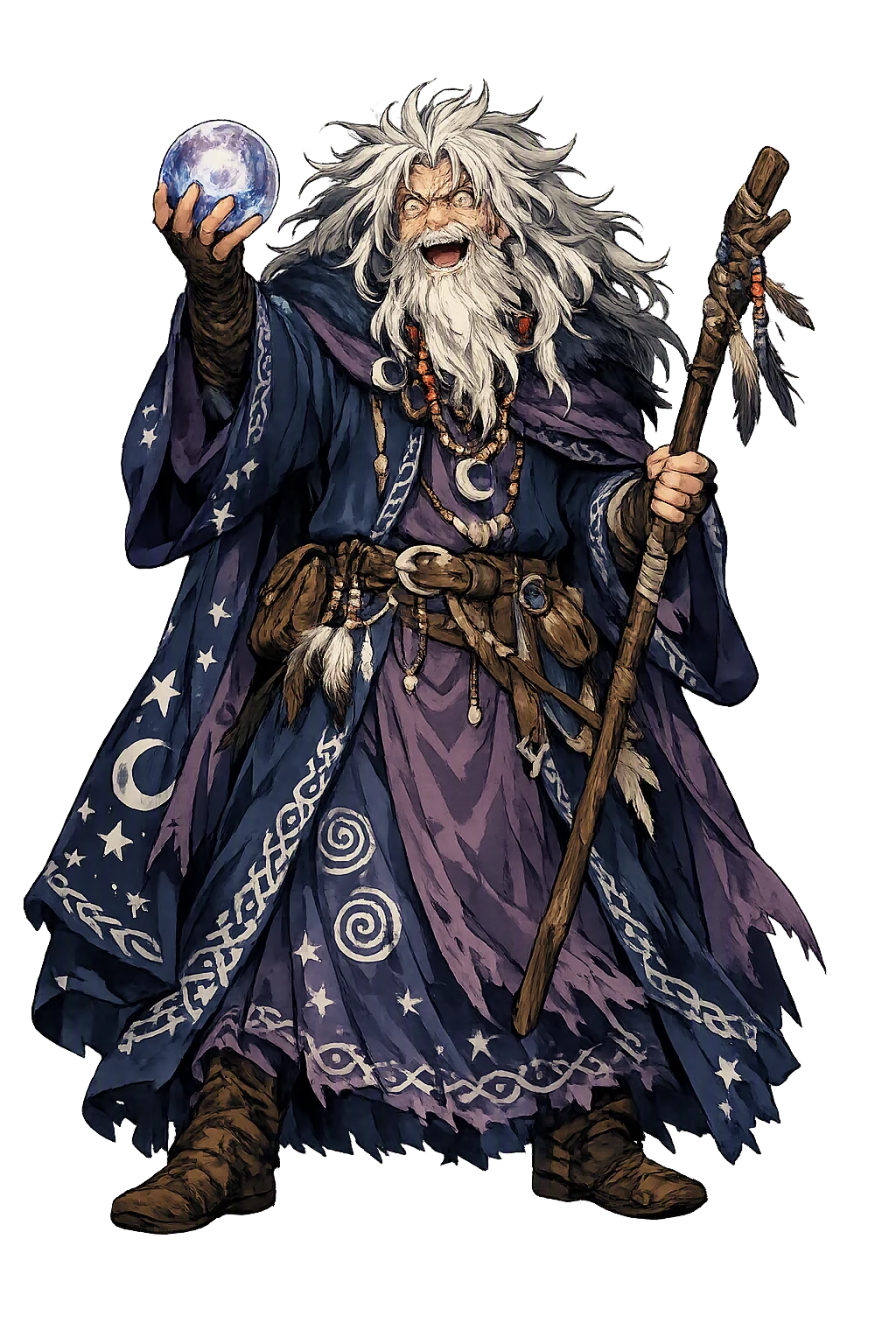
Why Myrddin is spelled that way — and what it costs to get it right
There is a version of this name the early internet had to settle for: myrddin. This is the file on how Myrddin replaced it.
Myrddin's dossier divides in two, and the tradition itself knew it: the northern prophet who went mad at Arfderydd and fled to Coed Celyddon, preserved in the Welsh Triads, the Annales Cambriae, and the Black Book poems; and Geoffrey of Monmouth's Merlinus, who carried the wild man into Latin and grafted him onto the Arthurian world. Gerald of Wales already separated them in the twelfth century: Merlinus Ambrosius, the boy prophet of Vortigern's tower, and Merlinus Celidonius — Sylvester — the wild man of the Caledonian forest.
At a Glance
- Restored name: Myrddin
- ASCII form: myrddin
- Meaning: "Merlin"
- Domain of influence: Seer, Wild Man
- Pantheon: Celtic
- Classification: Tier 2
- Original script: —
- Series: The Restoration Files, No. 326 of 548
The Name Before the Marks
Spoken, the name runs `/ˈmər.ðɨn/` — 'MUR-thin' — stress the first syllable (the Welsh penult); the dd is the soft 'th' of 'this', and the whole name takes two short beats, never 'MER-lin'.
The Temple That Stands Now
The restored name is not a plaque; it is an address. The temple of Myrddin lives at /myrddin/, with its mythology in the lore halls, its peer-reviewed record in the Scholarly Edition, and its place in the pattern atlas on the patterns floor.
One decisive feature survives — a single, honest mark — which places the restoration in Tier-2: exact, and exactly labeled.
Where the Name Stood First
Myrddin is a textual figure, and his witnesses are among the most precisely identified in Welsh letters. The Afallennau and Oianau stand in the Black Book of Carmarthen (Aberystwyth, NLW Peniarth MS 1, c. 1250), the earliest surviving manuscript in Welsh; the Cyfoesi Myrddin a Gwenddydd stands in the Red Book of Hergest (Oxford, Jesus College MS 111, c. 1382–1410); Geoffrey's Vita Merlini survives complete in a single manuscript (British Library, Cotton Vespasian E.iv, thirteenth century). The landscape behind the texts is real and partly recoverable: Arfderydd is traditionally identified with Arthuret near Longtown in Cumbria, in the Old North the poems remember; Caerfyrddin (Carmarthen) overlays the Roman fort of Moridunum, 'sea-fort', attested in the Antonine Itinerary and confirmed by excavation — the place-name from which, on the scholarly account, the prophet's name derives; and Dinas Emrys, the hillfort in Gwynedd where Nennius sets the fatherless boy and the dragons, yielded post-Roman occupation material in Savory's excavations of 1954–56. No inscription names Myrddin, and none would be expected: the early stones of Wales record the dead, not prophets. The temple on the web is the newest of these addresses — the first one that fits in a pocket.
The Archetype at Work
The pattern atlas seats this temple in 3 industries, each match argued and weighted: History, Archives & Records (the Vita Merlini and the Black Book prophecies — the Welsh Merlin before the romances claimed him.); Astrology, Tarot & Esoteric Services (the wild prophet of the Caledonian forest — prophecy spoken from the trees.); Forestry, Conservation & Outdoor Industries (the forest as sanctuary and sentence — the woods of Celyddon, his kingdom of madmen.). The Resonance File reads those seats through the myths themselves.
The File Continues
The temple's founding dispatch tells the name's story; its Resonance File reads the myths into the industries; the blog index holds the whole archive.
Continue the series — previous file: Muspellheimr (read it here) · next file: Nafanua (read it here).
The Restoration Files are written from the same canonical record as the temples themselves: the lexicon, the lore catalog, the pattern atlas, and the cited scholarly sources. If a file ever disagrees with its temple, the temple is right — tell us, and the file will be corrected.