PuniCodex

Extended Lore

𐤌𐤕 Mūt

Etymology · Orthography · Cult · Iconography · Reception · Sources

Tier 1 Mūt.com · mōt.com
Mūt — Death, Underworld
01

Quick Facts

Essential information about Mūt, Death, Underworld

Original Script𐤌𐤕
Unicode RestorationMūt
Reconstructed Pronunciation/moːt/
PantheonPhoenician
DomainDeath, Underworld
MeaningDeath
ClassificationTier 1
Primary DomainMūt.com
Sacred SymbolsDevouring mouth, Dust and dry earth, Sword and winnowing fan, Seven portions, Desert wasteland
02

Etymology & Word Family

From original script to Unicode restoration

Original Script 𐤌𐤕 Mūt — "Death"
Unicode Restoration Mūt Restored stress, length, and script
Modern ASCII mot Plain-ASCII fallback

The name Mūt carries the orthographic signature of the phoenician tradition: 𐤌𐤕. Unicode restoration recovers what ASCII flattens.

03

Unicode Character Breakdown

Character-by-character philological analysis

CharacterUnicodeNameBlockPhonetic Role
MU+004DLatin Capital Letter MBasic LatinSame, capitalized
ūU+016BLatin Small Letter U with MacronLatin Extended-AMacron: long /uː/ (Mūt)
tU+0074Latin Small Letter TBasic LatinSame

The Tier 1 classification reflects how much of the original phonology this restoration preserves — stress and vowel length for Greek names, distinctive letters and diacritics for every other tradition.

04

Cult & Worship

How the sacred was kept — rites, sanctuaries, remains

The Cult

No sanctuary of Mōt has ever been identified, and Ugarit built no temple to Death — which is itself a fact worth keeping. What the kingdom did maintain was a cult of the dead around him: the rpum texts summon the shades of ancestral kings to feast with Baꜥal, and KTU 1.161 preserves the funeral liturgy for King Niqmaddu, calling the dead ruler up into the company of the Rephaim while the gods of the underworld stand by name. Mōt rules that world, and the rites feed its population. The one later testimony to worship of Mōt himself is Phoenician: Philo of Byblos, quoted by Eusebius, reports that the Phoenicians honored Muth — deified death — with rites and equated him with Thanatos and Pluto. Everywhere else he was feared, fed, and fenced about with ritual rather than adored.

In the Earth

The Baꜥal Cycle tablets from Ras Shamra (KTU 1.4–1.6) are the principal witnesses to Mōt's mythology, preserving his threats, his swallowing of Baꜥal, and his dismemberment by ꜥAnat in alphabetic cuneiform. The Hellenistic Phoenician cosmogony survives only in the excerpts of Philo of Byblos transmitted by Eusebius. No distinct sanctuary of Mōt has been identified, but the widespread West Semitic word for death — Ugaritic mt, Phoenician mūt, Hebrew māwet, Akkadian mūtu — testifies to the concept's deep cultural reach.

05

Iconography

How Mūt was imaged across the ages

The Image

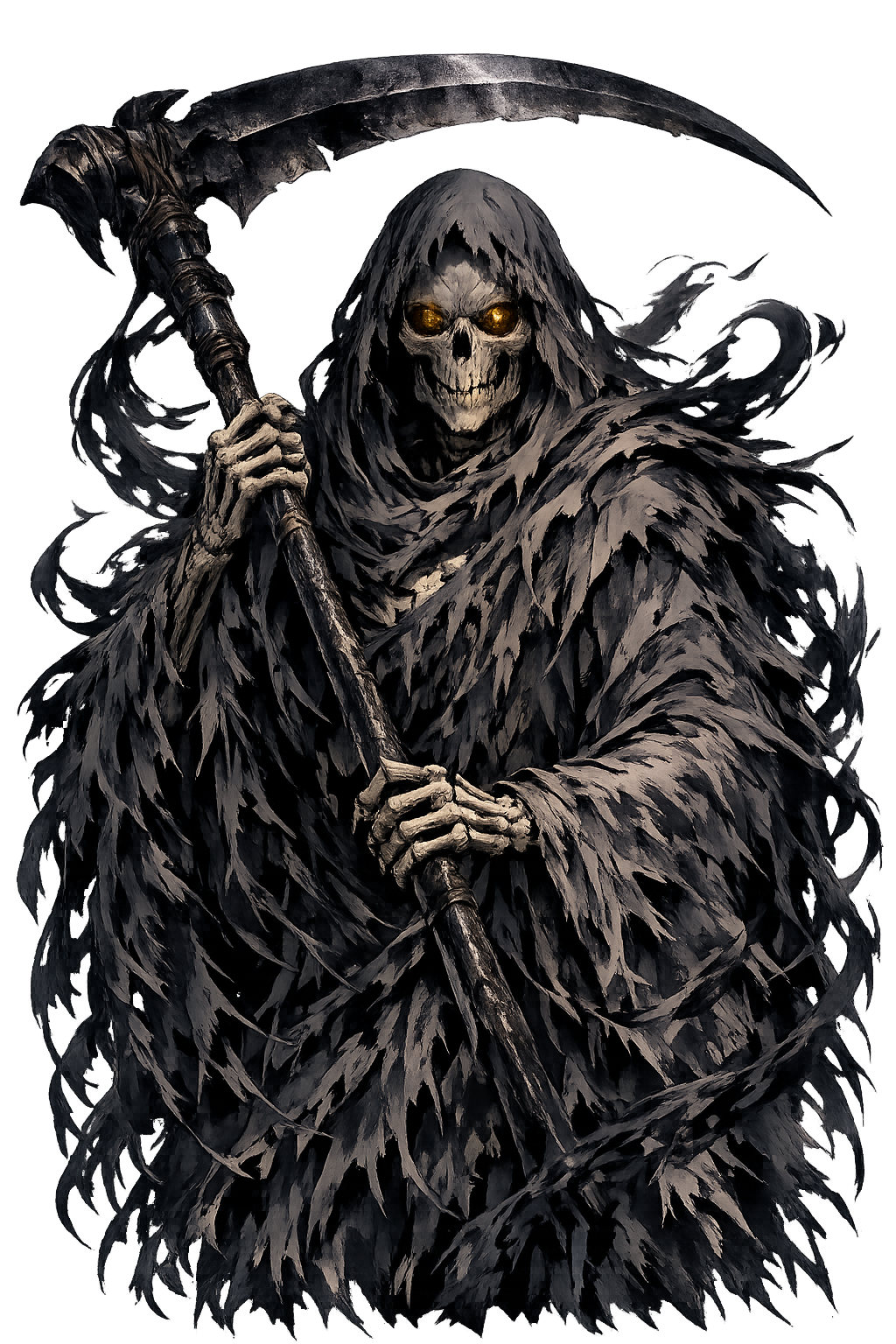
No depiction of Mōt survives from Canaan — not a seal, not an ivory, not a relief — and the Ugaritic poems describe his body only by appetite: a lip to the earth and a lip to the heavens, a throat like a lion's, a gullet like a whale's. The hints suggest a vast humanoid maw rather than a dragon: he eats gods by the double handful and drinks rivers. The nearest visual cousins are Mesopotamian — Nergal's lion-dragon on seals, the assembled judges of the death-god's circle — but importing them as portraits would be conjecture. Later ages, lacking an image, drew their own personifications of death, the gaunt reaper among them; those are medieval European inventions, not Canaanite survivals. For Mōt himself the honest answer is: we have a mouth, and no face.

06

Reception & Transformation

The name after its own age — transmission, translation, survival

Afterlives

Mōt's afterlife is a story of two transmissions. The first is ancient and thin: his name lived on as the ordinary Semitic word for death — Ugaritic mt, Phoenician mūt, Hebrew māwet, Arabic mawt — while Philo of Byblos' digest of Sanchuniathon, preserved because Eusebius quoted it in the Praeparatio Evangelica, carried a Phoenician Muth down to the fourth century CE. Then came silence for three millennia. The second transmission began in 1929, when Claude Schaeffer's excavations at Ras Shamra unearthed the Baꜥal Cycle; Hans Bauer's 1930 decipherment of Ugaritic cuneiform restored Mōt to history — Baꜥal's devouring rival, swallowed whole and then, dismembered by ꜥAnat, restored to the circle of the gods. The tablets electrified biblical studies: Ugaritic 'Death' instantly illuminated the Bible's personified māwet, and the modern discipline of Ugaritology, crowned by Smith's multi-volume Ugaritic Baal Cycle (1994, 2006), made Mōt a cornerstone of West Semitic scholarship. A god erased at the Bronze Age collapse returned as a load-bearing text.

Identifications Across Traditions

The Hellenistic Phoenician account preserved by Eusebius of Caesarea — quoting Philo of Byblos, who summarized Sanchuniathon — makes Mōt (Muth) a son of El and Rhea, deified after death and identified by the Phoenicians with the Greek Thanatos and Pluto. A more speculative cosmogonic strand in the same tradition makes Mōt arise from primal mud or putrefaction, the source from which the seeds of creation emerge. In the Hebrew Bible the common noun māwet ('death') sometimes appears almost personified, especially in Hosea 13:14, suggesting that the Canaanite figure lingered in Israelite imagination even where he was no longer worshipped.

Modern Legacy

Mōt's name survives in Hebrew māwet, Arabic mawt, and the common Semitic root for death itself — the god never outlived the noun. His myth helped shape later personifications of death in biblical and apocalyptic literature, from the personified Death of Hosea 13:14 to the pale rider of Revelation, and the Baꜥal–Mōt cycle has long fascinated scholars as a Near Eastern parallel to — and a warning against facile equations with — later dying-and-rising god traditions. Philo of Byblos, as quoted by Eusebius, still remembered a Phoenician Muth whom the learned identified with the Greek Thanatos and Pluto. In modern fantasy, games, and Neopagan reconstructions, Mōt appears as the Canaanite lord of the underworld, gaunt and voracious. He endures as the figure every pantheon must make room for: the one who says, without anger, that all feasting ends here.

07

The Meditation

What Mūt means — beyond the dictionary

Mōt is the god nobody wants to meet and nobody can avoid. He is not evil; he is hungry. His throat does not distinguish between good and bad, rich and poor, god and mortal. That is what makes him terrifying, and that is what makes him honest. Every other deity in the pantheon has favorites; Mōt has only appetite.

Yet Mōt is also necessary. Without the dry season, the seed would rot. Without the limit of death, life would have no shape. The Canaanites did not deny him; they told stories about how to survive him — how a sister's rage, a sun-goddess's warning, and a storm's return could push death back into its season. Mōt teaches that mortality is not a punishment but a boundary, and that the boundary is what makes the feast possible.

08

Frequently Asked Questions

Common questions about Mūt, Death, Underworld, and Unicode restoration

01How do you pronounce Mūt?

In reconstructed pronunciation, Mūt is /moːt/ — approximately 'MOHT' — one syllable with a long, drawn-out o (or oo) and a crisp final t.

02What does Mūt mean?

Mūt means Death in the phoenician tradition.

03What are the symbols of Mūt?

Mūt is associated with Devouring mouth (His throat is the abyss — 'like a whale's gullet' (KTU 1.5 i) — that swallows Baꜥal whole), Dust and dry earth (The landscape of his kingdom; when he wins, the world becomes his emblem), Sword and winnowing fan (The harvest tools ꜥAnat turns against him (KTU 1.6 ii)), Seven portions (The meal he demands — meat by double handfuls, drink by the riverful (KTU 1.4 viii)), Desert wasteland (The parched country that announces his season has begun).

04Why restore Mūt in Unicode?

Plain ASCII mot strips the stress, length, and script that make the name specific. Unicode restoration returns the name to its original written dignity.

05What is the most important myth about Mūt?

“The Appetite of Death” — the The Summons story that anchors the mythology of Mūt, told in full on the lore page.

09

Scholarly Sources

The philological foundations of this restoration

Every claim on this page is grounded in established scholarship. The orthographic restorations follow disciplinary convention. The etymological chain follows the best available reference works. This is not invention — it is resurrection through scholarship.

◈

Lexicography & Philology

  • Ugaritic texts
  • CIS
◎

Primary Texts

  • KTU (Ugaritic texts)
  • Smith, The Ugaritic Baal Cycle
  • Hebrew Bible, Hosea 13:14 (personified death)
  • KTU 1.4 vii–viii (Mot's summons)
  • KTU 1.5 (Baal's descent into Mot)
  • KTU 1.6 (Anat defeats Mot; the rematch)
◉

Archaeology & Art History

  • Material evidence — iconography, inscriptions, and temple archaeology — for Mūt and related cults.
✦

Religious Studies

  • Coogan, Stories from Ancient Canaan
  • Day, Yahweh and the Gods and Goddesses of Canaan
  • Eusebius, Praeparatio Evangelica (quoting Philo of Byblos/Sanchuniathon)
Return

The Surface Awaits

You have traced the name from its earliest attestation to its Unicode restoration. Now return to the myth. The story is where the name lives.

Back to Lore
Mūt mascot