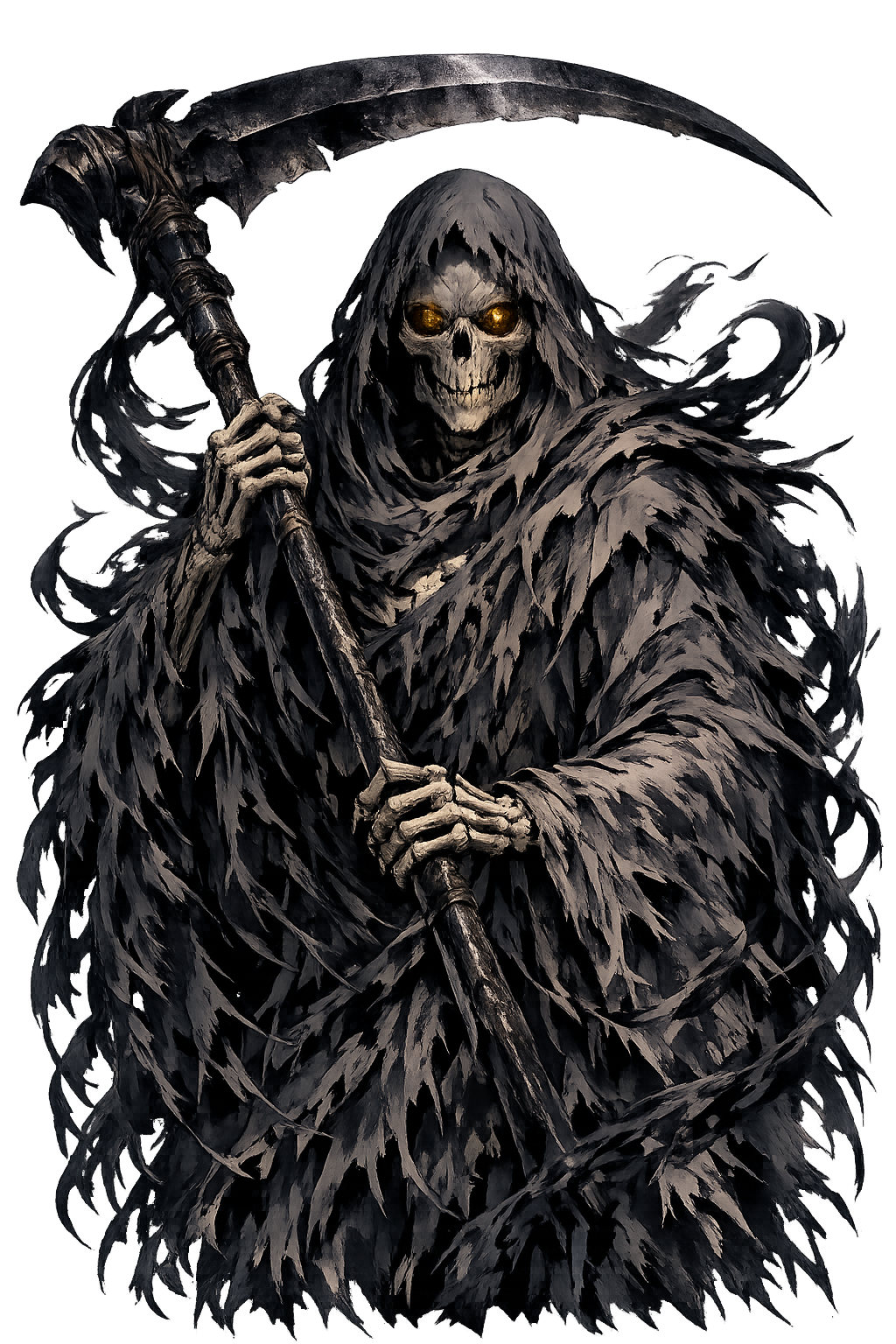
Stories of Mūt
Mōt's mythology is the dark season of the year made personal. His stories are preserved in the Baꜥal Cycle, where he confronts Baꜥal, kills him, and is in turn destroyed and reborn in a cycle that explains drought, death, and the return of fertility.
Death in the Canaanite imagination is not a reaper but an eater. When Baꜥal finishes his cedar palace and hosts the gods at his banquet, Mōt sends an answer from the underworld: because he was not invited, he will feast — and his dish is Baꜥal himself (KTU 1.4 vii–viii). His messengers describe their master with a connoisseur's precision: a throat like a lion's, a gullet like a whale's, 'a lip to the earth, a lip to the heavens... by double handfuls he eats, by the riverful he drinks.' The divine assembly is warned not to approach him too closely, 'lest he make you like a lamb in his mouth' (KTU 1.4 viii 17–20). The horror of the portrait is its honesty: Mōt does not hate; he hungers, without malice and without limit. He is the one guest who cannot be excluded forever, and the banquet of the gods is real only because he has agreed, for now, to wait.
Baꜥal does what no storm should: he goes down. Taking his clouds, winds, and bolts with him, he descends into Mōt's realm of dust, grime, and drought, 'into the throat of Death, son of El' (KTU 1.5). On earth the consequences are immediate. Ēl mourns like a mortal, sitting in the dust and gashing himself with a stone knife; Asherah orders the rites of mourning; ꜥAnat ranges the world searching. For seven years — the dry season made calendar — the rain withholds, the fields fail, and even the gods grow thin. The narrative power of the scene lies in its refusal of rescue: the high god cannot simply decree Baꜥal back, because Mōt's claim is legitimate within the order of things. Death, in this theology, is not a rebellion against creation but one of its standing institutions — the shadow the feast casts, the price the rains will eventually have to pay.
The answer to Death comes not from heaven's throne but from a sister's rage. After burying Baꜥal on Zaphon, ꜥAnat seizes Mōt and subjects him to the full grammar of the harvest he has starved (KTU 1.6 ii 30–35): 'with a sword she splits him, with a sieve she winnows him, with fire she burns him, with millstones she grinds him, in a field she scatters him.' The sequence is agricultural to the last verb — this is threshing, sifting, milling, and sowing — so that the destruction of death itself is imagined as the processing of grain. Scholars have long noted the deep logic: you cannot kill death, but you can reduce it, distribute it, return it to the soil as something the living can use. Baꜥal comes back by the word of El, and the rains return. The myth's consolation is not that death is defeated once for all, but that death, ground fine enough, becomes compost.
Mōt does not stay scattered. Seven years after his threshing he returns and finds Baꜥal again (KTU 1.6 vi), and the two gods fall into elemental combat — they gore like bulls, bite like serpents, kick like stallions, neither able to prevail. The deadlock is broken not by force but by light. The sun goddess Šāpšu warns Mōt: 'How can you battle Baꜥal the Conqueror?... El will overturn your throne of kingship, he will break your staff of judgment.' Mōt, deflated, concedes the kingship and retires to his own realm for his seasons. The ending is the cycle's most sophisticated moment: death is not destroyed — the earlier threshing bought only seven years — but it is bound to its time, pushed back by a coalition of love, light, and the old god's law. Fertility is not a permanent conquest; it is an annually renewed armistice, and the world survives on the terms of that truce.
Death, Drought, and the Underworld
Mōt is the personified appetite of death in Canaanite myth — not a reaper with a scythe but a being whose throat is a chasm and whose jaws grind gods and mortals alike. In the Baꜥal Cycle he is the necessary opposite of the storm-god: where Baꜥal brings rain, Mōt brings the parched season when growth stops and the world turns to dust.
The name itself is the Canaanite word for death; in Ugaritic he is a god, not merely an abstraction.
KTU 1.5 i describes a throat like a lion's, a gullet like a whale's, and an appetite that swallows armies.
His victory over Baꜥal brings years of barrenness; his defeat restores the rains and the fertility of the land.
He rules the arṣ, the land of death to which every living thing must eventually descend.
From the original script to the living URL
𐤌𐤕
The name in its original Phoenician form. Mūt (𐤌𐤕) is attested in the source tradition — “Death”. Its macron-length vowels carry the full phonetic and orthographic weight of the source tradition.
mot
Reduced to plain mot, the name loses everything that made it specific: macron-length vowels. What remains is an ASCII string that machines can parse but that no longer speaks with its original voice.
Mūt
The Unicode restoration recovers what ASCII flattened. Mūt restores macron-length vowels, returning the name to its original written dignity. The domain encodes to Punycode, but the browser displays the truth.
Mūt.com → xn--mt-gua.com
The non-ASCII characters in Mūt are encoded while the ASCII remains visible. To the DNS, it is Punycode. To humanity, it is Mūt.
Owned, ideal, and ASCII forms of Mūt
Mūt
Restores 𐤌𐤕. The live temple domain — mūt.com.
mōt
Restores 𐤌𐤕. A second live spelling — mōt.com.
mot
Flattens 𐤌𐤕. The plain ASCII fallback — what DNS and legacy systems see.
How Mūt was spoken
How Mūt travels from ancient script to the modern URL
Ugaritic/Phoenician mwt “death"; Mōt is the personification of death and drought in the Baal Cycle.
Death, Underworld
The Unicode restoration Mōt supplies registrable vowel diacritics; the Phoenician consonantal form is not registrable in .com.
The lore you have read is the living myth. Extended Lore opens the scholarly vault beneath it: the cult and its material remains, a history of the image, the name after antiquity, a meditation on what the name still means, and the full scholarly apparatus — etymology, orthography, sources.
Enter Extended Lore