
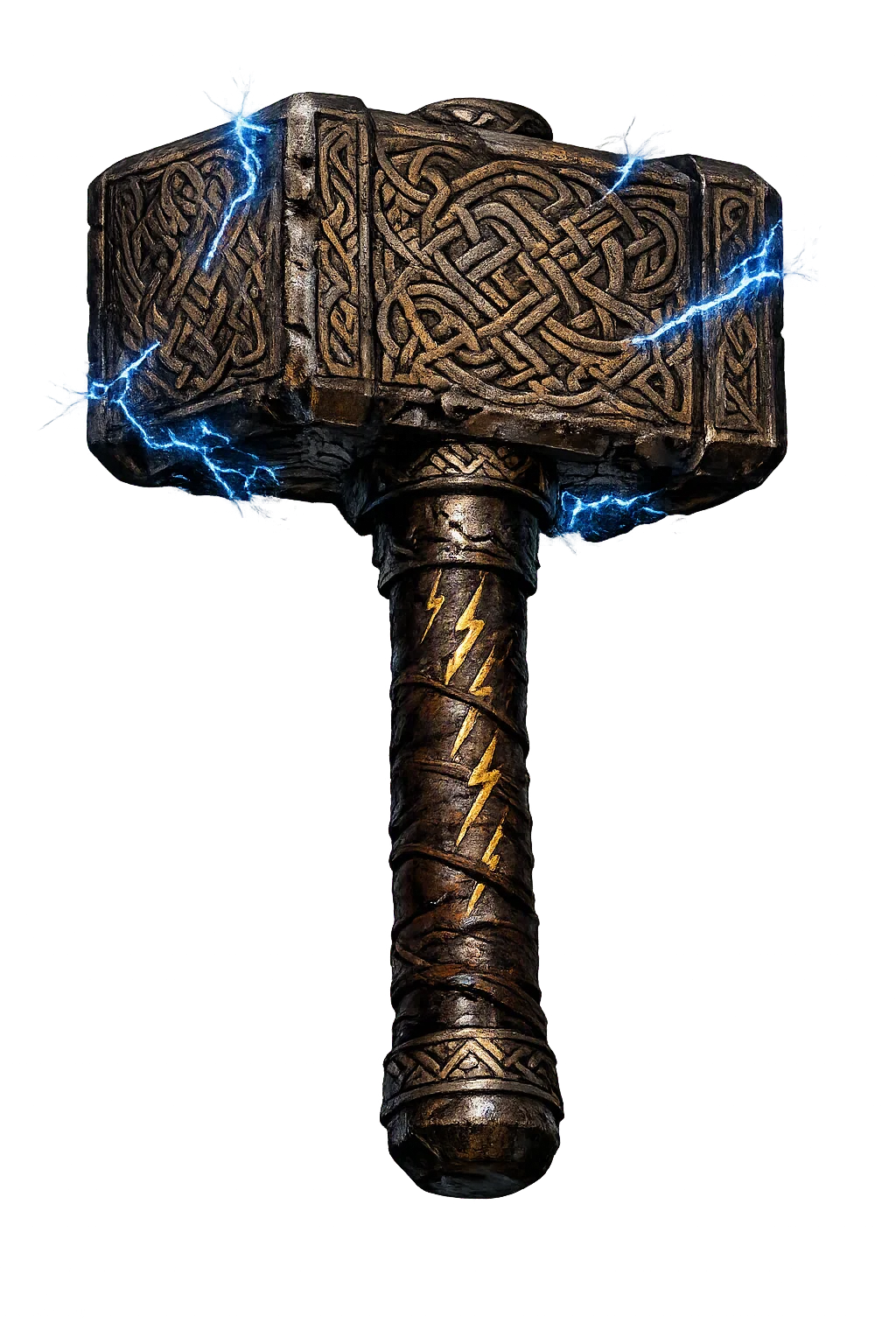
Mjǫllnir versus the internet
Court is in session. In the matter of Mjǫllnir, the register hears the evidence — the attestation, the marks, and the forms that stand accused.
At a Glance
- Canonical form: Mjǫllnir
- Reconstructed form: ᛘᛁᚢᛚᚾᛁᛦ (a normalized scholarly specimen)
- Pantheon: Norse
- Convention: normalized Old Norse spelling — þ, ð, ǫ, æ and length marks preserved as the editions print them
- False forms on record: 2
- Contested forms: none attested
- Series: The Canonical Register, No. 343 of 597
The Charge
That the name Mjǫllnir is routinely written in forms that move, drop, or invent its marks — and that each such form teaches the reader a different, lesser name. The register's task is to separate the honest fallback from the outright false.
The Defense of the Canonical Form
The reconstructed form is ᛘᛁᚢᛚᚾᛁᛦ — a normalized scholarly specimen, not an attested inscription. The canonical transliteration is Mjǫllnir.
No diacritics are required here: the canonical form is the exactness of the spelling itself, the form normalized Old Norse spelling — þ, ð, ǫ, æ and length marks preserved as the editions print them demands.
The Character Witness
The plain form mjolnir is not false — it is a fallback, and the register is exact about what that means. In systems that cannot carry diacritics (legacy databases, older tooling, parts of the address-bar pipeline) the flattened form is the accepted vehicle, and the rulebook names it explicitly as the final rung of the fallback hierarchy: full restoration first, circumflex where attested, macron-only by the academic standard, an attested variant, and only then plain ASCII.
What the fallback status forbids is promotion: mjolnir may carry the name where marks are impossible, but it may not represent the name where marks are possible. A fallback is a vehicle, never the primary.
Cross-Examination
The witness Mjollnir
Where it comes from: the publisher compromise — older books and hurried websites that print the "English equivalent" as if it were the name itself. Why it cannot stand: every substitution here (ǫ→o) is a romanization of convenience, not an attested spelling — it teaches the reader to guess, not to read.
The witness Mjöllnir
Where it comes from: the near-miss — a form that looks right at a glance and circulates on wikis and forums. Why it cannot stand: the o-with-ogonek (a nasal vowel) is not a diaeresis — different history, different sound.
Mitigating Circumstances
No alternate form of this name carries documented scholarly support in the lexicon's record. The convention here — normalized Old Norse spelling — þ, ð, ǫ, æ and length marks preserved as the editions print them — produces exactly one defensible transliteration: Mjǫllnir. Forms that differ from it are not contested; they are simply wrong.
The Convention's Own History
Old Norse orthography is a primary source in itself: þ (thorn) and ð (eth) are letters the language used natively, not transliteration marks — English once had them too, and lost them. ǫ (o with ogonek) is a nasal vowel with its own saga-era history, and normalized Old Norse spelling preserves it because the Eddas' editors do. To write th for þ or o for ǫ is not modernization; it is a different spelling of a different word. The Eddic poems survive in one manuscript tradition each — the register spells the names the way those manuscripts do.
Registration, Honestly
Three facts govern every domain this project registers. One: IDNA 2008 welcomes the marks — punycode encodes them legally and browsers show them faithfully. Two: welcome is not availability — registrars hold partial inventory, so the ideal form of a name may exist in the protocol yet not in the shop window today. Three: typeability is a separate virtue — a form no one can type on a phone is a form no one will visit, however canonical.
Hence the hierarchy the rulebook enforces: take the most complete form that is both attested and actually registrable, and never accept a wrong mark for the sake of availability. The wrong accent is not a rung on that ladder; it is off the ladder entirely.
The Verdict
So the register finds: Mjǫllnir, canonical; mjolnir, a sanctioned fallback; the contested forms, recorded with their support; the false forms, ruled against with their violations named. Every line of that finding cites its evidence, and the evidence is open to any reader — the register asks to be checked, not trusted. The temple keeps the canonical form at /mjolnir/.
The docket for this ruling: 2 false forms ruled against, Mjollnir first on the docket; no contested forms attested; the attestation rests on 6 cited sources — Poetic Edda: Þrymskviða — the theft of the hammer and Þórr's bridal disguise, Poetic Edda: Lokasenna — Loki's flyting, with the hammer as refrain and final threat, Prose Edda: Skáldskaparmál (Brodeur translation) — Loki's wager, the forging, and the duel with Hrungnir.
The Register Continues
Entry 343 of 597 in the Canonical Register. Around it: the temple's founding dispatch, the Restoration File on the marks themselves, the Resonance File on the archetype at work, and the Rulebook behind all of it.
Continue the register — previous entry: Mixcōātl (read it) · next entry: Mnēmosýnē (read it).
The Canonical Register is written from the same canonical record as the lexicon itself. If a false form is missing from this page, it is because the evidence does not support calling it false — or because we have not seen it yet. Show us, with a citation, and the register will answer.