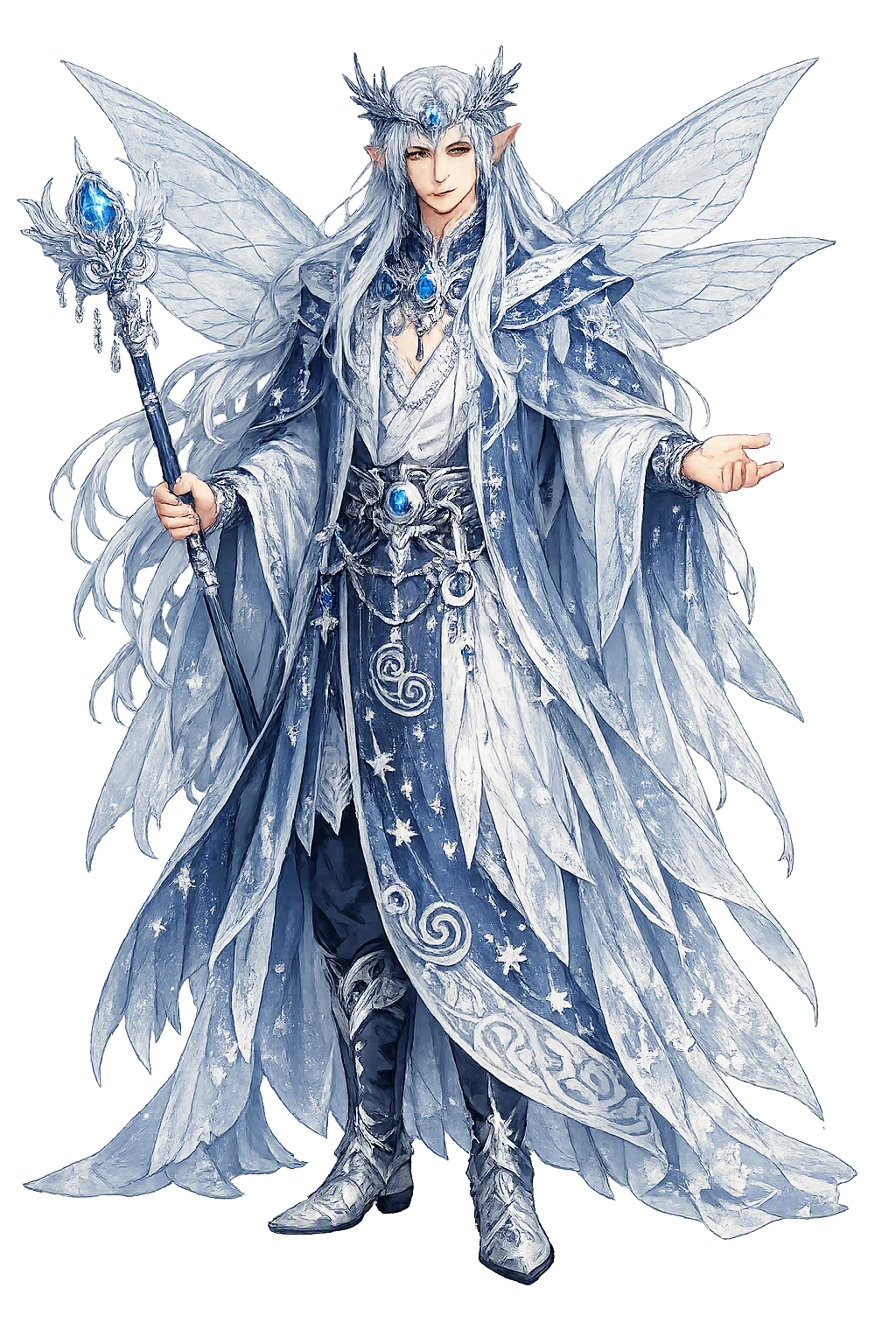
Stories of Midir
Midir's mythology is a single long courtship told in two lifetimes — the fullest Otherworld dossier in the corpus (Tochmarc Étaíne). It begins with a sloe-thorn and a bride-price, passes through jealousy, transformation, and a rebirth eleven hundred years later, and ends at a fidchell board in Tara and a war of spades against the hollow hills. Around that spine stands the fosterage: the lord of Brí Léith reared [[aengus|Óengus]].
Midir of Brí Léith was the foster-father of Óengus, and he came to Brú na Bóinne to visit his fosterling. While the boys of the Brug were at their hurling, a sloe-thorn sprang from the play and put out Midir's eye; he stayed a year in the mound while Dían Cécht, the physician of the Túatha Dé Danann, made him whole. For his reward and his heart's desire he named Étaín Echraide, daughter of Ailill, the fairest woman in Ireland — and it was Óengus who went to win her.
Her father Ailill mac Máta, king of the Ulaid, set a bride-price no mortal could pay: twelve plains cleared of their stones and wood, and twelve rivers led out of the land to the sea. Óengus performed the labors with the Dagda's strength behind him, and Midir brought Étaín home to Brí Léith as his wife. The tale's arithmetic is exact: the god's first possession of Étaín was bought by service, the price of a wounded eye — and it was the one part of the story that ended peaceably.
Midir already had a wife: Fuamnach, foster-daughter of Bresal the druid, and versed in her foster-father's arts. When Étaín came home to Brí Léith, Fuamnach's jealousy found its instrument — a rod of scarlet quicken-tree — and one stroke made her rival a pool of water, then a worm, then a purple fly of wondrous size and sweetness. For seven years the fly that was Étaín went with Midir wherever he went, and he knew her in her shape; but Fuamnach's malice outlasted his keeping.
The fly came at last to Brú na Bóinne, where Óengus knew her and built her a grianán, a crystal sun-bower filled with healing herbs — until Fuamnach raised a magic wind that swept her across Ireland for seven years more, to fall into the cup of the wife of Étar, an Ulster warrior, at the Bay of Cíú. She was drunk, conceived, and born again a thousand and twelve years after her first birth: Étaín, daughter of Étar. Midir's house is the still center of the storm — the husband whose hall became the battlefield of two women's powers, and who waited out the centuries the tale demanded of him.
In her second life Étaín married Eochaid Airem, high king of Ireland at Tara, and Midir came for her as the tale had promised. First he came in the shape of Ailill Anglonnach, the king's brother, who was wasting with love of her — three nights he lay beside her in that likeness and did not touch her, and so saved both her honor and Ailill's life. Then he revealed himself and asked her to come away with him; she answered that she would not go without her husband's leave. So Midir took the leave the hard way. He came to Tara and challenged Eochaid to fidchell, and game after game Midir lost, paying the stakes without stint — horses and treasures in such plenty that the king's greed was schooled by the god's purse.
Then the board was set once more, and the stake named was an embrace and a kiss from Étaín; Midir won. Eochaid deferred the payment for a month, and when the month was out Tara stood ringed with warriors. Midir appeared all the same in the midst of the hall, sang to Étaín the invitation to the wondrous land, took her in his arms, and the two rose through the smoke-hole as two swans linked by a silver chain, and the host of Ireland could do nothing.
Eochaid's answer was the spade: he set the men of Ireland to digging up the síd-mounds one by one, a war of delving against the hollow hills, until the host stood over Brí Léith itself. Then Midir came to the parley, and the bargain struck was surrender of a kind: on the morrow fifty women came out of the mound, every one of them in Étaín's exact likeness, and the king was told to choose his wife.
He chose — and chose his own daughter, born to Étaín in the síd and hidden in the likeness of her mother. By that unwitting union a daughter was conceived who was exposed and spared, reared as Mess Búachalla, the cowherd's fosterling, and through her the line ran down to Conaire Mór, the doomed king of the Bruiden Da Derga. When Midir revealed the deception he gave back the true Étaín as well; the tale lets the god keep the last word and the king keep his shame. It is the Otherworld's coldest jest: the wager was never about the game, and the digging was never going to win.
Behind the wooing stands the fosterage. When the Dagda divided the síd-mounds of Ireland among the Túatha Dé Danann, his son Óengus was away with Midir of Brí Léith, being fostered, and received nothing — the absence that led to the famous quibble of the day and the night, and to Brú na Bóinne passing to the son. The tradition thus ties the two mounds together from the beginning: the young god reared at Brí Léith, the proud god's eye healed at the Brug.
The foster-bond runs both ways through the dossier. It was for Midir that Óengus won Étaín Echraide and performed her father's labors; it was in Óengus's bower that Étaín the purple fly found her one refuge. Irish fosterage was no light tie — it stood beside blood, and the tales honor it. Midir's proudest title is not lord of Brí Léith but the one the stories keep proving: the man who raised the son of the young.
The proud lord of the síd of Brí Léith
Midir — Old Irish Mídir, styled the Proud — is the lord of the síd of Brí Léith and the central figure of Tochmarc Étaíne. His power is the strangest of the síd-lords: not the spear but the board game, the wager, and the patience that spans two lifetimes of the same woman. He fostered [[aengus|Óengus]], won Étaín by her father's impossible labors, and took her back at a fidchell board in Tara.
The game of kings at which Midir sat across from Eochaid Airem in Tara, losing stake after stake until the board was set for the one prize he had come for.
The payment taken in flight: Midir and Étaín rising through Tara's smoke-hole as two swans linked by a silver chain, while the king's guard watched from the walls.
His síd by Ardagh in Longford — the mound Eochaid's host dug open in the war of the spades, and the hill the Dindsenchas names as his.
Fuamnach's jealous stroke in his own hall, which made Étaín a pool of water, a worm, and a purple fly — the malice his kingship could not keep out.
From the original script to the living URL
Midir
The name survives in scholarly transliteration. Midir is the standard Celtic romanisation, documented in academic sources — “Judge”. Because the spelling uses only Latin letters, the form is the same in both ASCII and Unicode.
No indigenous writing system is securely attested for individual celtic names. The form shown is a modern scholarly transliteration.
midir
The plain midir form is identical to the Unicode restoration. Because this name is already written in Latin letters, no diacritics, stress, or script information were lost — only capitalization differs.
Midir
The Unicode restoration does not need to recover lost marks for Midir. Its value is canonical spelling and consistent cataloguing, not the reconstruction of erased orthography. The domain is readable as-is to both DNS and humanity.
Midir.com
This restoration is written entirely in ASCII letters — no Punycode encoding stands between Midir and the DNS. The domain reads identically to machines and to human eyes.
Owned, ideal, and ASCII forms of Midir
Midir
The full Unicode restoration. midir.com is not in the PuniCodex collection — it is watched for release; if it drops, this temple upgrades to an owned flagship.
How Midir was spoken
How Midir is preserved in writing
No indigenous writing system is securely attested for individual celtic names. The form shown is a modern scholarly transliteration.
Contribute scholarly provenance →The lore you have read is the living myth. Extended Lore opens the scholarly vault beneath it: the cult and its material remains, a history of the image, the name after antiquity, a meditation on what the name still means, and the full scholarly apparatus — etymology, orthography, sources.
Enter Extended Lore