Stories of Marishiten
Marishiten's mythology is liturgical rather than epic: no sutra tells her life-story, but the Mārīcī texts of the Chinese canon (Taishō nos. 1254–1257) and the iconographic manuals of Japanese esoteric Buddhism define her powers, her images, and the communities that claimed her protection — travelers first, then soldiers, then everyone whose survival depended on not being seen.
In Indian Buddhism, Mārīcī is the ray of light that runs ahead of the sunrise — her name is simply the Sanskrit mārīcī, 'ray, beam' — a goddess of the liminal hour when the world is still blind. The cluster of texts devoted to her in the Chinese Buddhist canon (Taishō nos. 1254–1257, translations made between the sixth and eighth centuries) prescribes her dhāraṇī — the spell that wins her protection — and promises her devotees the most practical of boons: invisibility to enemies, escape from fetters, and victory in conflict. The record should be exact about the evidence: there is no Indian epic of Mārīcī, no birth-narrative or war-story; her mythology is a theology of dawn compressed into liturgy. Yet the central intuition is old and deep — that the first light of morning is a power with a personality, and that to move inside the coming day is to be shielded by it. Her invisibility is not darkness but the light that blinds: to be seen by no enemy is to walk within the dawn itself.
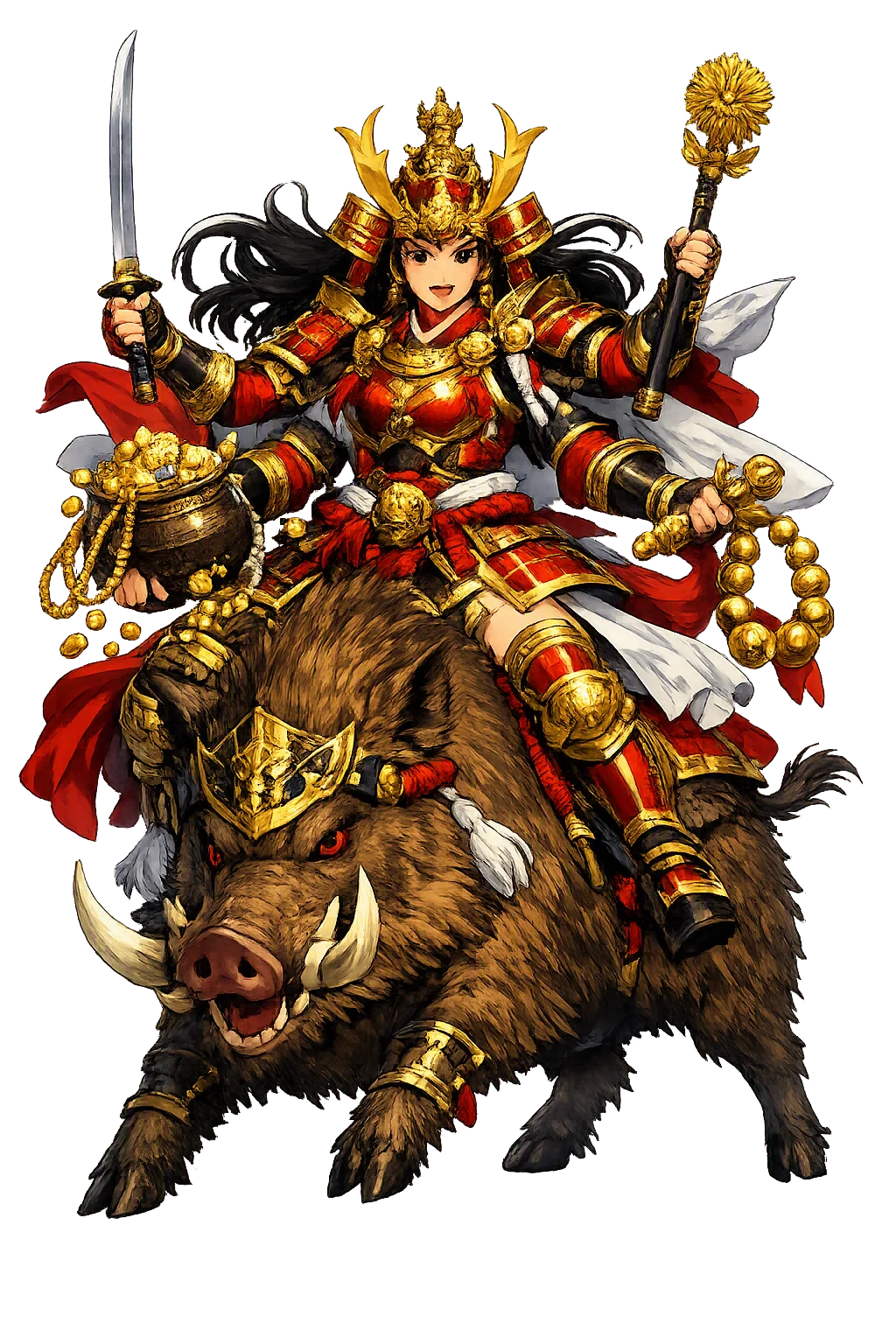
Chinese Buddhists received Mārīcī as Mólìzhītiān and gave her the iconography that still defines her: a serene, multi-armed goddess bearing wheel, bow, arrow, sword, and vajra, seated in a chariot drawn by seven pigs — or astride a single great boar — the dawn sun translated into esoteric symbols. Through the Tang and Song dynasties her dossier widened: the texts promise protection to travelers on dangerous roads, to the accused facing judgment, and to armies on campaign, and her cult travelled with the esoteric schools into Korea and Japan. The transformation is itself the lesson of the myth: transmitted across three civilizations, the ray of light kept acquiring faces — dawn goddess, guardian of the law, patron of soldiers — without losing the single power at her core, the light that arrives before anyone can prepare against it. Transmission did not dilute Mārīcī; it multiplied her offices.
The Mārīcī dhāraṇī's central promise is concealment. Keep the spell, the texts say, and your enemies will not see you; fetters will not hold you; the sword drawn against you will miss its mark. For travelers on bandit-haunted roads and soldiers on campaign, this was protection condensed into a sentence of Sanskrit — carryable, repeatable, unlosable. The boon is double-edged, and the later Japanese tradition knew it: the same goddess who hid the pious soldier also became, in the Edo period, the secret patron of gamblers, thieves, and firefighters — all professionals whose work happens best unseen. The myth of the hiding spell thus carries an ethical shadow that the sutras themselves do not resolve: invisibility is a gift, and gifts of power outrun the morality of their givers. What the goddess offers is not goodness but advantage — and every community that invoked her, from the battlefield to the back alley, understood the difference.
In Japan, where her name settled as Marishiten, the goddess found her most devoted congregation: the warrior class. From the Heian period the esoteric schools — Tendai on Hiei, Shingon on Kōya — enshrined her among the protective devas (tenbu), and by the Kamakura age the military houses had taken her as their own, for a goddess who blinds the enemy is the natural ally of the bowman and the swordsman alike. Sword and spear traditions folded her invocations into their secret transmissions, where her spell guarded the school's very techniques; confraternities (Marishiten-kō) of townspeople, firefighters, and gamblers kept her altars through the Edo centuries, when her gift of passing unseen spoke as loudly to the night worker as to the soldier. Modern kyūdō, the way of the bow, still keeps her name in its ceremonial memory. Her Japanese myth is a parable of adaptation: the ray that runs ahead of the sun became, in a warrior society, the patron spirit of everyone who must act before being seen — and of everyone who lives by it.
Protector of Warriors and Martial Artists
Marishiten is the Japanese form of Mārīcī, a Buddhist goddess of dawn, light, and victory. In Japan she became a patron of warriors, archers, and practitioners of the martial arts, worshipped for her power to make devotees invisible to harm and irresistible in battle. She rides a boar and is often depicted with multiple arms bearing weapons.
Samurai prayed to Marishiten for victory and protection in battle.
She was believed to hide her devotees from enemies and misfortune.
She is associated with the sun's chariot and the dawn.
She is often depicted riding a boar, symbol of ferocity and fertility.
From the original script to the living URL
摩利支天
The name in its original Japanese form. Marishiten (摩利支天) is attested in the source tradition — “Marici in Japanese”. Its original diacritics and script distinctions carry the full phonetic and orthographic weight of the source tradition.
marishiten
The plain marishiten form is identical to the Unicode restoration. Because this name is already written in Latin letters, no diacritics, stress, or script information were lost — only capitalization differs.
Marishiten
The Unicode restoration does not need to recover lost marks for Marishiten. Its value is canonical spelling and consistent cataloguing, not the reconstruction of erased orthography. The domain is readable as-is to both DNS and humanity.
Marishiten.com
This restoration is written entirely in ASCII letters — no Punycode encoding stands between Marishiten and the DNS. The domain reads identically to machines and to human eyes.
Owned, ideal, and ASCII forms of Marishiten
Marishiten
Restores 摩利支天. The full Unicode restoration. marishiten.com is not in the PuniCodex collection — it is watched for release; if it drops, this temple upgrades to an owned flagship.
How Marishiten was spoken
How Marishiten is preserved in writing
A bespoke provenance study for Marishiten is being prepared by the PUNICODEX scholarly team.
Contribute scholarly provenance →The lore you have read is the living myth. Extended Lore opens the scholarly vault beneath it: the cult and its material remains, a history of the image, the name after antiquity, a meditation on what the name still means, and the full scholarly apparatus — etymology, orthography, sources.
Enter Extended Lore