
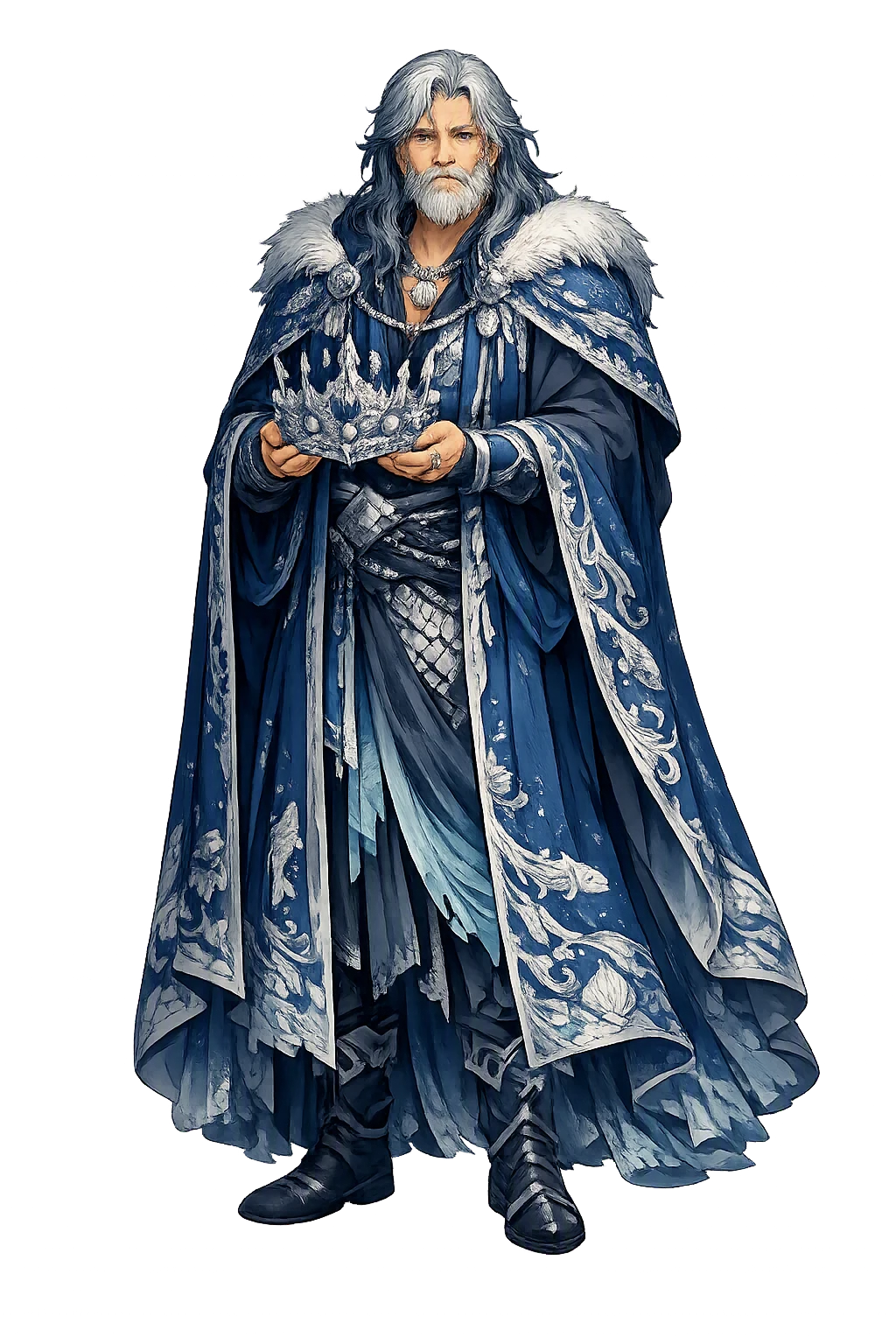
The name Manawydan and the world it opens
A name is a door. Manawydan opens onto an entire world: the domain of sea, craftsmanship, a Celtic tradition, and centuries of storytelling, worship, and scholarship. This post walks through that world room by room — the name and its roots, the original script, the sound of it, the myths, the symbols, the sites, the afterlife across cultures — and ends at the newest room of all: a Unicode domain that makes the whole structure addressable. manawydan gets you to the same building, but only the restored form tells you why it was built.
At a Glance
- Restored name: Manawydan
- ASCII form: manawydan
- Meaning: "Manannán (Welsh form)"
- Domain of influence: Sea, Craftsmanship
- Pantheon: Celtic
- Classification: Tier 2
Overview
Manawydan (manawydan) — Sea, Craftsmanship · Manannán (Welsh form) — is the counselor and craftsman of the Mabinogi: Manawydan fab Llŷr, brother of Brân the Blessed and Branwen, one of the seven survivors who brought Brân's wondrous head home from Ireland, and the hero of the Third Branch that bears his name — the man who, when Dyfed was emptied by enchantment, kept his patience, practiced three trades in exile, and unmade the spell by hanging a mouse and refusing three ransoms.
The Welsh figure is the Brythonic form of the being Ireland knows as Manannán mac Lir, the great sea god: the names are cognates, derived by Ifor Williams from Manaw, the Welsh name of the Isle of Man, and the fathers match exactly — Welsh Llŷr against Irish Lir, each a personification of the sea. Where Manannán strides through Irish myth as a wonder-working god of mist and ships, the Mabinogi keeps the sea-kinship and the uncanny craft but files its Manawydan down to a mortal of patience and wisdom — a euhemerized sea god turned counselor.
PuniCodex restores the name as Manawydan — identical to the ASCII input, because Middle Welsh writes no diacritic in this name. The mechanical rule therefore places it in Tier 2: nothing distinctive is lost in transit, a statement about orthography and never about the figure. No domain is claimed: the plain-ASCII manawydan.com is registered to a third party outside the collection and is watched for release.
The Name
The name is attested in Middle Welsh as Manawydan, normally with the patronymic — Manawydan fab Llŷr, 'Manawydan son of Llŷr' — in the White Book of Rhydderch and the Red Book of Hergest, the two great manuscripts of the Mabinogi. The derivation the scholarship prints is Ifor Williams's: the personal name is formed from Manaw, the Welsh name of the Isle of Man (and of Manaw Gododdin in the old North), so that Manawydan means, in effect, 'the Manxman' — and the Old Irish Manannán mac Lir is the exact cognate, the two names descending from a common Celtic inheritance rather than one borrowing the other. The lexicon gloss follows that line: 'Manannán (Welsh form)'. The derivation occasionally offered from a root *man- 'mind, thought' is not the one the handbooks carry, and this edition does not use it.
The patronymic does the theological work the given name no longer does. Llŷr is the Welsh form of Irish Lir, the sea personified — so that 'Manawydan son of Llŷr' and 'Manannán mac Lir' say the same sentence in two Celtic languages: the Manxman, son of the Sea.
The ASCII form manawydan loses nothing, because the Middle Welsh spelling is already plain Latin letters; the restoration is therefore a matter of canonical reference, not rescued diacritics, and the name is classified Tier 2 by the project's mechanical rule.
The letter-by-letter transformation runs:
- m → M — Same, capitalized
- a → a — Same
- n → n — Same
- a → a — Same
- w → w — Same
- y → y — Same
- d → d — Same
- a → a — Same
- n → n — Same
The project holds no domain for this name: manawydan.com is registered to a third party outside the PuniCodex collection and is watched for release. The temple lives at its canonical lexicon address.
The Original Script
The name is preserved in Middle Welsh in the Latin alphabet as Manawydan — attested Middle Welsh, c. 11th–14th c. CE, in the White Book of Rhydderch (NLW Peniarth MSS 4–5) and the Red Book of Hergest (Jesus College MS 111), the two great manuscripts of the Mabinogi, with earlier fragments in Peniarth 6. Middle Welsh writes the name in plain Latin letters; there is no diacritic and no distinctive letter for the restoration to recover, which is why the name stands in Tier 2.
The scholarly rendering proceeds step by step:
- Middle Welsh was written in the Latin alphabet in Insular-influenced scripts; the spelling Manawydan requires no diacritic.
- The stressed penult is -wy-, the glide [w] plus the high-central vowel [ɨ] — a sound the orthography writes with the plain letter y, which Welsh uses for [ɨ] and English lacks entirely.
- The name's kin are cross-language rather than orthographic: Old Irish Manannán mac Lir is the cognate, and the patronymic fab Llŷr matches mac Lir — the Manxman, son of the Sea.
- The Unicode restoration Manawydan is therefore identical to the ASCII form apart from the capital; the temple form is a canonical reference, not a rescued spelling.
One caution attaches to the record: because the name is pure ASCII, its domain was registered in the ordinary way decades ago — manawydan.com is held by a third party outside the PuniCodex collection and is watched for release. No form of the name is currently owned, and this temple claims none.
Pronunciation
The reconstructed pronunciation of the name is /manaˈwɨdan/ — Middle Welsh.
Phoneme by phoneme:
- Ma- — Bilabial nasal [m] and short open [a], unstressed
- -na- — Alveolar nasal [n] and a second short [a], unstressed
- -wy- — The stressed penult: the glide [w] into the Welsh high-central vowel [ɨ], the sound English has no letter for
- -dan — [d], short [a], [n], the unstressed final syllable
For the modern speaker, the closest approximation is: 'man-ah-WIH-dan' — stress the third syllable (the Welsh penult); the w is a quick glide, and the y is the Welsh central vowel [ɨ], closest to a tight, short 'ih'.
Kindred and historical forms of the name:
- Middle Welsh — Manawydan fab Llŷr, in the White Book of Rhydderch and the Red Book of Hergest
- Old Irish cognate — Manannán mac Lir, the sea god of Ireland
- Place-name — Manaw, the Welsh name of the Isle of Man (and of Manaw Gododdin in the old North)
- Manx — Mannan beg mac y Leir, the folk survival of the same figure
Manawydan is Tier 2 because the restoration preserves nothing ASCII loses: the letters of the manuscript form are the letters of the keyboard. The capital alone marks the temple form.
Mythology
Manawydan's mythology is the Second and Third Branches of the Mabinogi — Branwen ferch Llŷr, where he is one of the seven who bring the head home, and Manawydan fab Llŷr, the branch that bears his name, which critics since Ifor Williams have called the most perfectly constructed of the Four.
The Seven Who Brought the Head Home (Second Branch)
Manawydan stands beside his brother Brân — Bendigeidfran, the Blessed — when Matholwch, king of Ireland, comes to Harlech to ask for their sister Branwen, and he counsels the marriage that begins the catastrophe. When the insult of the mutilated horses festers into war, Brân wades the sea to Ireland, and the host comes home as seven men: Pryderi, Manawydan, Glifieu Eil Taran, Taliesin, Ynawg, Gruddieu fab Muriel, and Heilyn fab Gwyn — bearing the head of Brân, struck by a poisoned spear, which talks with them and is better company than ever it was in life. They feast seven years with it at Harlech, the three birds of Rhiannon singing to them, then pass eighty years at Gwales in Penfro in the Assembly of the Wondrous Head — two doors open, one shut toward Cornwall — until Heilyn opens the third door and all their losses return like a tide. They bury the head in the White Mount in London, facing France, and the triads count the burial among the Three Fortunate Concealments of the Island of Britain.
The Counsel and the Marriage (Third Branch)
While Brân's host was in Ireland, Caswallawn fab Beli — Manawydan's own cousin — had struck down the men left in charge and taken the crown of London. Pryderi would have fought; Manawydan counsels otherwise: Caswallawn is their kinsman, and the kingdom has suffered enough of war. It is the most characteristic speech in the Mabinogi — the best claim to vengeance declined out of arithmetic and mercy. Pryderi yields, and gives Manawydan his mother Rhiannon's hand and the seven cantrefs of Dyfed; the four — Manawydan, Rhiannon, Pryderi, and Pryderi's wife Cigfa — live at Arberth in unbroken fellowship.
The Thunder and the Mist (Third Branch)
They go up Gorsedd Arberth, and wonder comes: a peal of thunder, and a mist so thick they cannot see one another. When it lifts, Dyfed is gone — no dwelling, no animal, no smoke, no man, no woman, only the four and the empty land. For two years they live by hunting; in the third they grow weary of it, and the tale turns from endurance to answer.
The White Boar and the Golden Bowl (Third Branch)
A boar shining white leads their dogs to a fortress neither man has ever seen. Against Manawydan's counsel Pryderi goes in, finds a marble slab with a chained golden bowl, reaches for it — and his hands stick to the bowl, his feet to the slab, and speech leaves him. Rhiannon follows and is taken the same way, and with thunder and mist the fortress vanishes with them both. Manawydan is left with Cigfa, and the branch's second act belongs to them alone.
The Three Crafts and the Trial of the Mouse (Third Branch)
Manawydan will not beg in an emptied kingdom: at Hereford he becomes a saddler, then a shield-maker, then a shoemaker gilding shoes — each trade mastered at first attempt, each surrendered rather than repaid in blood when the guildsmen conspire. Back in Dyfed he sows three crofts of wheat; two are stripped overnight, and on the third night he keeps watch, sees a host of mice stripping the ears, and catches the fattest — slow, and heavy with young. He sets a miniature gallows on the gorsedd and condemns her as a thief. A scholar, then a priest, then a bishop offer ransom; he refuses each until the bishop hears the terms whole: Pryderi and Rhiannon freed, the enchantment lifted, no vengeance on the mice, and no spell on the seven cantrefs ever again. The bishop is Llwyd fab Cil Coed, enchanter and friend of Gwawl fab Clud — Rhiannon's jilted suitor of the First Branch — and the mice were his own household under shape, the fat one his wife. Pryderi comes back with the gate-hammers he had been made to carry, Rhiannon with the collars of asses about her neck, the mist lifts from Dyfed — and not one mouse is harmed.
Symbols & Iconography
Manawydan's attributes are the props of the Third Branch — a set of objects that trace, in order, the snare and its undoing:
- The golden bowl — The enchanted vessel on the marble slab in the sudden fortress, wrought with a craftsmanship Pryderi could not fathom: the snare that took him and Rhiannon by their own reaching
- The white boar — The shining lure that led the hunters out of the world: Otherworld white, like Arawn's hounds and the marvels of Annwn
- Gorsedd Arberth — The mound above Arberth where the thunder fell and Dyfed vanished — and where Manawydan later tried his thief
- The mouse on the gallows — The fattest wheat-thief, caught and condemned as a felon: the smallest catch that bought back a kingdom, and the branch's emblem of patience armed with procedure
- The shoemaker's last — The three crafts of Hereford in one tool: saddler, shield-maker, golden shoemaker — craft as survival, finer than the guilds'
Archaeology & Evidence
Manawydan is a textual figure: no inscription, votive deposit, or cult site names him, and the epigraphic record of pre-Christian Wales — Latin and ogham memorial stones of roughly the fifth to seventh centuries — records personal names, not theonyms. His evidence is manuscript evidence. The Four Branches survive complete in the White Book of Rhydderch (Aberystwyth, NLW Peniarth MSS 4–5, c. 1350) and the Red Book of Hergest (Oxford, Jesus College MS 111, c. 1382–1410), with earlier fragments in Peniarth 6; the tales' date of composition is argued rather than documented — Ifor Williams placed them in the later eleventh century, and current scholarship generally holds a range around 1060–1120.
The geography of the Third Branch is real and visitable: Dyfed is the historic kingdom of southwest Wales; Arberth is Narberth in Pembrokeshire, and the gorsedd is traditionally located on the hill above it; the seven cantrefs of Dyfed were still an administrative reality when the tales were written. The nearest linguistic trace of the sea-kinship is onomastic rather than archaeological: Manaw survives in the Welsh name of the Isle of Man and in Manaw Gododdin, the district of the old North remembered in place-names such as Clackmannan and Slamannan.
Realm & Domain
Manawydan is catalogued under the domain 'Sea, Craftsmanship' — the two words that carry, between them, his whole dossier: where he comes from, and how he survives.
Sea
He is the son of Llŷr — the sea personified, the Welsh Lir — and brother of Brân and Branwen; the Welsh form of Manannán mac Lir, lord of the waves and the mist between worlds. The Mabinogi never puts him on the water, but the kinship is the name itself: the Manxman, son of the Sea, in two Celtic languages at once.
Craftsmanship
When Dyfed is emptied and he must live, Manawydan takes up craft after craft in exile at Hereford — saddler, then shield-maker, then shoemaker gilding shoes — and at each trade his work is so fine the local guildsmen conspire against him. The Welsh triads never forgot: they rank him among the Three Golden Shoemakers of the Island of Britain.
The Counselor's Domain the Catalogue Cannot Hold
Between the two catalogued domains lies the quality the branch actually celebrates: patience as a method. He declines war with his cousin Caswallawn, endures the emptying of Dyfed, and wins everything back by watch-keeping and exact terms — the Mabinogi's one complete victory won without a drawn sword.
Across Cultures
Manawydan's one great comparison is also the deepest fact about him: he is the Welsh form of the figure Ireland knows as Manannán mac Lir, sea god and guardian of the Otherworld. The names are cognates — Ifor Williams derived both from Manaw, the Welsh name of the Isle of Man — and the fathers match exactly, Welsh Llŷr against Irish Lir, each the sea personified. What the Welsh tradition did with the inheritance is the interesting part: where Manannán strides through Irish myth as a god of mist, ships, and wonder-working treasure, the Mabinogi keeps the sea-kinship and the uncanny craft but makes its Manawydan mortal, patient, and wise — a euhemerized sea god filed down to a counselor. Whether the Welsh figure descends from the Irish or both from a lost common sea god is debated; the handbooks register the kinship and leave the direction open.
Within the Welsh corpus his closest kin are the figures of his own branches: Rhiannon, the queen he marries and rescues; Pryderi, the foster-son whose case he pleads; and Arawn, whose First Branch exchange-of-kings sets the pattern of tested honor the Third Branch replays as tested patience. In Manx folklore the same figure survived as Mannan beg mac y Leir and gave the Isle of Man its name. No Gaulish counterpart has ever been convincingly proposed; the comparison is an insular affair, Irish Sea water on both sides of it.
Cultural Legacy
Lady Charlotte Guest's translation of the Mabinogion (1838–49) carried Manawydan out of the White and Red Books and into English, and the Third Branch has held a special place ever since: critics from Ifor Williams onward have called it the most perfectly constructed of the Four Branches, and the trial of the mouse — the courtly ransomers, the miniature gallows, the terms exacted one by one — is the anthology piece of Welsh prose, comedy and wisdom in one tale. Scholarship gave the name its modern standing: Williams's Pedeir Keinc y Mabinogi (1930) fixed the text and the Manaw etymology, and Mac Cana's The Mabinogi made the branch's architecture a set text of Celtic studies.
Modern Druid and pagan practice honors Manawydan as a patron of craft, patience, and the sea-kinship; in Wales the name survives as a rare literary given name, carried less by folk memory than by the sheer durability of the Third Branch, which has never gone out of print since Guest.
The Scholarly Record
The account of Manawydan given in this edition rests on the witnesses and reference works listed below. The Second and Third Branches of the Mabinogi supply the narrative spine; Ifor Williams's edition fixes the Welsh text and the name's derivation; the triads preserve the Golden Shoemaker and the Concealment of the head; the handbooks arbitrate the Manannán question.
- Williams, Ifor, ed., Pedeir Keinc y Mabinogi (Caerdydd: Gwasg Prifysgol Cymru, 1930).
- Davies, Sioned, trans., The Mabinogion, Oxford World's Classics (Oxford: Oxford University Press, 2007).
- Bromwich, Rachel, ed. and trans., Trioedd Ynys Prydein: The Triads of the Island of Britain, 3rd ed. (Cardiff: University of Wales Press, 2006).
- Mac Cana, Proinsias, The Mabinogi, 2nd ed. (Cardiff: University of Wales Press, 1992).
- Guest, Lady Charlotte, trans., The Mabinogion (London, 1838–49).
- Koch, John T., ed., Celtic Culture: A Historical Encyclopedia, 5 vols. (Santa Barbara: ABC-CLIO, 2006), s.vv. Manawydan fab Llŷr, Manannán mac Lir, Llŷr, Manaw Gododdin.
- MacKillop, James, Dictionary of Celtic Mythology (Oxford: Oxford University Press, 1998), s.vv. Manawydan, Manannán, Mannan.
- Geiriadur Prifysgol Cymru / A Dictionary of the Welsh Language (Caerdydd: Gwasg Prifysgol Cymru, 1950–2002), s.v. Manawydan.
- Morris-Jones, John, A Welsh Grammar, Historical and Comparative (Oxford: Clarendon Press, 1913).
- Nash-Williams, V. E., The Early Christian Monuments of Wales (Cardiff: University of Wales Press, 1950).
- Charles-Edwards, Thomas, Wales and the Britons, 350–1064 (Oxford: Oxford University Press, 2013).
A Meditation
Manawydan is the Mabinogi's argument that wisdom is a kind of patience. Every test the tale sets him, he passes by declining the heroic option: when Caswallawn usurps the crown, he counts the cost of war and stays his hand; when Dyfed is emptied, he hunts, endures, and waits; when his companions are taken, he does not storm the fortress — he learns three trades and practices them beautifully in exile. Even his victory is procedural: a watch kept, a mouse caught, a gallows built, three ransoms refused, and terms — release, restoration, amnesty, guarantee — exacted one by one before the noose is loosened. He is the only hero in the Four Branches who wins everything he wants and kills nothing to get it.
The sea-named son of Llŷr spends his great story on land, but the sea is in the method: he outlasts what he cannot fight, and the tide turns. The question the branch leaves is uncomfortable and exact — how much of what we call courage is only impatience wearing armor?
The Unicode Restoration
Manawydan is classified as Tier 2: the restoration needs no distinctive letters or diacritics its ASCII form would lose. The ASCII fallback manawydan still resolves everywhere, but it is the restored form that carries the name's full information. That is the whole thesis of this temple: the marks are the message.
Why This Restoration Matters
A door only matters if people walk through it. The temple is open, and everything behind it — the myths, the scholarship, the canvas, the patrons — hangs on the restored spelling. The PuniCodex project bets that the web will make room for names as they were actually written, and Manawydan is one of its standing proofs. Visit, share, cite, type it yourself: each use is a small rehearsal for a web where no name has to hide its marks to be found.
Explore Further
This post is one doorway into the temple. The home page carries the full character breakdown and the ambient canvas; the lore page tells the myths in long form; the Scholarly Edition preserves the sources, pronunciation data, and revision history; and the patron wall supports the restoration directly. For the wider map, browse the Lexicon, explore the Pantheon, or return to the PuniCodex blog.
Related Names
Sources
The full scholarly apparatus — every citation, revision, and review — lives in the Scholarly Edition. Key references for this post:
- Williams, Ifor, ed., Pedeir Keinc y Mabinogi (Caerdydd: Gwasg Prifysgol Cymru, 1930); Davies, Sioned, trans., The Mabinogion (Oxford: Oxford University Press, 2007).
- Williams, Ifor, Pedeir Keinc y Mabinogi (1930), notes on the name; Koch, John T., ed., Celtic Culture: A Historical Encyclopedia (Santa Barbara: ABC-CLIO, 2006), s.vv. Manawydan fab Llŷr, Manannán mac Lir.
- Mac Cana, Proinsias, The Mabinogi, 2nd ed. (Cardiff: University of Wales Press, 1992).
- Geiriadur Prifysgol Cymru / A Dictionary of the Welsh Language (Caerdydd: Gwasg Prifysgol Cymru, 1950–2002), s.v. Manawydan.
- Lexicon authorities for this entry: Mabinogion, MacKillop.