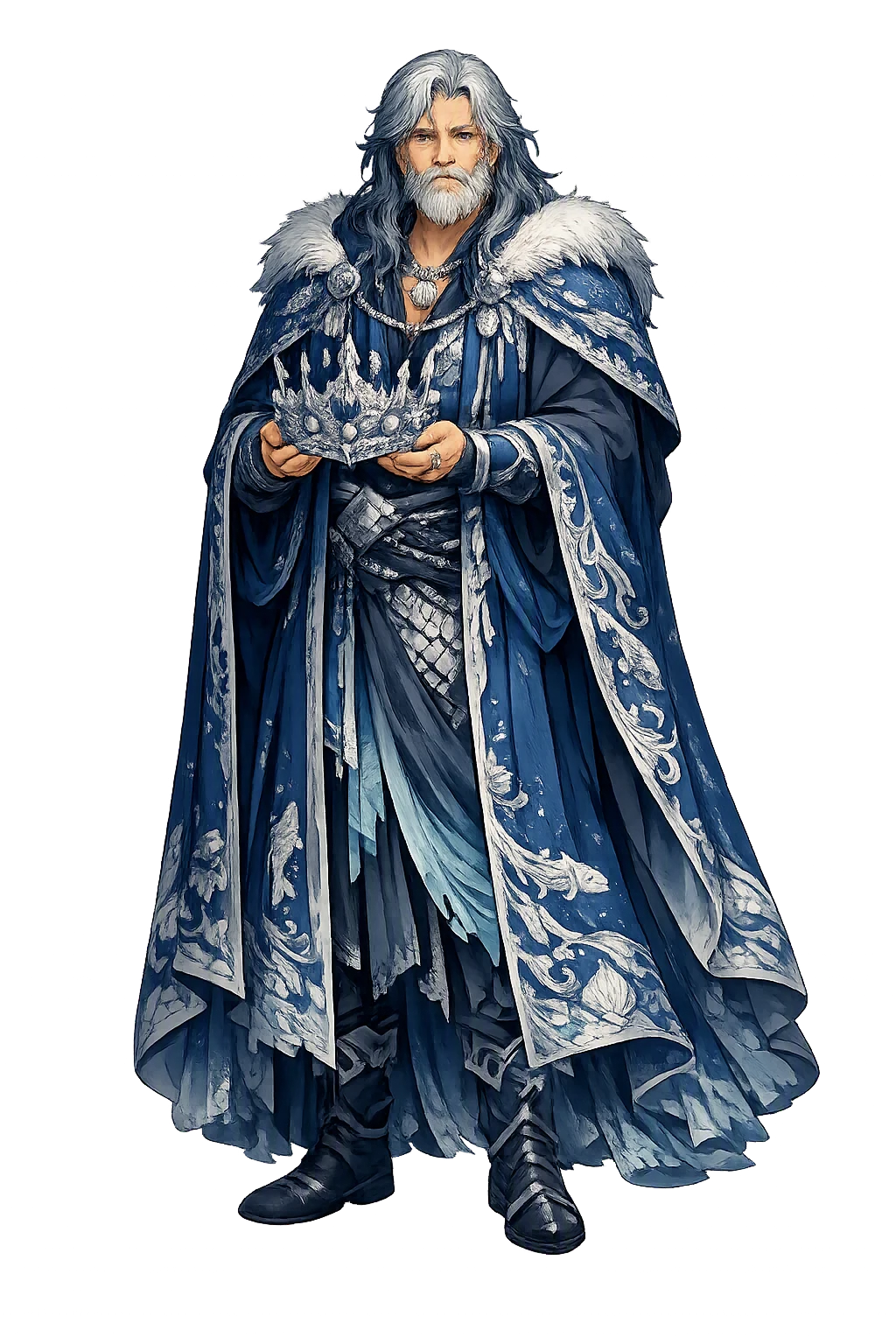
Stories of Manawydan
Manawydan's dossier is the Second and Third Branches of the Mabinogi: Branwen ferch Llŷr, where he is one of the seven who bring the head home, and Manawydan fab Llŷr, the branch that bears his name — the quietest and most perfectly built of the Four, a tale in which an entire kingdom is stolen by silence and won back by patience.
Manawydan stands beside his brother Brân — Bendigeidfran, the Blessed — when [[matholwch|Matholwch]], king of Ireland, comes to Harlech to ask for their sister Branwen, and he counsels the marriage that begins the whole catastrophe. When the insult of the mutilated horses has festered into war, Brân wades the sea to Ireland, and the host that crosses with him comes home as seven men: Pryderi, Manawydan, Glifieu Eil Taran, [[taliesin|Taliesin]], Ynawg, Gruddieu fab Muriel, and Heilyn fab Gwyn — bearing the head of Brân, struck by a poisoned spear, which talks with them and is better company than ever it was in life.
At Harlech they feast seven years with the head, the three songs of the birds of Rhiannon singing to them, and time does not move. At Gwales in Penfro they find a royal hall with two doors open and one shut — toward Cornwall — and there they pass eighty years in the Assembly of the Wondrous Head, forgetting every sorrow, until Heilyn fab Gwyn says 'shame on my beard if I do not open the door' — and opens it, and all their losses come back at once like a tide. Then they do as the head had commanded: they carry it to London and bury it in the White Mount, facing France, and the triads count that burial among the Three Fortunate Concealments of the Island of Britain. Manawydan, who had counseled the wedding, survives its end — the pattern of his whole life in one branch.
While Brân's host was in Ireland, Caswallawn fab [[beli|Beli]] — Manawydan's own cousin — had struck down the men left in charge and taken the crown of London. Pryderi, lord of Dyfed and son of Pwyll and [[rhiannon|Rhiannon]], would have fought him; Manawydan counsels otherwise: Caswallawn is their kinsman, and the kingdom has suffered enough of war. It is the most characteristic speech in the whole Mabinogi — a man with the best claim to vengeance declining it out of arithmetic and mercy. Pryderi yields, and gives Manawydan the fairest compensation the tale can imagine: his mother's hand and the seven cantrefs of Dyfed. Manawydan and Rhiannon wed, and the four — Manawydan, Rhiannon, Pryderi, and Pryderi's wife Cigfa — live at Arberth in unbroken fellowship.
They go up Gorsedd Arberth, the mound where, in the First Branch, wonders came to Pwyll — and wonder comes. As they sit, a peal of thunder falls, and with it a mist so thick they cannot see one another. When it lifts, Dyfed is gone: no dwelling, no animal, no smoke, no man, no woman — only the four of them and the empty land, house and court and courtiers vanished together. For a year they live by hunting and the kindness of the emptied land; for a second year they bear it; in the third they grow weary of it, and the tale turns from endurance to answer.
Hunting, Pryderi and Manawydan rouse a boar shining white, which leads their dogs to a fortress neither has ever seen — and no one ever sees twice. Against Manawydan's counsel Pryderi goes in after the dogs and finds a fountain with a marble slab, and on the slab a golden bowl fastened by chains, wrought with a craftsmanship he cannot fathom. He reaches for it: his hands stick to the bowl, his feet to the slab, and speech leaves him. Rhiannon, hearing her son lost, reproaches Manawydan for returning without him, goes in, lays hold of the bowl, and is taken the same way — and with thunder and a fall of mist the fortress vanishes with them both. Manawydan is left with Cigfa, and the branch's second act belongs to them alone.
Manawydan will not beg his bread in an emptied kingdom: 'Let us go into Lloegr,' he tells Cigfa, 'and take up a craft.' At Hereford he becomes a saddler, and his saddles are so fine that Hereford's saddlers, losing every customer, conspire to kill the strangers; Pryderi's heir would fight, Manawydan counts the odds, and they move on. He becomes a shield-maker — the same beauty, the same conspiracy, the same dignified retreat. He becomes a shoemaker, gilding the shoes, and the cordwainers drive them out like the rest. Three trades, each mastered at first attempt, each surrendered rather than repaid in blood: the triads never forgot it, ranking Manawydan among the Three Golden Shoemakers of the Island of Britain.
Back in empty Dyfed, Manawydan sows three crofts of wheat, and they come up the finest in the land. The first croft, ripe for reaping, is found in the morning stripped to the bare straw; the second goes the same way. On the third night Manawydan keeps watch, and sees a host of mice descend on the ears, each mouse stripping an ear and carrying it off. He runs them down and catches one — the fattest, and slow, and heavy with young. He sets a miniature gallows on the gorsedd and condemns her as a thief.
Then the ransomers come: a scholar, then a priest, then a bishop, each more richly robed than the last, each offering money for the felon's life, and to each Manawydan answers that he will not sell a convicted thief — until the bishop, pressed to name his terms, hears them whole: Pryderi and Rhiannon freed, the enchantment lifted from Dyfed, no vengeance taken on the mice, and no spell ever laid on the seven cantrefs again. The bishop is Llwyd fab Cil Coed, enchanter and friend of Gwawl fab Clud — Rhiannon's jilted suitor from the First Branch — and the whole desolation was his long revenge; the mice were his own household and warband under shape, and the fat one his wife. Pryderi comes back with the gate-hammers he had been made to carry, Rhiannon with the collars of asses about her neck, the mist lifts from Dyfed, and Manawydan keeps his word to the letter: not one mouse is harmed. It is the Mabinogi's most complete victory, and no sword is drawn in it.
Sea, Craftsmanship — the Son of Llŷr who outwitted an enchantment
Manawydan fab Llŷr is the Mabinogi's counselor and craftsman: a son of the sea-named Llŷr and brother of Brân the Blessed, one of the seven who came home from Ireland with the wondrous head — and the man who, when Dyfed was stripped bare by enchantment, kept his patience, took up the saddler's, the shield-maker's, and the shoemaker's trades, and unmade the spell without a sword-stroke, by hanging a mouse and refusing three ransoms.
Brother of Brân and Branwen, of the house whose very name is the sea — the Welsh face of the figure Ireland calls Manannán mac Lir.
In exile at Hereford he made shoes so fine the triads remember him among the Three Golden Shoemakers of the Island of Britain.
The mound above Arberth where the thunder came and the mist fell — and where Manawydan later built a gallows for a mouse.
The fattest of the wheat-thieves, caught and judged as a felon — the lever that finally pried the whole enchantment open.
From the original script to the living URL
Manawydan
The name survives in scholarly transliteration. Manawydan is the standard Celtic romanisation, documented in academic sources — “Manannán (Welsh form)”. Because the spelling uses only Latin letters, the form is the same in both ASCII and Unicode.
No indigenous writing system is securely attested for individual celtic names. The form shown is a modern scholarly transliteration.
manawydan
The plain manawydan form is identical to the Unicode restoration. Because this name is already written in Latin letters, no diacritics, stress, or script information were lost — only capitalization differs.
Manawydan
The Unicode restoration does not need to recover lost marks for Manawydan. Its value is canonical spelling and consistent cataloguing, not the reconstruction of erased orthography. The domain is readable as-is to both DNS and humanity.
Manawydan.com
This restoration is written entirely in ASCII letters — no Punycode encoding stands between Manawydan and the DNS. The domain reads identically to machines and to human eyes.
Owned, ideal, and ASCII forms of Manawydan
Manawydan
The full Unicode restoration. manawydan.com is not in the PuniCodex collection — it is watched for release; if it drops, this temple upgrades to an owned flagship.
How Manawydan was spoken
How Manawydan is preserved in writing
No indigenous writing system is securely attested for individual celtic names. The form shown is a modern scholarly transliteration.
Contribute scholarly provenance →The lore you have read is the living myth. Extended Lore opens the scholarly vault beneath it: the cult and its material remains, a history of the image, the name after antiquity, a meditation on what the name still means, and the full scholarly apparatus — etymology, orthography, sources.
Enter Extended Lore