PuniCodex

Extended Lore

Manawydan

Etymology · Orthography · Cult · Iconography · Reception · Sources

Tier 2 Manawydan
Manawydan — Sea, Craftsmanship
01

Quick Facts

Essential information about Manawydan, Sea, Craftsmanship

Scholarly TransliterationManawydan
Unicode RestorationManawydan
Reconstructed Pronunciation/manaˈwɨdan/
PantheonCeltic
DomainSea, Craftsmanship
MeaningManannán (Welsh form)
ClassificationTier 2
Primary DomainManawydan
Sacred SymbolsThe golden bowl, The white boar, The mouse on the gallows, The shoemaker's last, Gorsedd Arberth
02

Etymology & Word Family

From original script to Unicode restoration

Scholarly Transliteration Manawydan Manawydan — "Manannán (Welsh form)"
Unicode Restoration Manawydan Canonical scholarly spelling — ASCII-identical
Modern ASCII manawydan Plain-ASCII fallback

The name Manawydan reaches the modern world through scholarly transliteration of the celtic tradition. Because the conventional spelling uses only Latin letters, its Unicode and ASCII forms coincide — the tradition it carries is in the name itself, not in diacritics.

03

Unicode Character Breakdown

Character-by-character philological analysis

CharacterUnicodeNameBlockPhonetic Role
MU+004DLatin Capital Letter MBasic LatinSame, capitalized
aU+0061Latin Small Letter ABasic LatinSame
nU+006ELatin Small Letter NBasic LatinSame
aU+0061Latin Small Letter ABasic LatinSame
wU+0077Latin Small Letter WBasic LatinSame
yU+0079Latin Small Letter YBasic LatinSame
dU+0064Latin Small Letter DBasic LatinSame
aU+0061Latin Small Letter ABasic LatinSame
nU+006ELatin Small Letter NBasic LatinSame

The Tier 2 classification here reflects fidelity to the attested tradition, not recovered diacritics: every character of Manawydan already survives in ASCII. What the restoration preserves is the canonical spelling itself — the form scholarship standardised.

04

Cult & Worship

How the sacred was kept — rites, sanctuaries, remains

The Cult

No cult of Manawydan is attested, and honesty requires saying so plainly: no inscription, votive, or sanctuary names him anywhere in Wales. The evidence is manuscript evidence — the Four Branches of the Mabinogi, composed around 1060–1120 and preserved complete in the White Book of Rhydderch (c. 1350) and the Red Book of Hergest (c. 1382–1410). What the texts preserve is the memory of a cult, not the cult itself: a sea-god's son euhemerized into a patient counselor, his divinity surviving only in his name and parentage — Manawydan fab Llŷr, brother of Brân. His worship in the present is modern: Druid and pagan practice since the twentieth century honors him as patron of craft and patience, a veneration offered in the full knowledge that the medieval tale, not any temple, is his only scripture.

In the Earth

Manawydan is a textual figure: no inscription, votive deposit, or cult site names him, and the epigraphic record of pre-Christian Wales — Latin and ogham memorial stones of roughly the fifth to seventh centuries — records personal names, not theonyms. His evidence is manuscript evidence. The Four Branches survive complete in the White Book of Rhydderch (Aberystwyth, NLW Peniarth MSS 4–5, c. 1350) and the Red Book of Hergest (Oxford, Jesus College MS 111, c. 1382–1410), with earlier fragments in Peniarth 6; the tales' date of composition is argued rather than documented — Ifor Williams placed them in the later eleventh century, and current scholarship generally holds a range around 1060–1120. The geography of the Third Branch is real and visitable: Dyfed is the historic kingdom of southwest Wales; Arberth is Narberth in Pembrokeshire, and the gorsedd is traditionally located on the hill above it; the seven cantrefs of Dyfed were still an administrative reality when the tales were written. The nearest linguistic trace of the sea-kinship is onomastic rather than archaeological: Manaw survives in the Welsh name of the Isle of Man and in Manaw Gododdin, the district of the old North remembered in place-names such as Clackmannan and Slamannan.

05

Iconography

How Manawydan was imaged across the ages

The Image

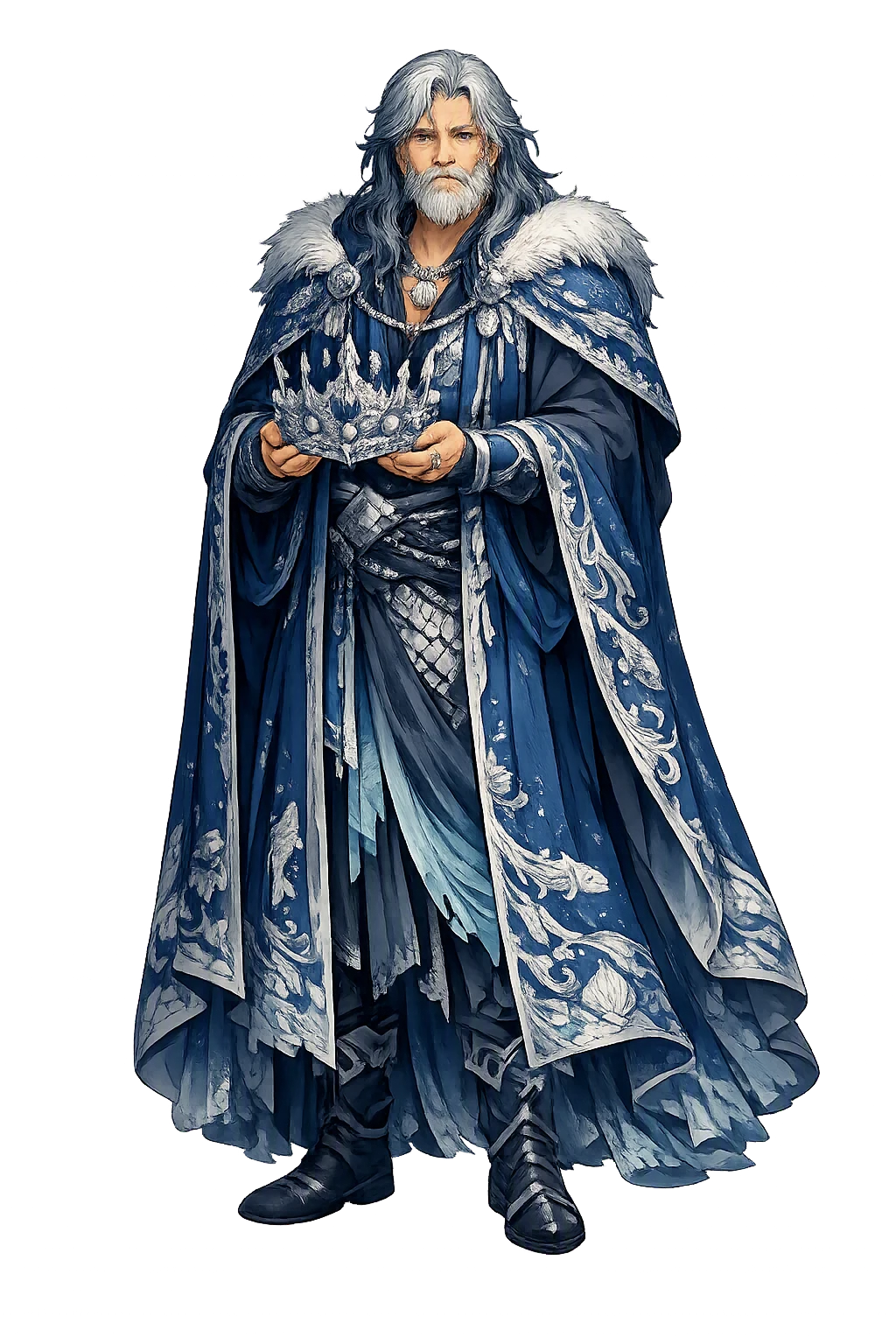
No image of Manawydan survives from the Middle Ages, and none was likely ever made: early Welsh tradition, unlike the Irish, left no figural cycle of its gods, and the manuscripts that carry his tale are decorated with calligraphy, not narrative illustration. His iconography is entirely textual, assembled from the Third Branch's own props: the sea-kinship implied by his name and father, the three golden crafts mastered at Hereford — saddlery, shield-making, gilded shoemaking — and the miniature gallows of the mouse-trial at Gorsedd Arberth. Every picture of him is modern, in book illustration and contemporary Celtic art that depicts the grey, patient craftsman of the emptied Dyfed; the pre-modern art-historical record is simply blank. Artists who attempt him keep choosing the same scene — a man sitting still on a silent land, outwaiting the enchantment — which is perhaps the truest portrait the texts allow.

06

Reception & Transformation

The name after its own age — transmission, translation, survival

Afterlives

Manawydan reached the modern world by the narrowest of roads: two medieval manuscripts. The Third Branch survives complete in the White Book of Rhydderch (c. 1350) and the Red Book of Hergest (c. 1382–1410), with earlier fragments in Peniarth 6 — a transmission chain in which professional storytellers' art became the literature of Welsh identity. The antiquaries met it late: Edward Lhuyd's Archaeologia Britannica (1707) first signaled the tales' value to outsiders, and Iolo Morganwg's Romantic forgeries muddied the record around them for a century. Philology then carried the name home: Ifor Williams's Pedeir Keinc y Mabinogi (1930) fixed text and etymology, Proinsias Mac Cana read the branch's architecture, and the Geiriadur Prifysgol Cymru tracks the word from medieval manuscript to modern dictionary. The triads, riding the same manuscript tradition, kept a second Manawydan alive — one of the Three Golden Shoemakers of the Island of Britain. His is the record of a tale that never left the language it was written in, and never had to.

Identifications Across Traditions

Manawydan's one great comparison is also the deepest fact about him: he is the Welsh form of the figure Ireland knows as [[manannan|Manannán mac Lir]], the sea god and guardian of the Otherworld. The names are cognates — Ifor Williams derived both from Manaw, the Welsh name of the Isle of Man, so that 'Manawydan' and 'Manannán' each mean, in effect, the Manxman — and the fathers match exactly, Welsh Llŷr against Irish Lir, each a personification of the sea. What the Welsh tradition did with the inheritance is the interesting part: where Manannán strides through Irish myth as a god of mist, ships, and wonder-working treasure, the Mabinogi keeps only the sea-kinship and the uncanny craft, and makes its Manawydan mortal, patient, and wise — a euhemerized sea god filed down to a counselor. Whether the Welsh figure is descended from the Irish, or both from a lost common sea god, is debated (Mac Cana; Koch); the handbooks register the kinship and leave the direction open. In Manx folklore the same figure survived as Mannan beg mac y Leir, first man of the island, and gave the Isle of Man its name. No Gaulish counterpart has ever been convincingly proposed; the comparison is an insular affair, Irish Sea water on both sides of it.

Modern Legacy

Lady Charlotte Guest's translation of the Mabinogion (1838–49) carried Manawydan into English, and the Third Branch has held a special place ever since: critics from Ifor Williams onward have called it the most perfectly constructed of the Four Branches, and the trial of the mouse — the courtly ransomers, the miniature gallows, the terms exacted one by one — is the anthology piece of Welsh prose comedy and wisdom in one. Scholarship gave the name its modern standing: Williams's Pedeir Keinc y Mabinogi (1930) fixed the text and the Manaw etymology, and Mac Cana's The Mabinogi made the branch's architecture a set text of Celtic studies. Modern Druid and pagan practice honors Manawydan as a patron of craft, patience, and the sea-kinship; in Wales the name survives as a rare literary given name, carried less by folk memory than by the sheer durability of the Third Branch, which has never gone out of print since Guest.

07

The Meditation

What Manawydan means — beyond the dictionary

Manawydan is the Mabinogi's argument that wisdom is a kind of patience. Every test the tale sets him, he passes by declining the heroic option: when Caswallawn usurps the crown, he counts the cost of war and stays his hand; when Dyfed is emptied, he hunts, endures, and waits; when his companions are taken, he does not storm the fortress — he learns three trades and practices them beautifully in exile. Even his victory is procedural: a watch kept, a mouse caught, a gallows built, three ransoms refused, and terms — release, restoration, amnesty, guarantee — exacted one by one before the noose is loosened. He is the only hero in the Four Branches who wins everything he wants and kills nothing to get it. The sea-named son of Llŷr spends his great story on land, but the sea is in the method: he outlasts what he cannot fight, and the tide turns. The question the branch leaves is uncomfortable and exact — how much of what we call courage is only impatience wearing armor?

08

Frequently Asked Questions

Common questions about Manawydan, Sea, Craftsmanship, and Unicode restoration

01How do you pronounce Manawydan?

In reconstructed pronunciation, Manawydan is /manaˈwɨdan/ — approximately 'man-ah-WIH-dan' — stress the third syllable (the Welsh penult); the w is a quick glide and the y is the Welsh central vowel [ɨ], a sound with no English equivalent, closest to a tight, short 'ih'.

02What does Manawydan mean?

Manawydan means Manannán (Welsh form) in the celtic tradition.

03What are the symbols of Manawydan?

Manawydan is associated with The golden bowl (The enchanted vessel on the marble slab — the snare that took Pryderi and Rhiannon by their own reaching), The white boar (The Otherworld lure that leads men out of the world they know, shining and wrong), The mouse on the gallows (Patience armed with procedure — the smallest catch that bought back a kingdom), The shoemaker's last (Craft as survival: the trades a dispossessed prince practiced better than the guildsmen), Gorsedd Arberth (The mound of wonders, where sitting is never safe and where the case was finally tried).

04Why restore Manawydan in Unicode?

Manawydan is written entirely in ASCII letters, so its restoration is about canonical fidelity rather than recovered diacritics: the temple fixes the name in its scholarly standard spelling, attested in the source tradition, instead of leaving it to drift.

05What is the most important myth about Manawydan?

“The Seven Who Brought the Head Home” — the Second Branch · Branwen ferch Llŷr story that anchors the mythology of Manawydan, told in full on the lore page.

09

Scholarly Sources

The philological foundations of this restoration

Every claim on this page is grounded in established scholarship. The orthographic restorations follow disciplinary convention. The etymological chain follows the best available reference works. This is not invention — it is resurrection through scholarship.

◈

Lexicography & Philology

  • Mabinogion
  • MacKillop
◎

Primary Texts

  • The Immram Brain (Voyage of Bran); Tochmarc Étaíne; Cóir Anmann; medieval Irish saga literature.
◉

Archaeology & Art History

  • Material evidence — iconography, inscriptions, and temple archaeology — for Manawydan and related cults.
✦

Religious Studies

  • The Mabinogi — Second Branch (Branwen ferch Llŷr): trans. Sioned Davies (Oxford, 2007); Welsh text ed. Ifor Williams, Pedeir Keinc y Mabinogi (1930)
  • The Mabinogi — Third Branch (Manawydan fab Llŷr): trans. Sioned Davies (Oxford, 2007); Welsh text ed. Ifor Williams, Pedeir Keinc y Mabinogi (1930)
  • Trioedd Ynys Prydein, ed. and trans. Rachel Bromwich — the Three Golden Shoemakers; the Fortunate Concealment of Brân's head
  • The Mabinogion, trans. Lady Charlotte Guest (1838–49)
  • Mac Cana, Proinsias, The Mabinogi, 2nd ed. (University of Wales Press, 1992) — the Third Branch's construction; the Manannán question
  • Koch, John T., ed., Celtic Culture: A Historical Encyclopedia (ABC-CLIO, 2006), s.vv. Manawydan fab Llŷr, Manannán mac Lir
  • MacKillop, James, Dictionary of Celtic Mythology (Oxford, 1998), s.vv. Manawydan, Manannán, Llŷr
  • Geiriadur Prifysgol Cymru / A Dictionary of the Welsh Language (GPC), s.v. Manawydan
Return

The Surface Awaits

You have traced the name from its earliest attestation to its Unicode restoration. Now return to the myth. The story is where the name lives.

Back to Lore
Manawydan mascot