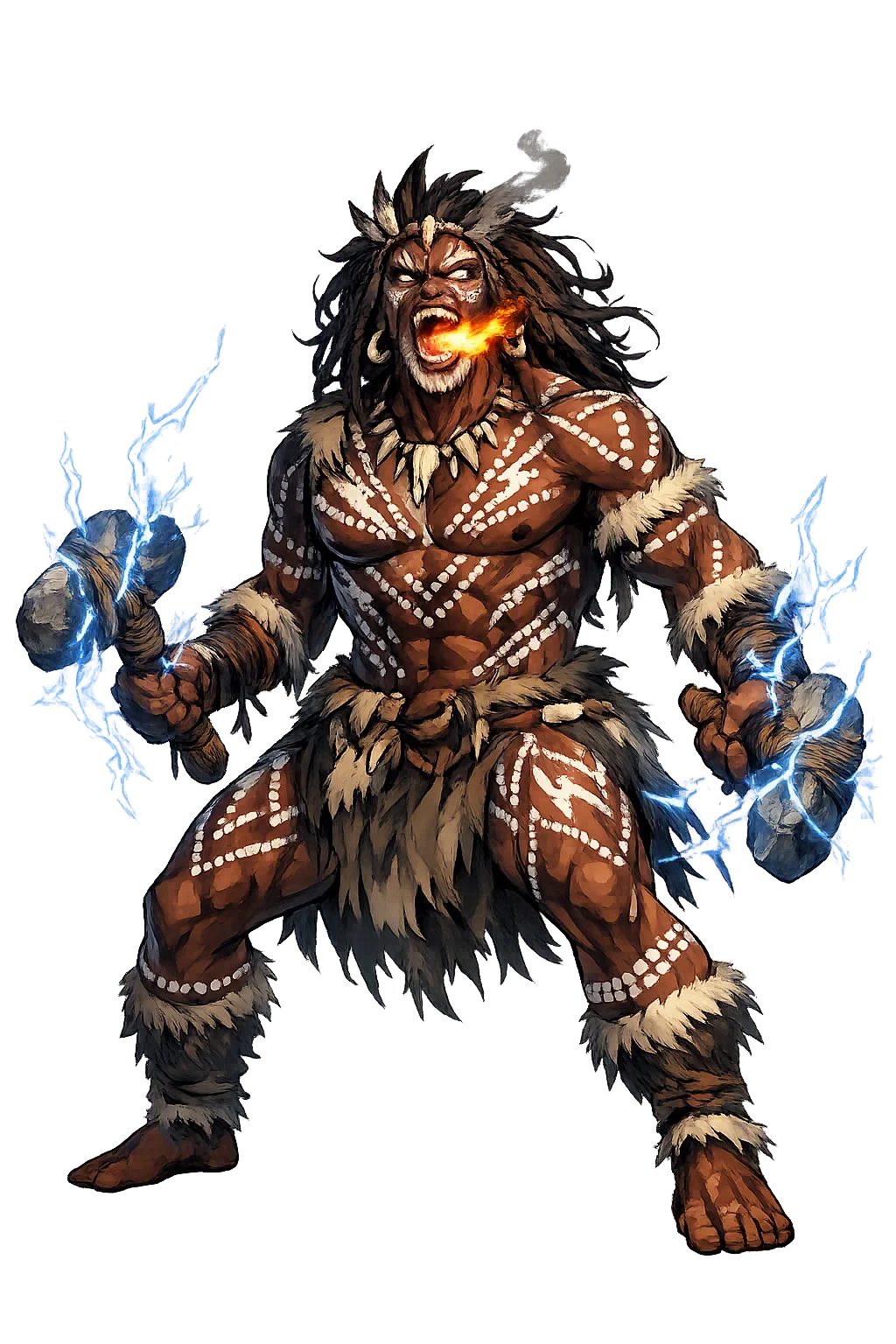
Stories of Mamaragan
Mamaragan belongs to the Aboriginal sacred geography of western Arnhem Land. His mythology is preserved not in a single written narrative but in rock art, song cycles, dance, and the seasonal knowledge carried by senior custodians. The published accounts are necessarily general, and some layers of meaning are restricted; what can be told publicly, the stories emphasize relationship: the lightning does not simply happen — it is the action of an ancestor who must be respected.
In the build-up to the wet season, the humidity gathers, the cloud masses stack over the sea, and the first storms roll in across the escarpment. The lightning ancestor is said to travel with these storms, his presence announced by thunder and the flash that splits the stone country (the seasonal cycle behind these stories was documented by the 1948 Arnhem Land Expedition: Mountford, Art, Myth and Symbolism, 1956). The rains transform the country: dry creek beds run, billabongs fill, the spear grass greens, and the animals breed. His arrival is both welcomed and feared — the same storm that brings life can burn a tree or strike the careless. In this tradition weather is not background to the ancestors' stories; it is their presence. The build-up months are read from beginning to end as a passage: the sky darkens, the ancestor walks, and the land answers.
Across western Arnhem Land, rock shelters preserve images of lightning beings: human-like figures with zigzag lines radiating from the head, arms, or torso, some shown with the axes or dilly bags that carry their power (Mountford 1956; Chaloupka, Journey in Time, 1993). These images are not portraits in the Western sense; they are manifestations of ancestral power tied to specific places, and to the right of particular clan groups to paint, sing, and recount them. Regional names differ — Namarrkon is the best-known Kunwinjku Lightning Spirit — and Mamaragan belongs to the same complex of beings: a name recorded for the lightning ancestor of the Liverpool River and surrounding country. The pictures are the ancestors' signatures in the stone: to see the zigzag issuing from a painted head is to be shown, without words, whose country you are standing in.
The stories teach that the lightning is not random. It follows the paths of the ancestors and answers the moral order of the country (the framework was set out by Berndt & Berndt, The World of the First Australians, 1964). To be out in the open in a severe storm, to mock the thunder, or to ignore the signs of the season is to risk the ancestor's anger. The teaching is practical as much as spiritual: it encodes when to travel and when to shelter, where the creeks will run, and how to read the sky of the stone country. An oral tradition keeps this knowledge alive by making it personal — the storm is not an 'it' but a 'who', and one behaves differently toward a who. Respect for the sky, in this teaching, is a technology of survival dressed as reverence.
The Kunwinjku seasonal calendar of western Arnhem Land divides the year into six seasons, and the storm ancestor's year has a second, louder movement. After the main monsoon months (Gudjewg) come the great late storms of Banggerreng — 'knock 'em down' — when violent squalls flatten the tall spear grass across the floodplains and the lightning returns in its last great passages (the seasonal round is documented in the published Kunwinjku calendars of the region). The turn of Banggerreng is a hinge of the year: the grass goes down, the air begins to cool, and the country readies itself for the dry. To the communities who read it, the flattening storm is the ancestor's final word of the wet season — a clearing of the ground, a loud punctuation, and a signal stored in story: the season is turning, and the country is about to change its face. The calendar is astronomy, meteorology, and theology in a single sky.
Thunder, Storm, and the Power of the Wet Season
Mamaragan is the Lightning Ancestor of western Arnhem Land, a sky being whose body is the storm and whose weapons are the lightning. In the wet season, when thunder rolls across the stone country and the sky splits with light, his presence is felt across the land. He is not merely a weather spirit; he is a living ancestor whose actions renew the country, fill the waterholes, and remind human beings of the power that moves behind the visible world.
His signature power: the bright flash that strikes from cloud to earth, carrying both danger and renewal.
The sound of his stone axes striking together, or of his voice rolling across the wet-season sky.
The storms he brings break the dry season, fill billabongs, and regenerate the plants and animals of the stone country.
A being of the upper realms, connected to the stars, clouds, and the winds that announce the monsoon.
From the original script to the living URL
Mamaragan
The name survives in scholarly transliteration. Mamaragan is the standard Aboriginal romanisation, documented in academic sources — “The lightning”. Because the spelling uses only Latin letters, the form is the same in both ASCII and Unicode.
No indigenous writing system is securely attested for individual aboriginal names. The form shown is a modern scholarly transliteration.
mamaragan
The plain mamaragan form is identical to the Unicode restoration. Because this name is already written in Latin letters, no diacritics, stress, or script information were lost — only capitalization differs.
Mamaragan
The Unicode restoration does not need to recover lost marks for Mamaragan. Its value is canonical spelling and consistent cataloguing, not the reconstruction of erased orthography. The domain is readable as-is to both DNS and humanity.
Mamaragan.com
This restoration is written entirely in ASCII letters — no Punycode encoding stands between Mamaragan and the DNS. The domain reads identically to machines and to human eyes.
Owned, ideal, and ASCII forms of Mamaragan
Mamaragan
The full Unicode restoration. mamaragan.com is not in the PuniCodex collection — it is watched for release; if it drops, this temple upgrades to an owned flagship.
How Mamaragan was spoken
How Mamaragan is preserved in writing
No indigenous writing system is securely attested for individual aboriginal names. The form shown is a modern scholarly transliteration.
Contribute scholarly provenance →The lore you have read is the living myth. Extended Lore opens the scholarly vault beneath it: the cult and its material remains, a history of the image, the name after antiquity, a meditation on what the name still means, and the full scholarly apparatus — etymology, orthography, sources.
Enter Extended Lore