PuniCodex

Extended Lore

Mamaragan

Etymology · Phonology · Orthography · Cultural Legacy · Primary Sources

Tier 2 Mamaragan
Mamaragan — Lightning Man
01

Quick Facts

Essential information about Mamaragan, Lightning Man

Scholarly TransliterationMamaragan
Unicode RestorationMamaragan
Reconstructed Pronunciation/ˈma.ma.ɹa.ɡan/
PantheonAboriginal
DomainLightning Man
MeaningThe lightning
ClassificationTier 2
Primary DomainMamaragan
Sacred SymbolsZigzag lightning, Stone axe, Dilly bag, Rain cloud
02

Etymology & Word Family

From original script to Unicode restoration

Scholarly Transliteration Mamaragan Mamaragan — "The lightning"
Unicode Restoration Mamaragan Restored stress, length, and script
Modern ASCII mamaragan Plain-ASCII fallback

The name belongs to the language complex of western Arnhem Land (Kunwinjku/Kuninjku and related dialects). English romanization introduces uncertainty: the medial consonant may be represented as r or rr, and the final syllable may be written -gan, -gen, or -kan. PuniCodex follows the most widely attested spelling, Mamaragan, capitalized as a proper name. Because the restoration adds only capitalization and no distinctive diacritic or special letter, the name is Tier 2.

03

Unicode Character Breakdown

Character-by-character philological analysis

CharacterUnicodeNameBlockPhonetic Role
MU+004DLatin Capital Letter MBasic LatinSame, capitalized
aU+0061Latin Small Letter ABasic LatinSame
mU+006DLatin Small Letter MBasic LatinSame
aU+0061Latin Small Letter ABasic LatinSame
rU+0072Latin Small Letter RBasic LatinSame
aU+0061Latin Small Letter ABasic LatinSame
gU+0067Latin Small Letter GBasic LatinSame
aU+0061Latin Small Letter ABasic LatinSame
nU+006ELatin Small Letter NBasic LatinSame

The Tier 2 classification reflects how much of the original phonology this restoration preserves — stress and vowel length for Greek names, distinctive letters and diacritics for every other tradition.

04

Cultural Significance

From ancient cult to modern Unicode

Ancient Domain

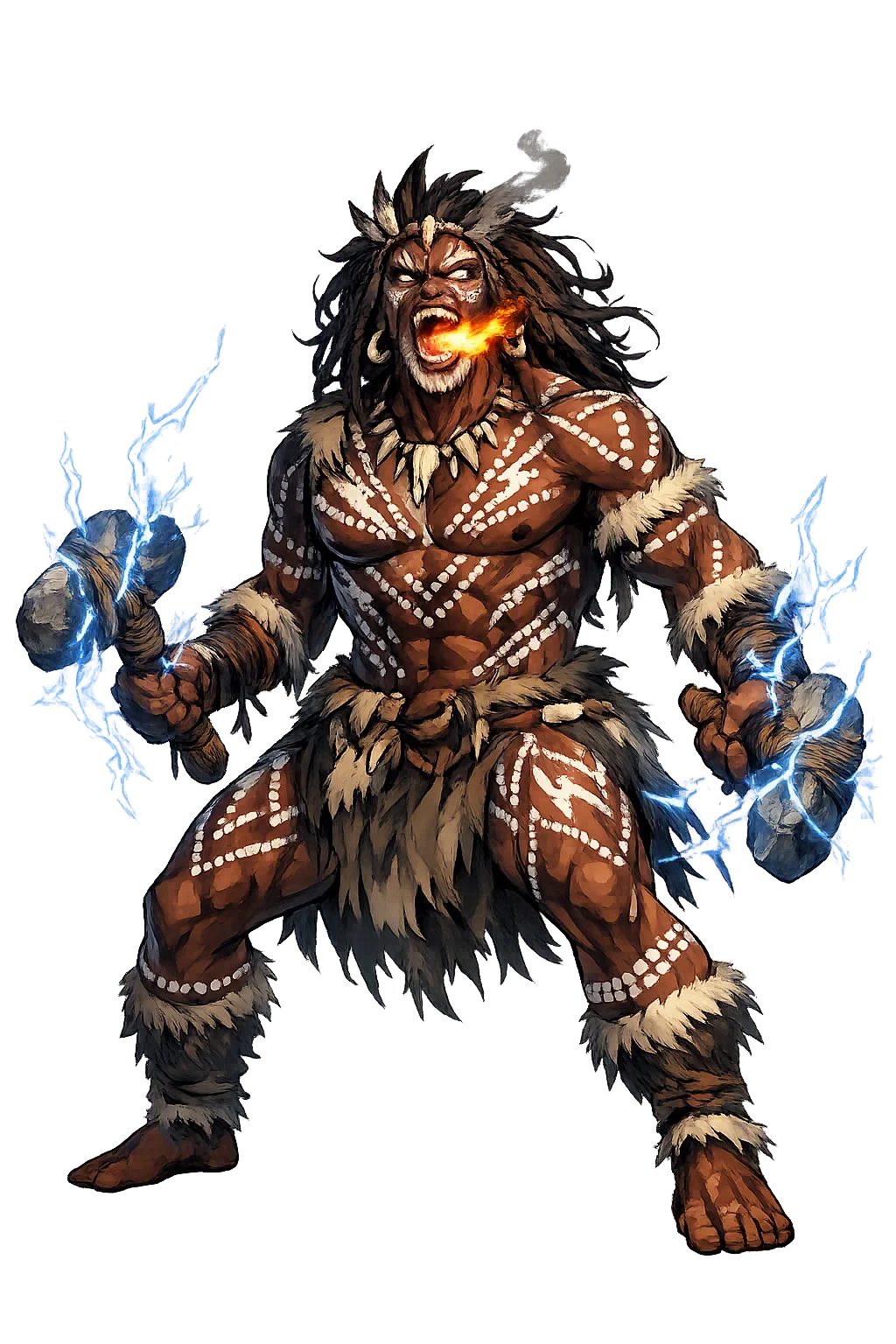
Mamaragan is the Lightning Ancestor of western Arnhem Land, a sky being whose body is the storm and whose weapons are the lightning. In the wet season, when thunder rolls across the stone country and the sky splits with light, his presence is felt across the land. He is not merely a weather spirit; he is a living ancestor whose actions renew the country, fill the waterholes, and remind human beings of the power that moves behind the visible world.

Mamaragan in Later Traditions

Mamaragan is best understood within the regional lightning-being tradition of western Arnhem Land rather than as a figure with wide intercultural syncretism. Nearby and related traditions speak of Namarrkon, a powerful lightning spirit whose stone axes are said to be visible in certain rocks and whose image is common in rock art. The relationship between Mamaragan and Namarrkon varies by clan and by song cycle; some accounts treat them as overlapping names or aspects of a single ancestral power, while others keep them distinct. Contemporary Aboriginal artists and custodians continue to paint and sing these figures, negotiating the boundary between restricted sacred knowledge and publicly shared cultural expression.

Modern Legacy

Mamaragan and the wider lightning-ancestor tradition remain part of the living culture of western Arnhem Land. Aboriginal artists from Kunwinjku and surrounding communities continue to depict lightning beings in bark paintings, prints, and rock-art-inspired works, often for public audiences while withholding the most restricted layers of meaning. The figure has also entered Australian popular consciousness through books such as Ainslie Roberts and Charles Mountford's The Dreamtime, where Arnhem Land lightning beings are introduced to non-Indigenous readers. In environmental discourse, the wet-season storms that Mamaragan embodies are recognized as essential to the ecology of northern Australia, linking ancestral knowledge with modern climate and land-management science.

Unicode Restoration as Cultural Act

Restoring Mamaragan in a domain name is more than orthographic accuracy. It is a statement that the internet should recognize the full range of human writing — not only the ASCII keyboard.

05

Frequently Asked Questions

Common questions about Mamaragan, Lightning Man, and Unicode restoration

01How do you pronounce Mamaragan?

In reconstructed pronunciation, Mamaragan is /ˈma.ma.ɹa.ɡan/ — approximately 'MA-ma-ra-gan' — say each vowel clearly as 'ah', keep the rhythm even, and stress the first and last syllables lightly. The name is not an English word; it should not be flattened into 'mam-er-AH-gun'..

02What does Mamaragan mean?

Mamaragan means The lightning in the aboriginal tradition.

03What are the symbols of Mamaragan?

Mamaragan is associated with Zigzag lightning (The visible trace of his power; in rock art it may issue from his head, limbs, or body), Stone axe (The weapon or tool that makes thunder when struck; a common motif in Arnhem Land lightning imagery), Dilly bag (The container that holds his lightning stones or axes in some accounts), Rain cloud (The body of the storm in which he travels; the wet-season cloud mass brings both life and danger).

04Why restore Mamaragan in Unicode?

Plain ASCII mamaragan strips the stress, length, and script that make the name specific. Unicode restoration returns the name to its original written dignity.

05What is the most important myth about Mamaragan?

In the build-up to the wet season, the humidity gathers and the first storms roll in from the sea. Mamaragan is said to travel with these storms, his presence announced by thunder and the flash of lightning across the escarpment. The rains he brings transform the stone country: dry creek beds become running water, billabongs fill, and the country wakes from the long dry. His arrival is both welcomed and feared — the same storm that brings life can also burn a tree or strike a careless traveler.

06

Scholarly Sources

The philological foundations of this restoration

Every claim on this page is grounded in established scholarship. The orthographic restorations follow disciplinary convention. The etymological chain follows the best available reference works. This is not invention — it is resurrection through scholarship.

Lexicography & Philology

  • AIATSIS
  • Berndt

Primary Texts

  • Primary sources in the aboriginal tradition for Mamaragan.

Archaeology & Art History

  • Material evidence — iconography, inscriptions, and temple archaeology — for Mamaragan and related cults.
  • The primary material evidence for Mamaragan and related lightning ancestors is the rock art of western Arnhem Land, where human-like figures with radiating lightning motifs occur in numerous shelters. The American-Australian Scientific Expedition to Arnhem Land (1948) documented many of these images. Bark paintings, ceremonial objects, and contemporary prints by Kunwinjku and Kuninjku artists continue the tradition. Because Aboriginal sacred knowledge is often restricted by clan, age, and initiation status, not all imagery or song cycles are publicly interpretable.

Religious Studies

  • AIATSIS — Australian Institute of Aboriginal and Torres Strait Islander Studies, general ethnographic and linguistic reference
  • Berndt, Ronald M. and Catherine H. Berndt, The World of the First Australians (Aboriginal Studies Press)
  • Elkin, A. P., The Australian Aborigines: How to Understand Them (Angus & Robertson)
  • Mountford, Charles P., Records of the American-Australian Scientific Expedition to Arnhem Land, vol. 1: Art, Myth and Symbolism (Melbourne University Press)
  • Roberts, Ainslie and Charles P. Mountford, The Dreamtime Book (Rigby)
  • Parker, K. Langloh, Australian Legendary Tales (Folklore of the Noongahburrahs) — comparative Aboriginal myth and lore
Return

The Surface Awaits

You have traced the name from its earliest attestation to its Unicode restoration. Now return to the myth. The story is where the name lives.

Back to Lore
Mamaragan mascot