
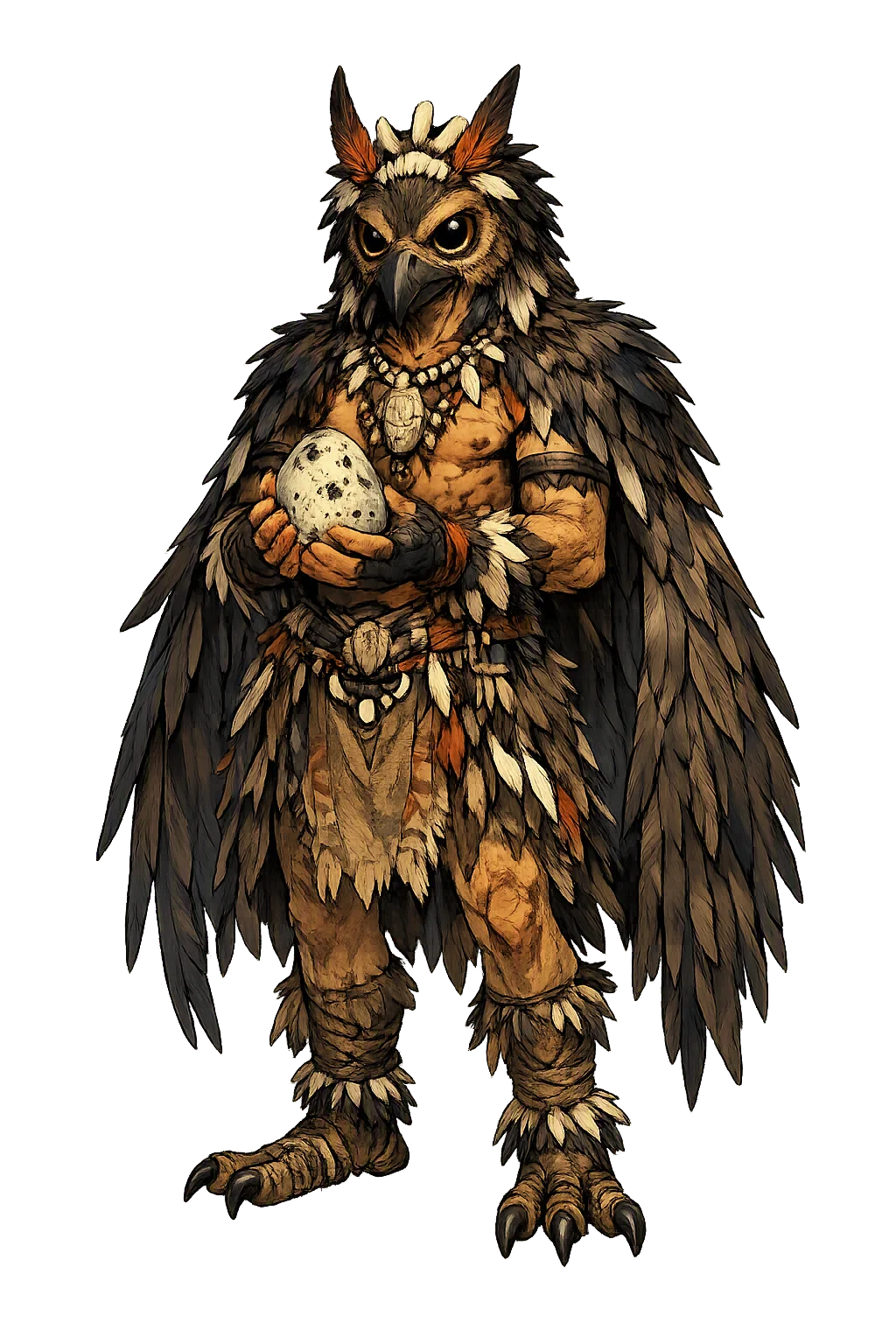
Makemake: the stories first, then the spelling
Before the spelling, the story. Makemake earns its restoration the old way — through what was actually told.
The Stories That Carry the Name
The Creator in the Chants. When the first ethnographers asked the islanders who made the world, the answer was Makemake. Alfred Métraux, working on Rapa Nui in 1934–35, recorded chants in which Makemake appears at the beginning of things as the great god, the maker of humankind, attended by the aku aku, the guardian spirits of the caves; Katherine Routledge heard related accounts during the Mana expedition of 1914–15. The surviving material is fragmentary — Peruvian slave raids and smallpox had shattered the population in the 1860s, carrying off the initiated experts, and much of the theology survived in the mouths of a handful of elders.
The Birdman Contest. Each spring the men of Rapa Nui gathered at Orongo, the stone village on the rim of the Rano Kau crater, to compete for the title of tangata manu — the birdman. Swimmers called hopu descended the sea cliffs and crossed shark-filled water to the islet of Motu Nui, there to await the sooty tern's first egg of the season. The sponsor whose hopu returned first with an unbroken egg won: he was shaved, painted red and black, given the egg to wear against his body, and seated for a year in sacred seclusion as Makemake's chosen — the year's lord of fertility, whose fortune was read in the fortunes of land and sea.
The Eyes of Orongo. The village of Orongo is itself Makemake's great icon. Its flat lava slabs are covered with petroglyphs — birdmen with human faces and birds' bodies, frigatebirds, Komari fertility symbols, and above all the staring face of Makemake himself, the eyes hugely enlarged, peering from the rock beside the contest grounds. Georgia Lee's survey, The Rock Art of Easter Island (1992), catalogued some twelve hundred designs and showed the wide-eyed faces clustered at the very village where the tangata manu contest was held: the god carved as witness.
And Here Is What the Spelling Preserves
At a Glance
- Restored name: Makemake
- ASCII form: makemake
- Meaning: "To see, to know"
- Domain of influence: Creator, Fertility, Bird-Man
- Pantheon: Polynesian
- Classification: Tier 2
- Original script: —
- Series: The Restoration Files, No. 292 of 548
The Name Travels
Makemake had no classical syncretism — there was no neighboring pantheon on the loneliest island in the world. His transformation came with catastrophe: after the Peruvian slave raids and epidemics of the 1860s, the survivors embraced Catholicism, and the creator god was absorbed into the image of the Christian God or quietly retired to the petroglyphs.
The Address It Earned
The temple of Makemake stands at /makemake/ — lore, scholars, patterns — because a name carrying this much story deserves more than a parking page. One decisive feature survives — a single, honest mark — which places the restoration in Tier-2: exact, and exactly labeled.
The Sources Are Open
The myths above are retold from the temple's record; the primary voices are in the Sacred Texts: Kumulipo and Polynesian Mythology. Nothing in this file outranks them.
The File Continues
Read the founding dispatch for the name's full story, the Resonance File for the archetype at work — or the whole archive in one sitting.
Continue the series — previous file: Maitreya (read it here) · next file: Mamaqucha (read it here).
The Restoration Files are written from the same canonical record as the temples themselves: the lexicon, the lore catalog, the pattern atlas, and the cited scholarly sources. If a file ever disagrees with its temple, the temple is right — tell us, and the file will be corrected.