Stories of Makemake
Makemake is the creator god of Rapa Nui (Easter Island): father of fertility, lord of the seabirds, and the hidden face behind the island's birdman cult. The sources are late — the tradition was recorded in the late nineteenth and early twentieth centuries, after the population's collapse — and they must be read as the memory of a wounded tradition.
When the first ethnographers asked the islanders who made the world, the answer was Makemake. Alfred Métraux, working on Rapa Nui in 1934–35, recorded chants in which Makemake appears at the beginning of things as the great god, the maker of humankind, attended by the aku aku, the guardian spirits of the caves; Katherine Routledge heard related accounts during the Mana expedition of 1914–15. The surviving material is fragmentary — Peruvian slave raids and smallpox had shattered the population in the 1860s, carrying off the initiated experts, and much of the theology survived in the mouths of a handful of elders. In the recorded lore Makemake stands at the head of the pantheon, paired with the sea-god Tangaroa. What can be said with confidence is this: on the most isolated inhabited island on earth, creation was not a distant cosmic event but a local one, governed by a god whose staring face was carved into the living stone of the island itself.
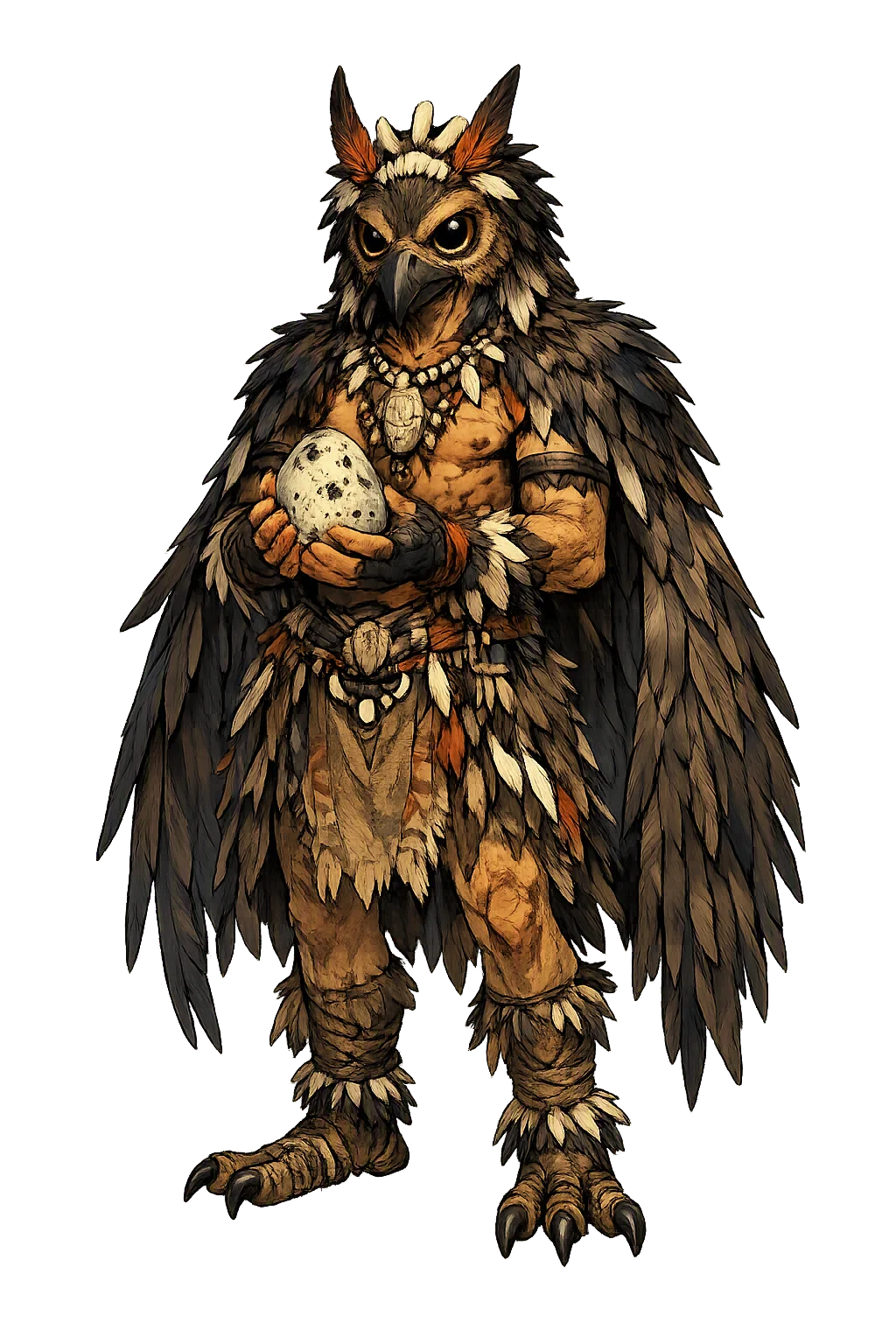
Each spring the men of Rapa Nui gathered at Orongo, the stone village on the rim of the Rano Kau crater, to compete for the title of tangata manu — the birdman. Swimmers called hopu descended the sea cliffs and crossed shark-filled water to the islet of Motu Nui, there to await the sooty tern's first egg of the season. The sponsor whose hopu returned first with an unbroken egg won: he was shaved, painted red and black, given the egg to wear against his body, and seated for a year in sacred seclusion as Makemake's chosen — the year's lord of fertility, whose fortune was read in the fortunes of land and sea. Métraux reconstructed the full ritual cycle from informants' testimony, and Routledge saw the last performances in 1914. The contest means that on an island without kingship, legitimacy came not from conquest but from a god-given sign: the birdman's egg was the island's crown, and Makemake alone conferred it.
The village of Orongo is itself Makemake's great icon. Its flat lava slabs are covered with petroglyphs — birdmen with human faces and birds' bodies, frigatebirds, Komari fertility symbols, and above all the staring face of Makemake himself, the eyes hugely enlarged, peering from the rock beside the contest grounds. Georgia Lee's survey, The Rock Art of Easter Island (1992), catalogued some twelve hundred designs and showed the wide-eyed faces clustered at the very village where the tangata manu contest was held: the god carved as witness. Métraux had already recorded that the islanders named these faces as Makemake's. The image means that knowledge is sight — the lexicon's gloss of the name, 'to see, to know', is literally carved at Orongo, where the god's whole function is to watch, and where being seen by Makemake is the entire power of the ceremony.
The cult did not survive contact intact. Peruvian slavers carried off around a thousand islanders in 1862–63, including the last initiated experts; smallpox followed; by 1868 the survivors stood for mass baptism. Métraux heard the birdman cycle from men who had never seen it performed, and Routledge found Orongo already standing empty, its sacred houses abandoned. Yet the name never died. In the later twentieth century the Tapati Rapa Nui festival began staging the birdman legend again — canoe races, body-painting, and the choosing of a festival queen — and the tangata manu story became the emblem of the islanders' revived identity. In 2008 the astronomers who found the bright dwarf planet beyond Pluto gave it Makemake's name. The history means that a god once reduced to a stone face watched over the slow return of the people who had made him: the watcher outlasted the silence.
Creator
Makemake is the creator god of Rapa Nui — Easter Island: father of fertility, lord of the seabirds, and the hidden face behind the island's birdman cult. His carved eyes watch from the stone village of Orongo, where each spring a contest chose the tangata manu, the man who bore the god's sign for a year.
The birdman of the Orongo contest — the year's chosen lord, raised by Makemake's sign: the first sooty-tern egg brought unbroken from Motu Nui.
Head of the island's recorded pantheon: maker of humankind, father of fertility, lord of the manu, the birds on which the island's life depended.
The stone village on the rim of the Rano Kau crater, where hundreds of petroglyphs carry Makemake's enormous staring face.
The island's annual festival, where the birdman legend is staged again — the tradition's living return after the nineteenth-century silence.
From the original script to the living URL
Makemake
The name survives in scholarly transliteration. Makemake is the standard Polynesian romanisation, documented in academic sources — “To see, to know”. Because the spelling uses only Latin letters, the form is the same in both ASCII and Unicode.
No indigenous writing system is securely attested for individual polynesian names. The form shown is a modern scholarly transliteration.
makemake
The plain makemake form is identical to the Unicode restoration. Because this name is already written in Latin letters, no diacritics, stress, or script information were lost — only capitalization differs.
Makemake
The Unicode restoration does not need to recover lost marks for Makemake. Its value is canonical spelling and consistent cataloguing, not the reconstruction of erased orthography. The domain is readable as-is to both DNS and humanity.
Makemake.com
This restoration is written entirely in ASCII letters — no Punycode encoding stands between Makemake and the DNS. The domain reads identically to machines and to human eyes.
Owned, ideal, and ASCII forms of Makemake
Makemake
The full Unicode restoration. makemake.com is not in the PuniCodex collection — it is watched for release; if it drops, this temple upgrades to an owned flagship.
How Makemake was spoken
How Makemake is preserved in writing
No indigenous writing system is securely attested for individual polynesian names. The form shown is a modern scholarly transliteration.
Contribute scholarly provenance →The lore you have read is the living myth. Extended Lore opens the scholarly vault beneath it: the cult and its material remains, a history of the image, the name after antiquity, a meditation on what the name still means, and the full scholarly apparatus — etymology, orthography, sources.
Enter Extended Lore