PuniCodex

Extended Lore

Makemake

Etymology · Orthography · Cult · Iconography · Reception · Sources

Tier 2 Makemake
Makemake — Creator, Fertility, Bird-Man
01

Quick Facts

Essential information about Makemake, Creator, Fertility, Bird-Man

Scholarly TransliterationMakemake
Unicode RestorationMakemake
Reconstructed Pronunciation/makemake/
PantheonPolynesian
DomainCreator, Fertility, Bird-Man
MeaningTo see, to know
ClassificationTier 2
Primary DomainMakemake
Sacred SymbolsThe sooty tern's egg, The wide-eyed face, Frigatebird (manu), Rano Kau crater, Aku aku
02

Etymology & Word Family

From original script to Unicode restoration

Scholarly Transliteration Makemake Makemake — "To see, to know"
Unicode Restoration Makemake Canonical scholarly spelling — ASCII-identical
Modern ASCII makemake Plain-ASCII fallback

The name Makemake reaches the modern world through scholarly transliteration of the polynesian tradition. Because the conventional spelling uses only Latin letters, its Unicode and ASCII forms coincide — the tradition it carries is in the name itself, not in diacritics.

03

Unicode Character Breakdown

Character-by-character philological analysis

CharacterUnicodeNameBlockPhonetic Role
MU+004DLatin Capital Letter MBasic LatinSame, capitalized
aU+0061Latin Small Letter ABasic LatinSame
kU+006BLatin Small Letter KBasic LatinSame
eU+0065Latin Small Letter EBasic LatinSame
mU+006DLatin Small Letter MBasic LatinSame, capitalized
aU+0061Latin Small Letter ABasic LatinSame
kU+006BLatin Small Letter KBasic LatinSame
eU+0065Latin Small Letter EBasic LatinSame

The Tier 2 classification here reflects fidelity to the attested tradition, not recovered diacritics: every character of Makemake already survives in ASCII. What the restoration preserves is the canonical spelling itself — the form scholarship standardised.

04

Cult & Worship

How the sacred was kept — rites, sanctuaries, remains

The Cult

Makemake's cult was the birdman institution, and its address was Orongo. Each year, as the sooty terns returned to the islets below Rano Kau, the island's men gathered at the stone village on the crater rim; sponsors chose swimmers — hopu — who descended the sea cliffs and crossed shark-filled water to Motu Nui to await the season's first egg. The sponsor whose hopu returned with an unbroken shell was shaved, painted with ochre, and secluded for a year as tangata manu, Makemake's chosen, his clan holding the rights of the season's first eggs. There was no professional priesthood: legitimacy flowed through the contest itself, under the eyes of the ariki. The cult ended violently — Peruvian slave raids and smallpox in 1862–63 removed the last experts, and by 1868 the survivors stood for baptism. What we know of its practice was reconstructed by Katherine Routledge in 1914–15 and Alfred Métraux in 1934–35 from informants who had never seen it performed.

In the Earth

The material evidence is concentrated at Orongo, the ceremonial village on the Rano Kau crater rim: some fifty stone houses and over a thousand petroglyphs, including the wide-eyed Makemake faces and birdman figures documented by Routledge (1914–15) and catalogued by Georgia Lee (1992). Several carved slabs were removed to museums in the 1970s after weathering and vandalism; the village was consolidated under William Mulloy's restoration program. The islets of Motu Nui, Motu Iti and Motu Kao Kao below the cliffs preserve the contest's arena; Rano Raraku's quarry and the ahu platforms (notably Ahu Tongariki) form the wider sacred landscape. The Rapa Nui National Park has been a UNESCO World Heritage Site since 1995.

05

Iconography

How Makemake was imaged across the ages

The Image

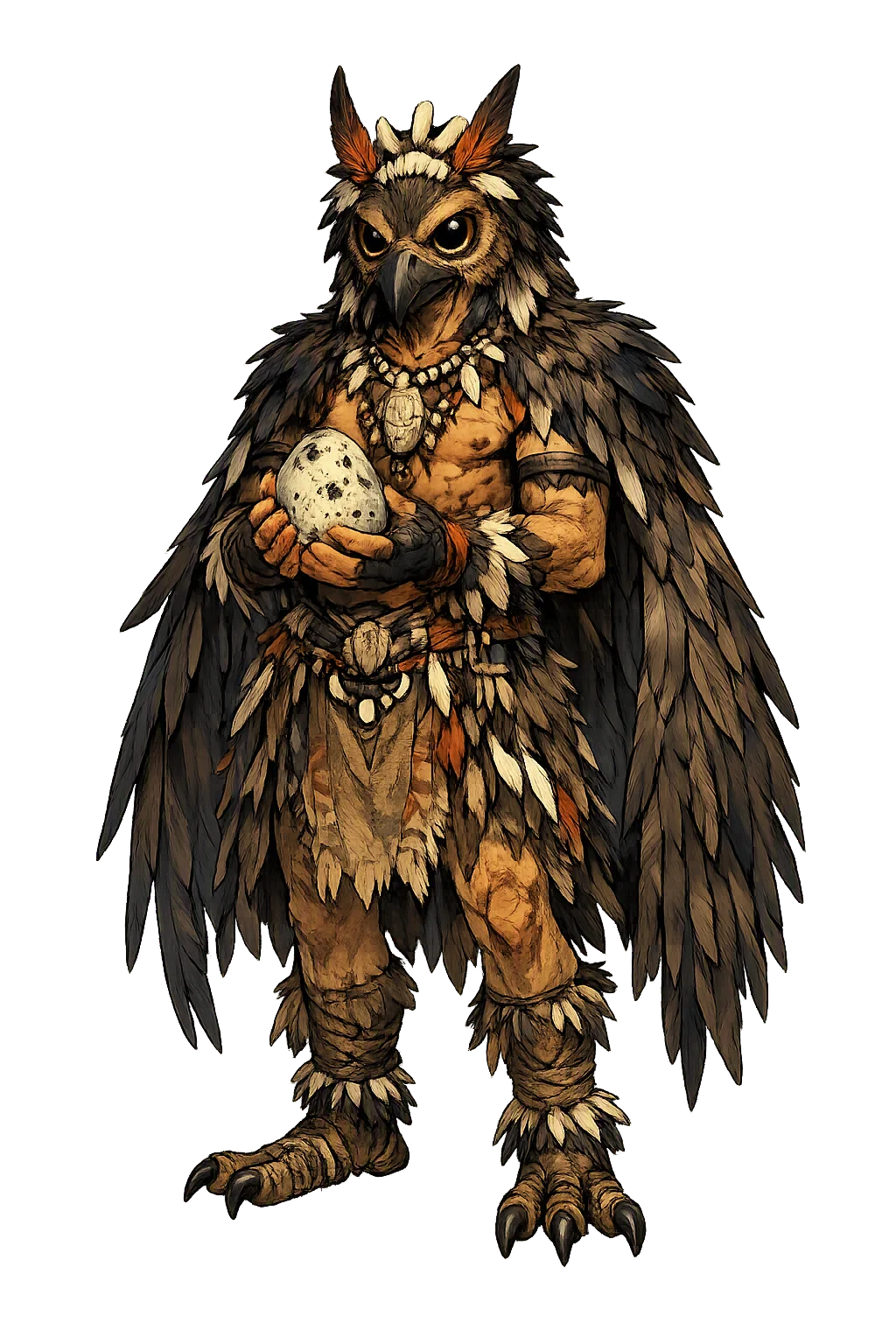
The god's face is carved in lava. The basalt slabs of Orongo carry more than a thousand petroglyphs — birdmen with human bodies and frigatebird heads, komari fertility signs, and above all the staring face of Makemake himself, the eyes hugely enlarged, set beside the very ground where the contest was judged. The islanders named these faces for the god to Métraux: an eyewitness report in stone. The colossal moai belong to a different corpus — images of deified ancestors, not of the creator — and the undeciphered rongorongo tablets probably carry his name in glyph form, though that remains unproven. Small wooden birdman statuettes collected in the nineteenth century preserve the human-bird hybrid in portable form. Georgia Lee's Rock Art of Easter Island (1992) catalogued some twelve hundred designs and showed the wide-eyed faces clustering exactly where the tangata manu ritual happened: the god carved as witness, whose whole function was to watch.

06

Reception & Transformation

The name after its own age — transmission, translation, survival

Afterlives

Makemake's transmission is a history of salvage. The catastrophe of the 1860s — slave raids, epidemics, mass baptism in 1868 — broke the chain of initiated knowledge within a decade; what remained was rescued by visitors. The missionary Eugène Eyraud recorded what he could in the 1860s, Alphonse Pinart collected oral material in 1877, and the serious work began with Katherine Routledge's Mana expedition of 1914–15, whose informants remembered the last contests, and with Alfred Métraux's fieldwork of 1934–35, published as the Ethnology of Easter Island (1940) — still the standard account. Twentieth-century archaeology gave the god back his ground: William Mulloy's restoration programme consolidated Orongo from the 1960s, and Jo Anne Van Tilburg and Georgia Lee mapped the wider sacred landscape. The scholarship Métraux founded anchors every modern account; a deity whom catastrophe reduced to a stone face now has, through ethnography and excavation, the best-documented cult of any Polynesian island.

Identifications Across Traditions

Makemake had no classical syncretism — there was no neighboring pantheon on the loneliest island in the world. His transformation came with catastrophe: after the Peruvian slave raids and epidemics of the 1860s, the survivors embraced Catholicism, and the creator god was absorbed into the image of the Christian God or quietly retired to the petroglyphs. Comparison with other Polynesian traditions remains the useful lens: Tahiti's Ta'aroa and the wide Tangaroa-complex of the eastern Pacific give the intellectual frame for understanding how a high creator-god sits above a crowd of specialist spirits and ancestor-deities. In the modern world the identification has run in reverse — the dwarf planet Makemake, named in 2008 after the Easter Island god, has carried the name of a Polynesian creator into every astronomy textbook, a rare case of a colonial-era suppressed deity colonizing the heavens.

Modern Legacy

The birdman's egg became the island's flag: the Tapati Rapa Nui festival, held each February, stages canoe races and dance competitions in which the old birdman legend is the centerpiece, and the winner's crown echoes the tangata manu's year of rule. Orongo, restored as a ceremonial village, anchors the UNESCO-listed Rapa Nui National Park. In 2008 the International Astronomical Union named the dwarf planet Makemake — one of the largest objects in the Kuiper belt — after the god, explicitly honoring Easter Island's cultural heritage. Meanwhile the Rapa Nui language, once nearly extinct, is taught again in island schools, and with it the old names return to living mouths. A tradition recorded from the last survivors of a catastrophe has become the founding charter of a cultural renaissance.

07

The Meditation

What Makemake means — beyond the dictionary

Makemake is the god of the watching face: on an island of 165 square kilometers, where every horizon ends in ocean, creation was a matter of sight — the god who sees, the god who knows. His cult turned that metaphysics into sport: each year the whole society wagered its fertility on who could first see, and bring back, a single egg. The birdman contest is among the most beautiful institutions in the ethnographic record — an election without ballots, a kingship without war, legitimacy conferred by a seabird's arithmetic. And the lesson of the silence matters as much as the contest: traditions recorded from the last elders, like the chants Métraux wrote down in 1934, are not museum pieces but threads — cut, they take whole cosmologies with them. Makemake's staring eyes at Orongo are a reminder that being watched is the oldest form of being known.

08

Frequently Asked Questions

Common questions about Makemake, Creator, Fertility, Bird-Man, and Unicode restoration

01How do you pronounce Makemake?

In reconstructed pronunciation, Makemake is /makemake/ — approximately Say 'makemake' with the stress and length implied by the scholarly restoration 'Makemake'.

02What does Makemake mean?

Makemake means To see, to know in the polynesian tradition.

03What are the symbols of Makemake?

Makemake is associated with The sooty tern's egg (The unbroken egg carried from Motu Nui by the swimmer: Makemake's annual sign, the seed of the birdman's year of sacred rule.), The wide-eyed face (Makemake's carved visage at Orongo, eyes hugely enlarged: the god as watcher — seeing and knowing everything that happens below, the lexicon's gloss made stone.), Frigatebird (manu) (The great sea-bird of the contest islets; manu, 'bird', is the root of tangata manu, the birdman himself, and of the god's lordship over the flocks.), Rano Kau crater (The great volcanic bowl above Orongo whose rim is the ceremonial stage of the birdman cult — the island's sacred theater, open to the sea.), Aku aku (The guardian spirits of the caves in the recorded lore — attendants of Makemake's hidden realm, keepers of what the island buried.).

04Why restore Makemake in Unicode?

Makemake is written entirely in ASCII letters, so its restoration is about canonical fidelity rather than recovered diacritics: the temple fixes the name in its scholarly standard spelling, attested in the source tradition, instead of leaving it to drift.

05What is the most important myth about Makemake?

“The Creator in the Chants” — the Creation story that anchors the mythology of Makemake, told in full on the lore page.

09

Scholarly Sources

The philological foundations of this restoration

Every claim on this page is grounded in established scholarship. The orthographic restorations follow disciplinary convention. The etymological chain follows the best available reference works. This is not invention — it is resurrection through scholarship.

◈

Lexicography & Philology

  • Métraux
  • Fedorova
◎

Primary Texts

  • Primary sources in the polynesian tradition for Makemake.
◉

Archaeology & Art History

  • Van Tilburg, Easter Island: Archaeology, Ecology and Culture (1994)
✦

Religious Studies

  • Métraux, Ethnology of Easter Island (1940)
  • Routledge, The Mystery of Easter Island (1919)
  • Englert, La tierra de Hotu Matu'a (1948)
  • Lee, The Rock Art of Easter Island (1992)
  • UNESCO World Heritage listing, Rapa Nui National Park (1995)
Return

The Surface Awaits

You have traced the name from its earliest attestation to its Unicode restoration. Now return to the myth. The story is where the name lives.

Back to Lore
Makemake mascot