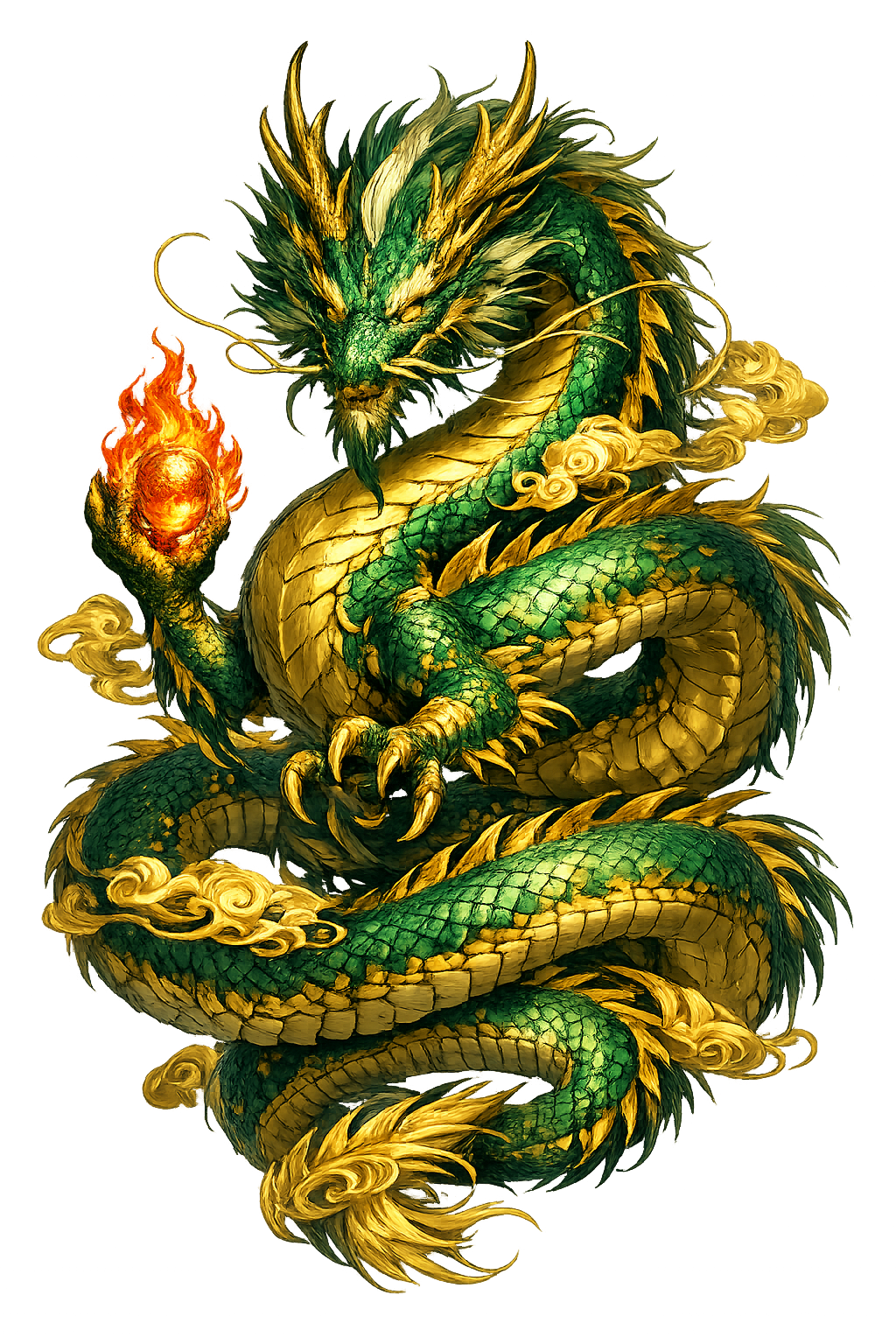
Stories of Lóng
Chinese dragon lore is less a single narrative than a vast ecology of stories — about weather, examinations, bureaucracy, and the sky itself. The lóng is not born but achieved: a fish that leaps, a rain that answers petition, a constellation that keeps the seasons. These four episodes map its four habitats: myth, folklore, religion, and the stars.
The oldest dragon of record is a war-machine of rain. When the Yellow Emperor faced the rebel Chiyou at Zhuolu — the battle that made Chinese kingship — Chiyou raised a fog so thick that day became night and the imperial armies lost their way. The compass-chariot answered the fog, and Yinglong, the winged dragon, answered Chiyou: 'Yinglong slew Chiyou, and afterwards slew Kuafu' (Shanhaijing, 'Great Wilderness: North'). The later poem asks the pointed question: 'How did Yinglong mark out the land? By what did the rivers come to run?' (Chuci, 'Heavenly Questions') — the dragon's body becoming geography, rivers traced by the coils of its tail. Yinglong's biography is the biography of Chinese statecraft in miniature: heaven sends rain, rain serves the throne, and the dragon is the treaty between them, sealed at the founding battle.
Every spring the carp of the Yellow River run upstream past the rapids called Longmen, 'Dragon Gate', the cleft the Great Yu was said to have cut through the mountain. Few survive the leap; those that do are transformed into dragons. The story is first recorded in the lost geography Sanqin ji (三秦記, 'Account of the Three Qin'), known through quotations in later encyclopedias such as the Taiping Yulan — and it gave Chinese its standard metaphor for examination success: lǐyú tiào lóngmén, 'the carp leaps the Dragon Gate'. For two thousand years the phrase carried the hopes of farming families: a boy who passed the jinshi examinations transformed his lineage as completely as a fish changes its element. The myth quietly defines the dragon itself — not a breed but a rank, an estate reached through effort, upstream, against the current, at the one gate in the world where water and heaven touch.
With Buddhism came the nāgas — serpent-kings of waters and treasure — and China answered with its own bureaucracy of the deep: the Four Dragon Kings who rule the seas at the four quarters and answer for rain. Their temples line the coasts and riverbanks; in drought, officials led processions to the Dragon King shrine to petition for clouds, and a temple that failed to deliver rain could be, in legend and occasionally in fact, punished. The best known of them, Ao Guang of the Eastern Sea, meets the reader twice in the Ming novels: in Investiture of the Gods the boy Nezha beats his third son and humiliates the king himself, forcing him to petition Heaven; in Journey to the West (ch. 3) the monkey Sun Wukong invades his palace and arms himself from the deep treasury. The Dragon Kings are the comic register of an ancient awe: the ocean as a court, complete with armies, ledgers, treasures — and a grievance procedure even the gods must answer.
Qīnglóng, the Azure Dragon, guards the eastern quarter of the sky — one of the Four Symbols that anchor Chinese cosmology, alongside the White Tiger of the West, the Vermilion Bird of the South, and the Dark Tortoise of the North. The Huainanzi, in its 'Treatise on Celestial Patterns', maps the correspondence system: east is wood, wood is spring, spring is the azure dragon, and the dragon's voice is the year's first thunder. Star atlases draw the beast across seven lunar mansions of the eastern horizon — from Horn to Tail — its sinuous body built from stars that Greek astronomy filed under Scorpius and Libra. Under this sign the Han emperors aligned gates and founded observatories; the Azure Dragon is where astronomy stops being foreign and becomes the calendar of sowing. When the first spring thunder sounds over the fields, the old texts say, the dragon has turned in its sleep — and the year has begun.
Imperial Power, Fertility, Cosmic Yang
Lóng is not the fire-breathing tyrant of Western fairy tales. The Chinese dragon is a composite being — antlers of a stag, head of a camel, eyes of a demon, neck of a snake, belly of a clam, scales of a carp, claws of an eagle, pads of a tiger — and yet it moves as a single fluid force. It is the spirit of water in all its forms: the river, the rain, the mist, and the storm. It is also the imperial emblem of absolute legitimacy, the yang counterweight to the phoenix's yin, and the power that makes the fields fertile.
Wherever Chinese civilization spread, the dragon went with it: carved on jade, coiled around columns, embroidered on silk, and raised above temples as a promise that heaven still listened.
Dragons command rivers, lakes, clouds, and rain; drought is read as the dragon's withdrawal, flood as its untimely arrival.
The five-clawed dragon was reserved for the Son of Heaven; to usurp it was treason, to bear it legitimately was the mandate of heaven.
The dragon chasing a flaming pearl symbolizes the pursuit of enlightenment, potency, and the luminous source of all things.
As the active, ascending, bright principle, the dragon pairs with the phoenix to model the complementary dynamism of the cosmos.
From the original script to the living URL
龍
The name in its original Chinese form. Lóng (龍) is attested in the source tradition — “Chinese dragon”. Its acute stress marks carry the full phonetic and orthographic weight of the source tradition.
long
Reduced to plain long, the name loses everything that made it specific: acute stress marks. What remains is an ASCII string that machines can parse but that no longer speaks with its original voice.
Lóng
The Unicode restoration recovers what ASCII flattened. Lóng restores acute stress marks, returning the name to its original written dignity. The domain encodes to Punycode, but the browser displays the truth.
Lóng.com → xn--lng-gna.com
The non-ASCII characters in Lóng are encoded while the ASCII remains visible. To the DNS, it is Punycode. To humanity, it is Lóng.
Owned, ideal, and ASCII forms of Lóng
Lóng
Restores 龍. The live temple domain — lóng.com.
long
Flattens 龍. The plain ASCII fallback — what DNS and legacy systems see.
How Lóng was spoken
How Lóng travels from ancient script to the modern URL
The character is both pictographic and phono-semantic; its phonetic component has been linked to words for 'dragon' across Sino-Tibetan.
Dragon, symbol of imperial power, rain, fertility, and yang energy.
Pinyin Lóng with acute is registrable; the tone mark is the single distinctive feature preserved in the Unicode restoration.
The lore you have read is the living myth. Extended Lore opens the scholarly vault beneath it: the cult and its material remains, a history of the image, the name after antiquity, a meditation on what the name still means, and the full scholarly apparatus — etymology, orthography, sources.
Enter Extended Lore