PuniCodex

Extended Lore

龍 Lóng

Etymology · Orthography · Cult · Iconography · Reception · Sources

Tier 1 Lóng.com
Lóng — Dragon
01

Quick Facts

Essential information about Lóng, Dragon

Original Script龍
Unicode RestorationLóng
Reconstructed Pronunciation/lʊŋ˧˥/
PantheonChinese
DomainDragon
MeaningChinese dragon
ClassificationTier 1
Primary DomainLóng.com
Sacred SymbolsDragon pearl, Antlers and horns, Carp scales, Clouds and waves, Five claws
02

Etymology & Word Family

From original script to Unicode restoration

Original Script 龍 Lóng — "Chinese dragon"
Unicode Restoration Lóng Restored stress, length, and script
Modern ASCII long Plain-ASCII fallback

The name Lóng carries the orthographic signature of the chinese tradition: 龍. Unicode restoration recovers what ASCII flattens.

03

Unicode Character Breakdown

Character-by-character philological analysis

CharacterUnicodeNameBlockPhonetic Role
LU+004CLatin Capital Letter LBasic LatinSame, capitalized
óU+00F3Latin Small Letter O with AcuteLatin-1 SupplementSecond tone
nU+006ELatin Small Letter NBasic LatinSame
gU+0067Latin Small Letter GBasic LatinSame

The Tier 1 classification reflects how much of the original phonology this restoration preserves — stress and vowel length for Greek names, distinctive letters and diacritics for every other tradition.

04

Cult & Worship

How the sacred was kept — rites, sanctuaries, remains

The Cult

The dragon was worshipped in China as the governor of water, and its cult was everywhere and nowhere — less a temple system than a standing assumption of the ritual calendar. Han ritual sent processions to the streams with clay dragons to summon rain, a liturgy the scholar Dong Zhongshu systematized and Wang Chong mocked; that agrarian rain-cult is the dragon's oldest altar. The throne absorbed the same power: the emperor alone wore the five-clawed dragon on his robes, and when the rains failed, the court answered with fasting and prayer, treating drought as a failure of royal virtue before heaven. At the village level the dragon lived in the spring rite called Lóngtái — the 'dragon raising its head,' on the second day of the second lunar month — when households woke it with the year's first haircut and kitchen-ash dragon-signs. Later temple practice routes most water-prayer to the Dragon Kings, who own the shrines; the dragon itself remains the cosmos those shrines address.

In the Earth

The earliest dragon image in China may be the C-shaped jade 'pig-dragon' of the Hongshan culture (c. 4700–2900 BCE) from Inner Mongolia and Liaoning; the Erlitou culture (c. 1900–1500 BCE) produced a turquoise-inlaid dragon plaque; Shang and Zhou bronzes coil dragon-derived taotie masks across their surfaces. Han dynasty tomb murals and stone reliefs show dragons pulling chariots, guarding ascents to immortality, and arching between earth and heaven. Textually the dragon is present from the oracle-bone inscriptions onward, already a royal and meteorological sign by the Western Zhou — three thousand years of continuous iconography for a creature that was never alive and never stopped acting.

05

Iconography

How Lóng was imaged across the ages

The Image

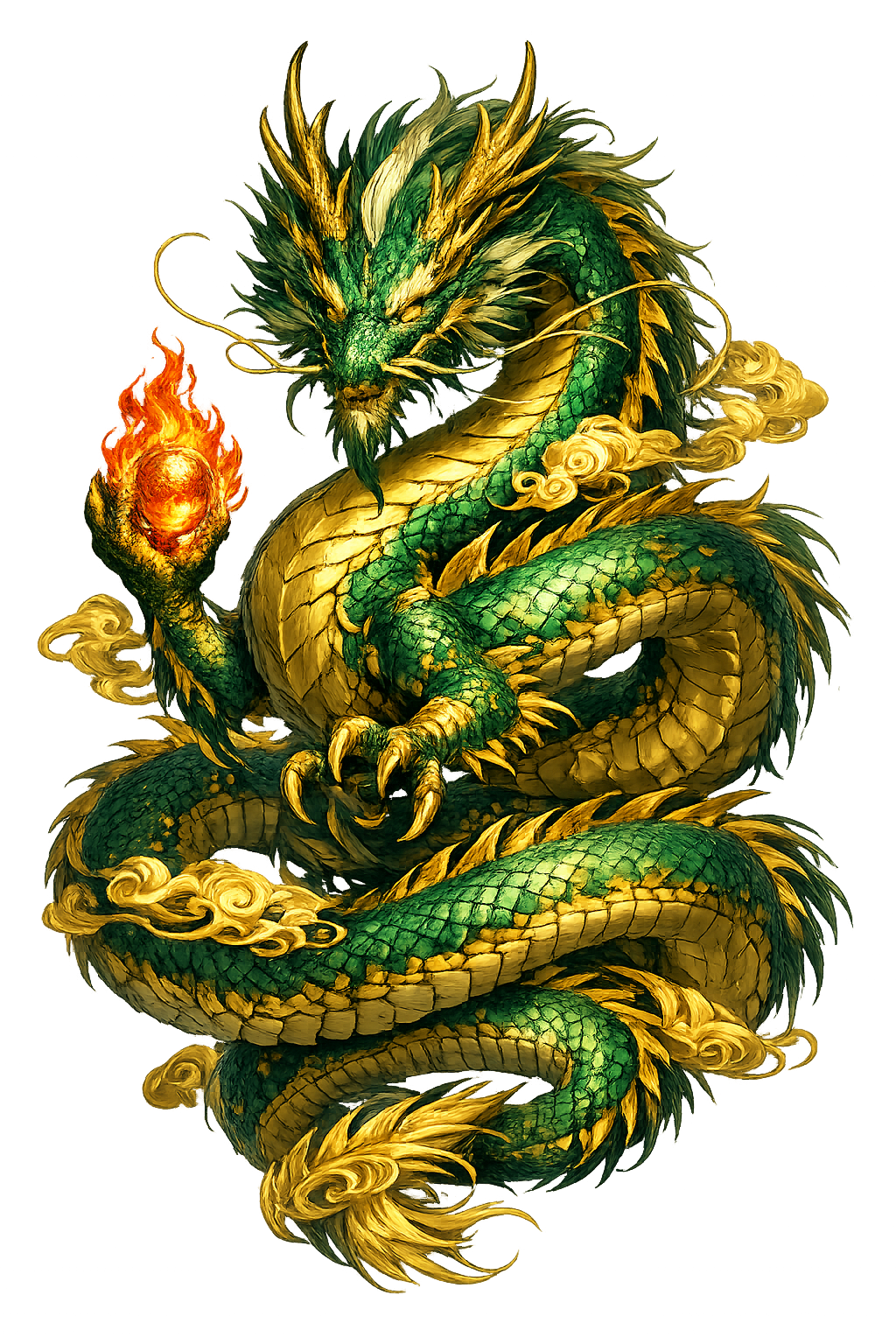
Learn the grammar of claws and you can date a Chinese dragon at fifty paces. The earliest images are already complete in conception: the Hongshan 'pig-dragon' of neolithic Inner Mongolia, a C-shaped jade with a boar's snout, and the Erlitou turquoise mosaic dragon, its long body laid out in inlaid plates — water's animal in embryo. Shang bronzes dissolved the body into the staring taotie mask; Han tomb art reassembled it as the escort of the dead and the guardian of the eastern sky. The canonical anatomy — camel's head, stag's antlers, snake's neck, carp's scales, eagle's claws — was codified only late, by Song antiquarians such as Luo Yuan in the Erya yi, and every painter after quoted it. Maturity froze the code into rank: five claws for the emperor, four for princes, three for high officers, so that the Ming and Qing dragons on robes and roof-ridges became legible as bureaucracy in scales. The type never evolved again — only its permits changed.

06

Reception & Transformation

The name after its own age — transmission, translation, survival

Afterlives

The dragon's transmission is the story of a translation that stuck. Jesuit missionaries in Ming China matched lóng to the Latin draco — a word Greek in origin, drákōn — and for four centuries the West has read a water-sovereign through the grammar of a fire-breathing hoarder. The image itself had traveled earlier and farther: along the Silk Road on Sogdian silver and Sasanian silk, where the coiling Chinese serpent tangled with the Iranian simurgh; into the Buddhist cave-temples, where the nāgas learned to wear the dragon's horns and crown. Chinoiserie made it furniture: Meissen porcelain, Chippendale fretwork, and the painted dragons of eighteenth-century European gardens all quote Ming originals at second hand. Scholarship slowly untied the knot. James Legge's nineteenth-century versions of the classics naturalized 'dragon' in English; twentieth-century archaeology recovered the deep sequence from Hongshan jade to Han mural; Jessica Rawson's studies of Chinese jade taught museum audiences to date the beast by its medium. The dragon the world calls Chinese is a palimpsest — neolithic jade under imperial lacquer under Jesuit Latin — and every layer is still legible.

Identifications Across Traditions

The Chinese dragon absorbed and influenced dragon imagery across East Asia. The Japanese ryū and tatsu, the Korean yong, and the Vietnamese rồng all descend from the same visual and cosmological root, though each culture adjusted claw count, temperament, and color symbolism. Indian nāgas — serpent deities of water and the underworld — entered China with Buddhism and were often depicted as dragon-like guardians, especially in rain-making ritual and at temple gates. The Western dragon is a distinct tradition: a hoarding, fire-breathing antagonist shaped by Near Eastern and medieval European warfare, only superficially related to the Chinese rain-bringing sovereign. Modern global culture often conflates the two, but they answer to different cosmologies — one guards gold in a cave, the other brings the rain that fills the rice bowl.

Modern Legacy

The dragon never left Chinese public life. The Qing imperial flag was a five-clawed dragon on a yellow field; the Republic and early People's Republic used dragon motifs on currency, stamps, and regalia. Today the dragon dance winds through Lunar New Year streets worldwide, and the Year of the Dragon is the most auspicious sign in the zodiac. In feng shui, dragon imagery channels qi; in martial arts, styles such as Dragon Shape imitate its coiling power; in language, lóng compounds mark excellence — lóngfèng (dragon and phoenix) for harmonious marriage, wàngzǐlóng for the hope of sons. The dragon has also become a contested nationalist symbol — claimed by state propaganda, diaspora communities, and pop culture alike as the badge of Chinese identity and ancestral continuity. Restoring Lóng with its tone mark returns the rise in pitch that the character 龍 has carried for three thousand years.

07

The Meditation

What Lóng means — beyond the dictionary

The Chinese dragon teaches that power need not be hard. It is water made conscious: yielding enough to flow around any obstacle, forceful enough to wear down mountains. Unlike the Western dragon guarding a static hoard, the Chinese dragon is process — rain becoming river, river becoming mist, mist returning to cloud. It is a reminder that sovereignty in the Chinese imagination is less about domination than about maintaining the dynamic balance that lets life flourish.

To name a domain Lóng is therefore to claim something older than empire: the claim that the cosmos itself pulses with living, transformative energy. The dragon does not ask to be worshipped from a distance; it asks to be recognized in the rain on the field, the mist on the mountain, and the long coiling body of a river moving toward the sea — power that arrives, feeds everything it touches, and leaves.

08

Frequently Asked Questions

Common questions about Lóng, Dragon, and Unicode restoration

01How do you pronounce Lóng?

In reconstructed pronunciation, Lóng is /lʊŋ˧˥/ — approximately LUHNG — the 'o' is like the 'oo' in 'book', and the tone rises from mid to high, as in a questioning intonation.

02What does Lóng mean?

Lóng means Chinese dragon in the chinese tradition.

03What are the symbols of Lóng?

Lóng is associated with Dragon pearl (Wisdom, spiritual energy, and the moon or sun the dragon protects), Antlers and horns (Vitality, longevity, and the stag-like generative power of nature), Carp scales (Transformation — the carp that leaps the Dragon Gate becomes a dragon), Clouds and waves (The dragon's medium; it does not fly through air but swims through mist and rain), Five claws (Imperial supremacy; fewer claws marked nobility or vassal states).

04Why restore Lóng in Unicode?

Plain ASCII long strips the stress, length, and script that make the name specific. Unicode restoration returns the name to its original written dignity.

05What is the most important myth about Lóng?

“Yinglong, the Winged Dragon” — the Shanhaijing story that anchors the mythology of Lóng, told in full on the lore page.

09

Scholarly Sources

The philological foundations of this restoration

Every claim on this page is grounded in established scholarship. The orthographic restorations follow disciplinary convention. The etymological chain follows the best available reference works. This is not invention — it is resurrection through scholarship.

◈

Lexicography & Philology

  • Chinese folklore
  • Chinese classics
◎

Primary Texts

  • Primary sources in the chinese tradition for Lóng.
◉

Archaeology & Art History

  • Material evidence — iconography, inscriptions, and temple archaeology — for Lóng and related cults.
✦

Religious Studies

  • Shanhaijing (Classic of Mountains and Seas), 'Great Wilderness: North' — Yinglong (ctext.org/shan-hai-jing)
  • Chuci, 'Heavenly Questions' (Tianwen) — the questions on Yinglong and the rivers
  • Huainanzi, 'Treatise on Celestial Patterns' (Tianwen xun) — the Four Symbols
  • Sanqin ji (三秦記, lost), preserved in leishu quotations such as Taiping Yulan — the carp at Dragon Gate
  • Wu Cheng'en, Journey to the West, ch. 3; Fengshen yanyi (Nezha cycle) — Ao Guang
  • Eberhard, Wolfram, A Dictionary of Chinese Symbols (1986)
Return

The Surface Awaits

You have traced the name from its earliest attestation to its Unicode restoration. Now return to the myth. The story is where the name lives.

Back to Lore
Lóng mascot