Stories of Lahmu
Lahmu is not a protagonist of long narrative cycles; his power is concentrated at origins and thresholds. He appears at the very beginning of the Babylonian cosmos, and he endures at the edges of the ordered world as a guardian.
The Enuma Elish opens with Apsû, the freshwater abyss, and Tiāmat, the salt sea: 'when sweet and bitter mingled together, no reed was plaited, no rushes muddied the water' (Enuma Elish, Tablet I, lines 1–20). From the mingled waters the gods were born in pairs — first Lahmu and Lahamu, then Anshar and Kishar, then Anu, and finally Ea, the line that ends in Marduk. Lahmu is therefore the first divine body to emerge from chaos, the earliest shape the cosmos takes after the waters meet. The interpretive claim of the genealogy is deliberate: the gods do not precede the deep — they arise out of it, in twos, and the very first of them is already a threshold-being, standing where the two waters become one.
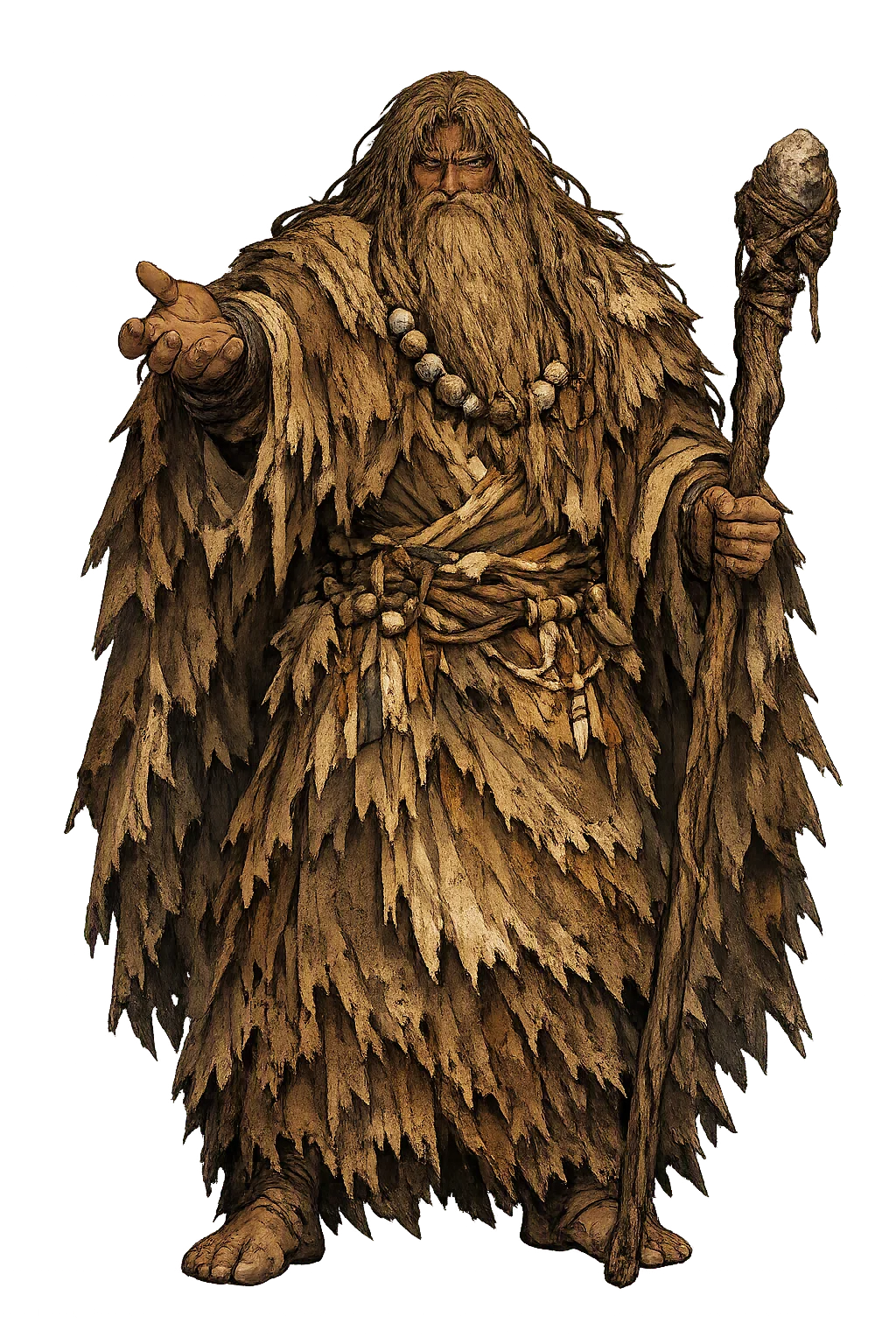
In ritual texts and iconography Lahmu is a protective demon stationed at doorways. His shaggy body and beard were believed to frighten away evil. Clay figurines and glazed reliefs show him as a muscular, bearded male with curled hair, often flanking an entrance; ritual texts prescribe the burial of such figures beneath thresholds and beside door sockets, so that the passage between street and sanctuary is permanently guarded (Wiggermann, Mesopotamian Protective Spirits). To pass his gate was to move from dangerous outside into protected inside. The choice of a hairy body is practical magic: in Mesopotamian thought the monstrous face the demon turns toward the world of demons is the very thing that keeps them at bay — the guard must be as frightening as what he guards against.
Lahmu is recognizable in Mesopotamian art by his long beard arranged in six or seven rounded curls, a naked or lightly clad hairy body, and an aggressive stance. He sometimes grasps a weapon or a gatepost, and on glazed brick reliefs from palace façades he stands in profile between real and painted doors, so that the image itself performs the warding. These attributes made him instantly readable as an apotropaic figure: the hair that named him became the visual sign of his power. The standardized curls are the mark of an established craft tradition — the guardian's face was drawn, moulded, and glazed by workshops who knew exactly which god they were posting at the king's door, even when no caption named him.
Lahmu is paired with Lahamu, a feminine counterpart whose name shares the same root. In the Enuma Elish the pair is born together from the mingled waters, before Anshar and Kishar, and they grow up to bear the next generation; in ritual art they appear as matching figures on either side of a door, male and female aspects of a single protective function. The pairing is not decorative but structural: the threshold is the most charged line in the Mesopotamian house, and a line needs two sides. Where one guardian would personify defence, the twin pair personifies completeness — the whole doorway, both jambs, both directions of passage. It is the oldest architectural theology in the world: the door as a place, and the place as a couple.
Primordial Protector · Gatekeeper · Silt and Threshold
Lahmu is the Mesopotamian primordial being whose name simply means 'the hairy one'. In the Enuma Elish he is the firstborn of Apsû and Tiāmat, the earliest divine generation before sky and earth were fixed; beyond cosmogony he is a protective spirit, the bearded, hair-covered guardian posted at doorways and thresholds to turn aside demons and pollution — the border between chaos and order made flesh.
First child of Apsû and Tiāmat; the divine line that leads to Anshar, Kishar, Anu, and Ea begins with him.
In ritual and iconography Lahmu protects temple and palace doorways, the hairy sentinel at the threshold.
His name and form declare the power of hair: the beard, the mane, the shaggy pelt that marks the apotropaic demon.
Lahmu and Lahamu appear together as a twin protective pair, male and female guardians of the entrance.
From the original script to the living URL
𒀭𒌓𒈬
The name in its original Mesopotamian form. Lahmu (𒀭𒌓𒈬) is attested in the source tradition — “The hairy one”. Its original diacritics and script distinctions carry the full phonetic and orthographic weight of the source tradition.
lahmu
The plain lahmu form is identical to the Unicode restoration. Because this name is already written in Latin letters, no diacritics, stress, or script information were lost — only capitalization differs.
Lahmu
The Unicode restoration does not need to recover lost marks for Lahmu. Its value is canonical spelling and consistent cataloguing, not the reconstruction of erased orthography. The domain is readable as-is to both DNS and humanity.
Lahmu.com
This restoration is written entirely in ASCII letters — no Punycode encoding stands between Lahmu and the DNS. The domain reads identically to machines and to human eyes.
Owned, ideal, and ASCII forms of Lahmu
Lahmu
Restores 𒀭𒌓𒈬. The full Unicode restoration. lahmu.com is not in the PuniCodex collection — it is watched for release; if it drops, this temple upgrades to an owned flagship.
How Lahmu was spoken
How Lahmu travels from ancient script to the modern URL
The lore you have read is the living myth. Extended Lore opens the scholarly vault beneath it: the cult and its material remains, a history of the image, the name after antiquity, a meditation on what the name still means, and the full scholarly apparatus — etymology, orthography, sources.
Enter Extended Lore