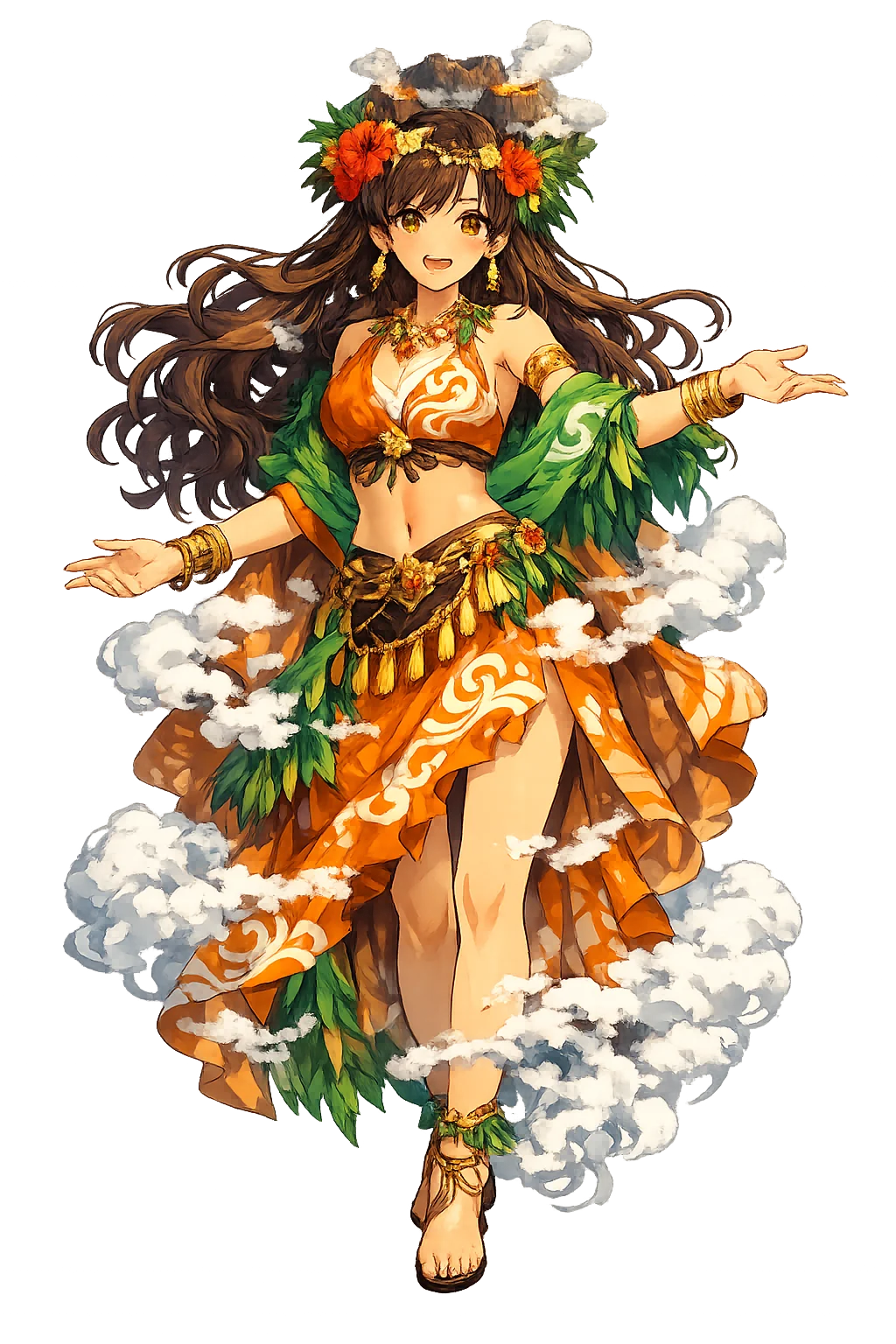
Stories of Kyūshū
Kyūshū claims the mythology of beginnings: the chronicles land the sun goddess's grandson on its peaks, send the first emperor out from its shores, and let its storms write themselves into the national soul.
The Kojiki and Nihon Shoki bring the heavenly grandson Ninigi down to earth on the peak of Takachiho — placed by tradition in Kyūshū's mountains — where he marries the blossom-princess Konohanasakuya-hime. She proves her divine conception by setting fire to the birthing hut and delivering three sons amid the flames; their line leads to Jimmu, the first emperor. The imperial charter myth is, geographically, a Kyūshū story. The shrine at Takachiho still marks the descent-spot, and the Ama-no-iwato cave in the gorge beside it — where the sun goddess Amaterasu once hid — anchors the whole island as the stage of the Age of the Gods. The myth means Japan's sacred geography begins not at the capital but at the gateway: the gods landed where the continent first appears.
The chronicles begin Japan's history on this island. Jimmu, the great-grandson of Ninigi, tired of ruling only the Hyūga coast and resolved on the eastern expedition to Yamato: 'the land to the east is fair... let us go to the land of the rising sun.' His first fleet was wrecked, his brother Itsuse died of a wound, and the way was cleared only after the vanishing sacrifice of the empress — but the divine crow Yatagarasu, three-legged, was sent to guide him, and after the mountain campaign against Nagasunehiko he founded the dynasty at Kashihara, in 660 BCE by the chronicles' reckoning. Myth means history here in the full sense: Japan's imperial charter is a Kyūshū story of leaving Kyūshū. The gateway completes its service by producing the one who crosses it.
Twice the Mongol-Chinese fleets of Kublai Khan reached Kyūshū — 1274 and 1281, the second numbering thousands of ships — and twice, after hard fighting on the Hakata beaches, typhoons destroyed the armadas. The shrines had prayed for deliverance, and the nation named the storm kamikaze, 'divine wind': weather as providence, and the coast of Hakata Bay as the sacrificial altar of the largest seaborne invasions the world had yet seen. Later tradition credited the prayers of Iwashimizu and Hakozaki shrines, and modern underwater archaeology at Takashima has raised the fleets' own testimony — anchor stones, ceramic bombs, and hulls preserved in Imari Bay. The myth means providence has a shoreline: the same straits that carried every gift from the continent also carried the storm that saved the island from it.
Francis Xavier landed at Kagoshima in 1549; within decades Kyūshū had a quarter-million Christians, daimyō baptized with their domains, and seminaries at Arima and Azuchi. Then came the turn: persecution, the crucifixions at Nagasaki, the Shimabara-Amakusa rising of 1637 — and 250 years of hidden Christians keeping Latin prayers in corrupted Japanese, baptizing in secret, venerating statues of Kannon as the Virgin. Their revelation in 1865, when farmers of Urakami knelt before a French priest at the Ōura Cathedral overlooking the harbor, stunned the mission world. The Ōura church still stands, and the villages of the Amakusa islands and the Nagasaki coast are UNESCO-listed as the 'Hidden Christian Sites in the Nagasaki Region.' The myth means the gateway keeps what it takes in even when the door is slammed: a faith survived two and a half centuries on this shore purely by being hidden in plain sight.
The Gateway, the Kamikaze, and the Christian Century
Kyūshū is Japan's front door: the island facing Korea and China across the narrowest straits, where the continent's rice, Buddhism, and iron first arrived — and where the Mongol fleets, the Portuguese traders, and the Jesuit fathers all made their landfall. The gateway of Japan has always stood open on this shore, even when the country tried to shut it.
The "divine wind" typhoons of 1274 and 1281 that shattered two Mongol invasion fleets off this coast.
The one window kept open in the closed country: two centuries of Dutch and Chinese trade through a single fan-shaped island.
Xavier's 1549 landing, a quarter-million converts, the Shimabara rising, and the hidden Christians' 250-year secret.
From the original script to the living URL
九州
The name in its original Japanese form. Kyūshū (九州) is attested in the source tradition — “'Nine provinces' (九州)”. Its macron-length vowels carry the full phonetic and orthographic weight of the source tradition.
kyushu
Reduced to plain kyushu, the name loses everything that made it specific: macron-length vowels. What remains is an ASCII string that machines can parse but that no longer speaks with its original voice.
Kyūshū
The Unicode restoration recovers what ASCII flattened. Kyūshū restores macron-length vowels, returning the name to its original written dignity. The domain encodes to Punycode, but the browser displays the truth.
Kyūshū.com → xn--kysh-w7ac.com
The non-ASCII characters in Kyūshū are encoded while the ASCII remains visible. To the DNS, it is Punycode. To humanity, it is Kyūshū.
Owned, ideal, and ASCII forms of Kyūshū
Kyūshū
Restores 九州. The live temple domain — kyūshū.com.
kyushu
Flattens 九州. The plain ASCII fallback — what DNS and legacy systems see.
How Kyūshū was spoken
How Kyūshū is preserved in writing
A bespoke provenance study for Kyūshū is being prepared by the PUNICODEX scholarly team.
Contribute scholarly provenance →The lore you have read is the living myth. Extended Lore opens the scholarly vault beneath it: the cult and its material remains, a history of the image, the name after antiquity, a meditation on what the name still means, and the full scholarly apparatus — etymology, orthography, sources.
Enter Extended Lore