The Living Myth
Strength, Power, Sovereignty · Personification of brute force
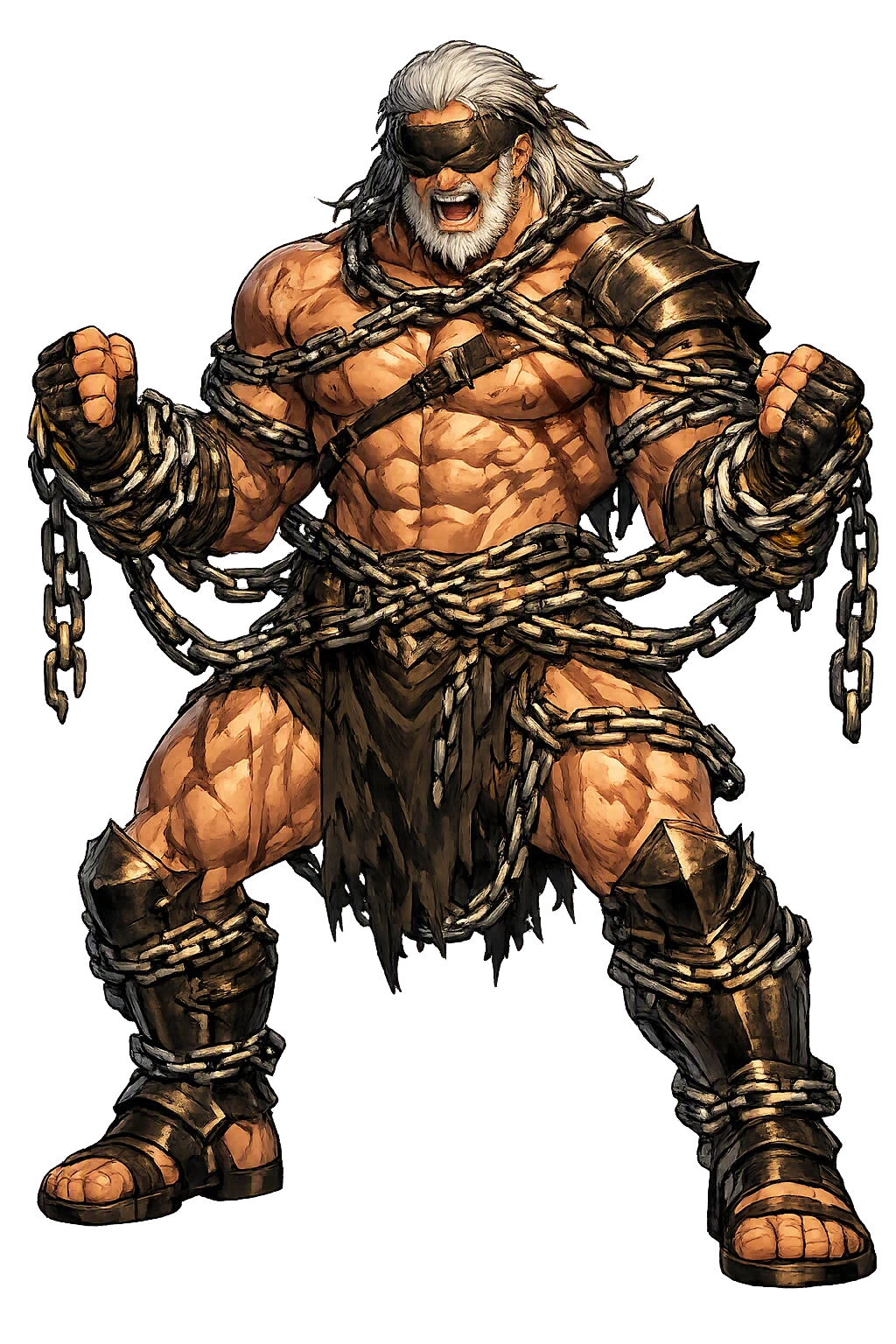
Stories of Krátos
Krátos has no independent mythology — no quests, no loves, no temples. His entire dossier is a genealogy, an oath, one terrible scene, and the trace of a word in epic: the binding of Prometheus, in which he is the speaking voice of power.
Hesiod gives Krátos his family in the Theogony (375–383): the river Styx, daughter of Ocean, bore to Pallas four children — Zelos (Rivalry), trim-ankled Níkē (Victory), Krátos (Might), and Bía (Force). They are not decorative attendants. When the Titanomachy broke out, Styx was the first of the gods to bring her children over to Zeus's side, and for that loyalty Zeus granted them a rare honor: they live with him forever, 'for he ordained that they should dwell with him always and have honor beyond the other gods' (Theogony 383–403). Hyginus (Fabulae, preface) repeats the list and calls them primos in omnibus — first among all. The myth explains something precise about Greek ideas of rule: victory, rivalry, might, and force are not Zeus's rivals but his household, bound to him by gratitude and oath.
Aeschylus stages Krátos in person. At the opening of Prometheus Bound, Might and Force — Krátos and Bía — drag the defiant Titan to a crag at the world's edge, and Krátos addresses the workman Hephaestus with the play's entire thesis: Zeus is new to power and ruthless; old loyalties count for nothing; 'there is no one free except Zeus' (Prometheus Bound 50–52). Hephaestus pities Prometheus and hesitates over the hammer; Krátos has no pity to hesitate with — he only checks that the work is done. Then he leaves the stage, his task complete, and never returns: force has nothing more to say once the chain is set. The drama built the West's first portrait of power as a functionary — efficient, unpersuadable, bored by the suffering it administers — and gave the abstraction a mask the audience could boo.
Krátos's mother is herself an institution. In the Theogony (775–806) Hesiod explains that when the gods must swear their most terrible oath, they swear by Styx: an Olympian pours her water, and any god who forswears lies breathless for a full year, then serves nine more years exiled from the divine company. Zeus granted her this honor precisely because her children had stood by him in the war — the oath of the gods is, literally, the reward of loyalty. So Krátos descends from the one power in the cosmos that even Zeus must respect: the pledge by which rule itself is guaranteed. The genealogy is a lesson in political theology — might and the binding oath are mother and son, because force that cannot be sworn to is only violence, and an oath that cannot be enforced is only a wish.
Homer never names a god Krátos, yet the word haunts his Zeus like a bodyguard. When the Father of Gods and Men challenges the whole pantheon, his boast is built on the noun itself: he claims an irresistible kratos and dares the gods to hang a golden rope from heaven and pull — 'you would not drag Zeus the high counselor from heaven to earth, however hard you strove' (Iliad 8.18–27). Later, when Hera calls his supremacy tyranny, she names exactly what she fears: a power without check or counsel (Iliad 8.478–483). The epic thus keeps two registers of the same word — the kratos that is Zeus's attribute and the Krátos who is Zeus's functionary, sovereignty in heaven and Might on stage. It is the ambiguity the Greeks lived with: the same strength that holds the cosmos up holds the Titan down.
Strength, Power, Sovereignty
Krátos is Strength enthroned beside Zeus: the personified might that executes the ruler of heaven's will. Son of Styx and Pallas, brother of Níkē, Bía, and Zelos, he dwells forever at the tyrant's right hand — and speaks Greek tragedy's bleakest doctrine: none is free but Zeus.
Executive force: the power that enacts a decree once Zeus has made it — the will of heaven with hands.
The Greek noun behind -cracy itself: dēmokratíā, aristokratíā, autokratíā — the word that built 'democracy.'
The restoration Krátos recovers the acute pitch accent that plain ASCII kratos flattens.
Attested in the original script as Κράτος — Hesiod's Theogony and Aeschylus' Prometheus Bound.
From the original script to the living URL
Κράτος
The name in its original Greek form. Krátos (Κράτος) is attested in the source tradition — “Strength, power”. Its acute accents carry the full phonetic and orthographic weight of the source tradition.
kratos
Reduced to plain kratos, the name loses everything that made it specific: acute accents. What remains is an ASCII string that machines can parse but that no longer speaks with its original voice.
Krátos
The Unicode restoration recovers what ASCII flattened. Krátos restores acute accents, returning the name to its original written dignity. The domain encodes to Punycode, but the browser displays the truth.
Krátos.com → xn--krtos-yqa.com
The non-ASCII characters in Krátos are encoded while the ASCII remains visible. To the DNS, it is Punycode. To humanity, it is Krátos.
Owned, ideal, and ASCII forms of Krátos
Krátos
Restores Κράτος. The live temple domain — krátos.com.
kratos
Flattens Κράτος. The plain ASCII fallback — what DNS and legacy systems see.
How Krátos was spoken
How Krátos is preserved in writing
A bespoke provenance study for Krátos is being prepared by the PUNICODEX scholarly team.
Contribute scholarly provenance →The lore you have read is the living myth. Extended Lore opens the scholarly vault beneath it: the cult and its material remains, a history of the image, the name after antiquity, a meditation on what the name still means, and the full scholarly apparatus — etymology, orthography, sources.
Enter Extended Lore