PuniCodex

Extended Lore

Κράτος Krátos

Etymology · Orthography · Cult · Iconography · Reception · Sources

Tier 2 Krátos.com
Krátos — Strength, Power, Sovereignty
01

Quick Facts

Essential information about Krátos, Strength, Power, Sovereignty

Original ScriptΚράτος
Unicode RestorationKrátos
Reconstructed Pronunciation/kratos/
PantheonGreek
DomainStrength, Power, Sovereignty
MeaningStrength, power
ClassificationTier 2
Primary DomainKrátos.com
Sacred SymbolsThe adamantine bonds, The Scythian crag, Styx, mother, The house of Zeus
02

Etymology & Word Family

From original script to Unicode restoration

Proto-indo-european *kret- to be strong
Original Script Κράτος Krátos — "Strength, power"
Unicode Restoration Krátos Restored stress, length, and script
Modern ASCII kratos Plain-ASCII fallback

Greek κράτος 'strength, power, might'; personified as one of the children of the Titan Pallas and Styx.

03

Unicode Character Breakdown

Character-by-character philological analysis

CharacterUnicodeNameBlockPhonetic Role
KU+004BLatin Capital Letter KBasic LatinKappa
rU+0072Latin Small Letter RBasic LatinRho
áU+00E1Latin Small Letter A with AcuteLatin-1 SupplementAcute on alpha
tU+0074Latin Small Letter TBasic LatinTau
oU+006FLatin Small Letter OBasic LatinOmicron
sU+0073Latin Small Letter SBasic LatinSigma

The Tier 2 classification reflects how much of the original phonology this restoration preserves — stress and vowel length for Greek names, distinctive letters and diacritics for every other tradition.

04

Cult & Worship

How the sacred was kept — rites, sanctuaries, remains

The Cult

No altar, festival, votive, or priesthood of Krátos is attested anywhere in the Greek world — the silence is itself the datum. Even his family barely escaped it: of Styx's children, only his sister Níkē received temples, while the oath-river herself was honored at a single Arcadian spring and a hill in Elis (Pausanias 8.17–18). The Greeks evidently preferred to worship victory rather than the executive force behind it.

In the Earth

No temple, image, or votive of Krátos is attested; his entire material record is textual. The binding of Prometheus was a favorite of Attic vase painters from the sixth century BCE — Hephaestus strapping the Titan to the crag, the Oceanids wringing their hands — but the painters show the smith, not Might; the pairing of Krátos and Bía belongs to Aeschylus' stage, and papyri of Prometheus Bound from Roman Egypt are the god's only 'sites.' Even his mother left barely a footprint: Styx was honored at a single Arcadian spring and a hill in Elis (Pausanias 8.17–18) — a fitting inheritance for the family of oaths: real, but rarely visited.

05

Iconography

How Krátos was imaged across the ages

The Image

Krátos left no image, but he was once brilliantly costumed. In Aeschylus' Prometheus Bound he is a stage personification — mask, boots, the costume of power — and the play's most famous piece of double-casting is textual: Might speaks, while his sister Force, Bía, stands silent through the entire scene. The vase painters of the age show the binding itself but paint Hephaistos doing the work, leaving Might off the crag; the pair of supervising figures is the playwright's invention, not the painter's. What iconography he has is therefore verbal: the adamantine chains checked link by link, the hammer, the cliff at the world's edge. Later art almost never pictured him — abstractions without cults rarely survive visually — and the Aeschylean tableau remains his likeness: two functionaries, one speaking and one not, over a chained Titan.

06

Reception & Transformation

The name after its own age — transmission, translation, survival

Afterlives

Krátos' afterlife is a study in transmission without a figure. The word is Homeric — Zeus' krátos, the supremacy none may resist — and Hesiod fixed the genealogy; Aeschylus then gave the abstraction its one indelible scene, though scholars have doubted the play's authorship since the nineteenth century and Prometheus Bound still carries an asterisk in most editions. The text survived the usual cliff-edge: Aeschylus descends from the tenth-century Laurentian codex, and the Byzantine school selection — which chose only seven of his plays — is why we have this one at all. Print carried it outward: the Aldine Aeschylus of 1518 put the Greek on European shelves, and Elizabeth Barrett's verse translation (1850) came in the play's great Romantic season, when Goethe and Shelley were reading Prometheus as the rebel and his jailers as the state. Nineteenth-century comparative philology added the final twist, setting Greek krátos beside Vedic Sanskrit kratú- — power, resolve — so that the personification without a temple received, at last, an Indo-European genealogy.

Identifications Across Traditions

Rome had no Krátos: the personification was too specifically Aeschylean to transplant, and no Latin cult of Vis or Potestas mirrors him. His afterlife is instead linguistic and theatrical. Through the suffix -kratia the word seeded the political vocabulary of the West — dēmokratíā, aristokratíā, autokratíā, bureaucratia: 'democracy,' 'aristocracy,' 'autocracy,' 'bureaucracy' are all his name doing new work. And in 2005 Sony's God of War borrowed the name for a Spartan anti-hero — a character who shares nothing with Hesiod's functionary beyond the word, which is itself the point. Strength recognizes no genealogy: wherever power is enthroned and chains are fastened without pity, the audience still supplies the name.

Modern Legacy

Krátos's cult was nonexistent, but his word built a civilization's self-description. Classical Athens put his name in its constitution — dēmokratíā, the kratos of the dēmos — the same word, with the master changed, that Aeschylus' Krátos had claimed exclusively for Zeus. Every modern -cracy, from democracy to bureaucracy, descends from a god no city ever worshipped. Prometheus Bound, meanwhile, has been read in every age as an anatomy of state violence — by the Romantic rebels, by the generation of Marx, by modern stages that costume Krátos in a uniform. The personification without a temple turned out to have the largest parish of all: everyone who has felt the chain tighten knows exactly who is speaking.

07

The Meditation

What Krátos means — beyond the dictionary

Krátos is the honest god. The Greeks gave altars to Victory, Rivalry, and even Rumor, but none to Might alone — because everyone already served it. His entire theology fits in one stage direction: he enters with the chains, supervises the fastening, checks the work, and leaves. Force, Aeschylus understood, has no second act; it does not argue, does not explain, does not stay to watch.

Yet the tradition keeps returning to him with unease, and that unease is the legacy. When Athens named its constitution dēmokratia — the kratos of the demos — it answered the tyrant's Krátos in his own vocabulary: same word, opposite master. Every generation since has rehearsed the argument. Is power legitimate when it calls itself the people? Is the chain just when the decree was voted? Krátos asks nothing and answers nothing; he stands at the cliff with the hammer, waiting to see who gives the order.

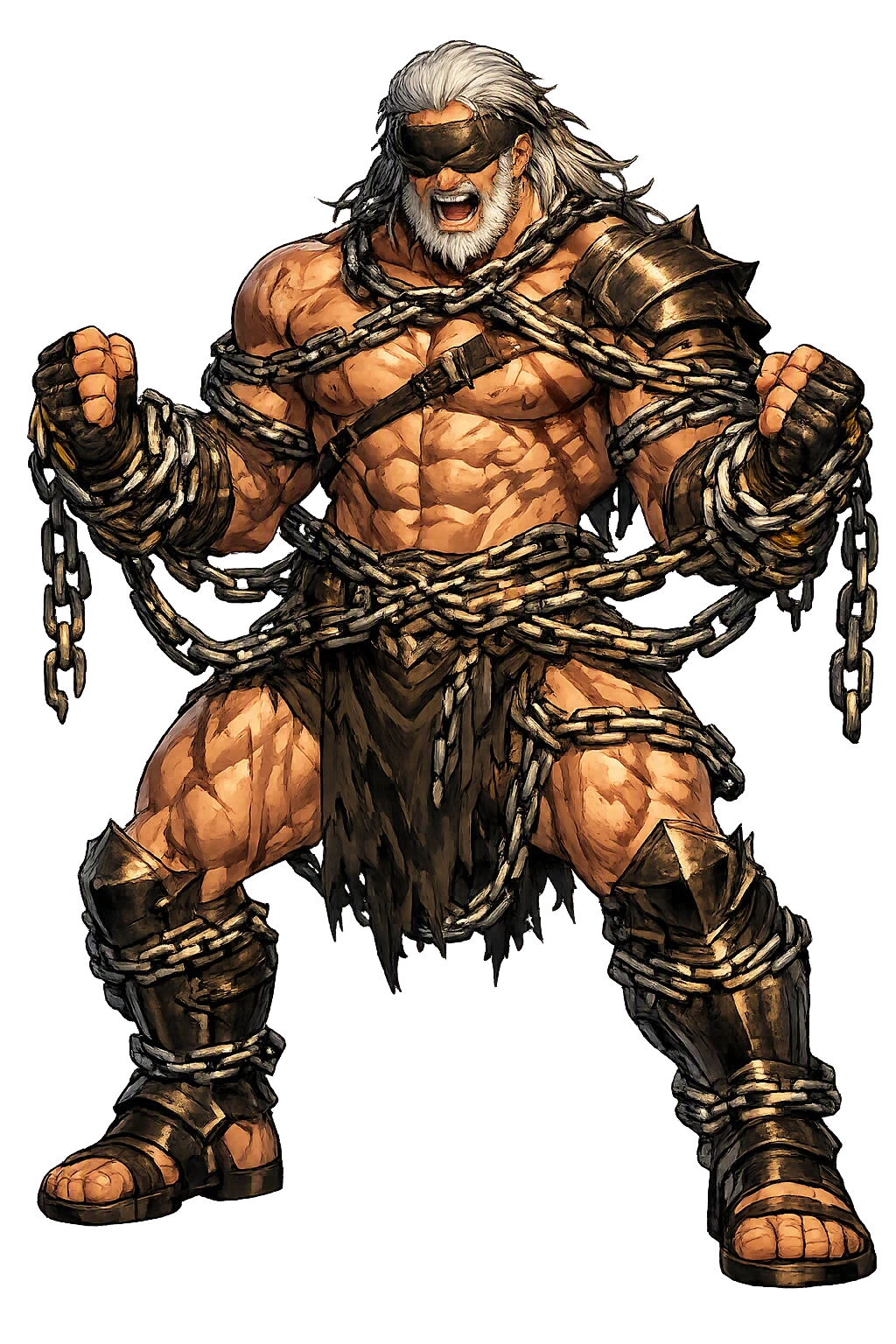
08

Frequently Asked Questions

Common questions about Krátos, Strength, Power, Sovereignty, and Unicode restoration

01How do you pronounce Krátos?

In reconstructed pronunciation, Krátos is /kratos/ — approximately 'KRATOS' — pronounce the restored form with attention to the preserved diacritics and length.

02What does Krátos mean?

Krátos means Strength, power in the greek tradition.

03What are the symbols of Krátos?

Krátos is associated with The adamantine bonds (The unbreakable chains Hephaestus forged in ignorance and Krátos fastens without pity (Prometheus Bound)), The Scythian crag (The remote cliff at the world's edge where Prometheus is nailed — the geography of force's work), Styx, mother (The underworld river whose oath binds the gods themselves — Krátos is born of the most terrible pledge), The house of Zeus (His only dwelling: the permanent right, granted after the Titanomachy, to sit forever beside the ruler of Olympus).

04Why restore Krátos in Unicode?

Plain ASCII kratos strips the stress, length, and script that make the name specific. Unicode restoration returns the name to its original written dignity.

05What is the most important myth about Krátos?

“The Children of Styx” — the Theogony 375–403 story that anchors the mythology of Krátos, told in full on the lore page.

09

Scholarly Sources

The philological foundations of this restoration

Every claim on this page is grounded in established scholarship. The orthographic restorations follow disciplinary convention. The etymological chain follows the best available reference works. This is not invention — it is resurrection through scholarship.

◈

Lexicography & Philology

  • Liddell, H. G., Scott, R., & Jones, H. S. A Greek-English Lexicon. Oxford: Clarendon Press, 9th ed. 1996.
◎

Primary Texts

  • Hesiod
  • Hesiod, Theogony 375–403 (genealogy and honor) and 775–806 (the oath of Styx)
  • Aeschylus, Prometheus Bound 1–87 (Krátos on stage)
  • Homer, Iliad 8.18–31 and 478–483 (the kratos of Zeus)
◉

Archaeology & Art History

  • Material evidence — iconography, inscriptions, and temple archaeology — for Krátos and related cults.
✦

Religious Studies

  • Hyginus, Fabulae, preface (children of Styx and Pallas, primos in omnibus)
  • LSJ, A Greek-English Lexicon, s.v. κράτος
  • Beekes, Etymological Dictionary of Greek, s.v. κράτος
Return

The Surface Awaits

You have traced the name from its earliest attestation to its Unicode restoration. Now return to the myth. The story is where the name lives.

Back to Lore
Krátos mascot