PuniCodex

Extended Lore

Kotoshironushi — The Deeper Record

Etymology · Orthography · Cult · Iconography · Reception · Sources

ASCII-equivalent form Kotoshironushi
Kotoshironushi — Oracles, Fishing
01

At a Glance

Kotoshironushi — every fact links to its home

PantheonJapanese
DomainOracles, Fishing
Original Script事代主神 →
Primary Sources5 cited →
02

Etymology & Word Family

From original script to canonical restoration — the full etymology page →

Original Script 事代主神 Kotoshironushi — "Lord who substitutes"
Canonical Restoration Kotoshironushi Canonical scholarly spelling — ASCII-identical
Modern ASCII kotoshironushi Plain-ASCII fallback

The name Kotoshironushi reaches the modern world through scholarly transliteration of the japanese tradition. Because the conventional spelling uses only Latin letters, its canonical and ASCII forms coincide — the tradition it carries is in the name itself, not in diacritics.

03

Character breakdown

Character-by-character philological analysis

CharacterUnicodeNameBlockPhonetic Role
KU+004BLatin Capital Letter KBasic LatinSame, capitalized
oU+006FLatin Small Letter OBasic LatinSame
tU+0074Latin Small Letter TBasic LatinSame
oU+006FLatin Small Letter OBasic LatinSame
sU+0073Latin Small Letter SBasic LatinSame
hU+0068Latin Small Letter HBasic LatinSame
iU+0069Latin Small Letter IBasic LatinSame
rU+0072Latin Small Letter RBasic LatinSame
oU+006FLatin Small Letter OBasic LatinSame
nU+006ELatin Small Letter NBasic LatinSame
uU+0075Latin Small Letter UBasic LatinSame
sU+0073Latin Small Letter SBasic LatinSame
hU+0068Latin Small Letter HBasic LatinSame
iU+0069Latin Small Letter IBasic LatinSame

This restoration reflects fidelity to the attested tradition, not recovered diacritics: every character of Kotoshironushi already survives in ASCII. What the restoration preserves is the canonical spelling itself — the form scholarship standardised.

04

Cult & Worship

How the sacred was kept — rites, sanctuaries, remains

The Cult

Kotoshironushi left almost no ancient cult footprint under his own name, and honesty must start there: his worship is known from the chronicles' mythology and from two shrines that later claimed him. At Ōmiwa in Nara prefecture — among Japan's oldest sanctuaries, where Mount Miwa itself is the god's body and no main hall intervenes — tradition associates him with the oracle kami Ōmononushi, through whom the mountain's will was delivered by divination; the identification is a scholarly hypothesis, but the site's antiquity is not in doubt. At Nishinomiya in Hyōgo his claim is total: the shrine is the head shrine of Ebisu, and every January the Tōka Ebisu festival fills its precincts for three days with merchants and fishermen buying lucky bamboo grass to welcome the god of the new year into shops and boats — a rite documented from the Edo period. What looks like revival is in fact continuity: the same two poles, oracle-mountain and market-god, have held his cult for a thousand years.

In the Earth

Ōmiwa Jinja in Sakurai, Nara prefecture — among the oldest shrine sites in Japan — faces Mount Miwa directly, the mountain itself revered as the shintai, the divine body of the god; no main hall stands between worshipper and peak. The site’s antiquity is supported by third-century Chinese chronicles, which attest the political prominence of the Yamato region’s great shrine cults, and by the dense concentration of kofun burial mounds in the Miwa area. At the other pole of his myth, Suwa in Nagano preserves the Takeminakata cult that the land-transfer story left behind. Nishinomiya Shrine’s Ebisu identification took its present form in the early modern period, but the shrine claims older precedent, and the Tōka Ebisu rite is documented from the Edo period onward.

05

Iconography

How Kotoshironushi was imaged across the ages

The Image

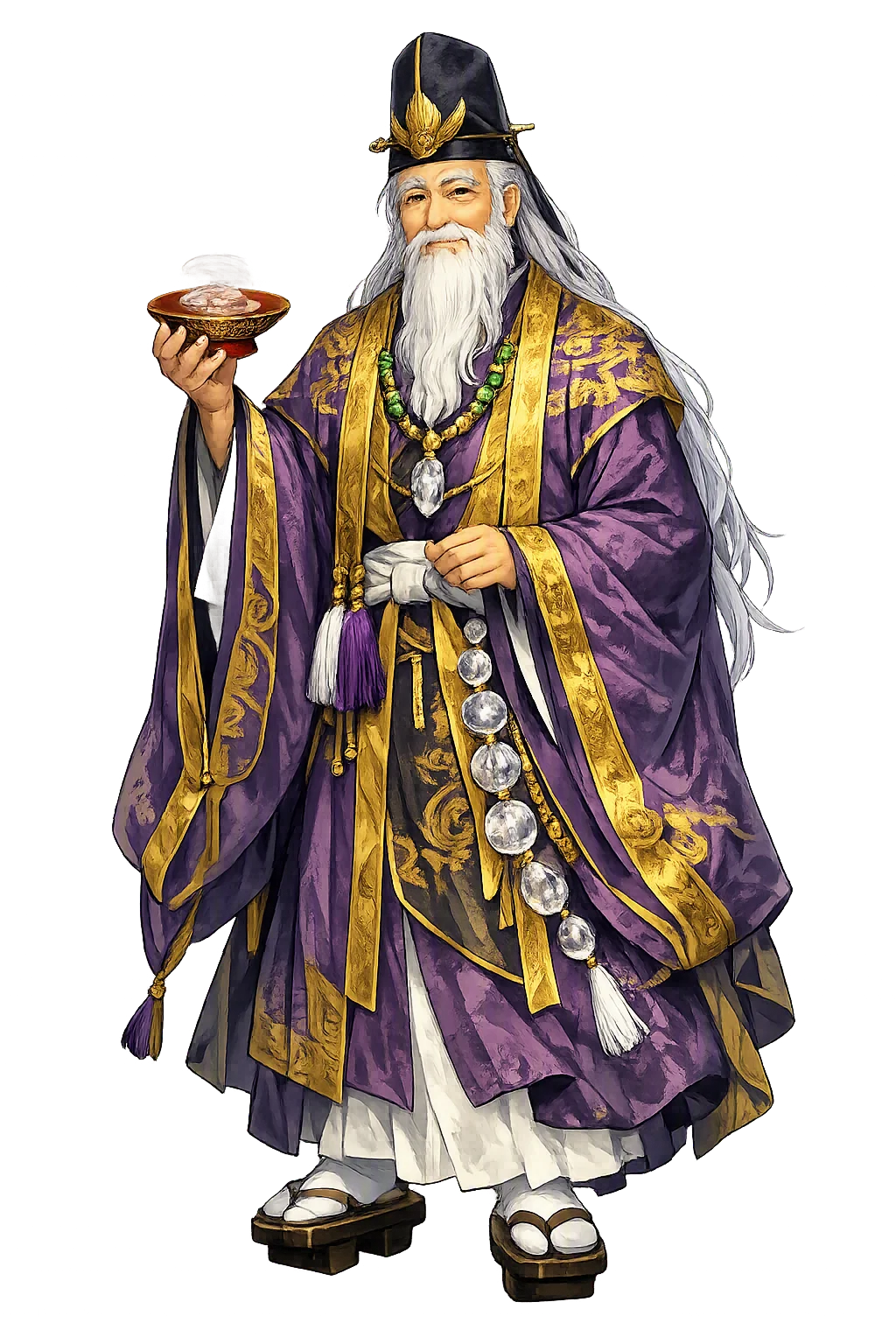
No image of Kotoshironushi survives from before the Middle Ages, and under his own name he barely has one at all: the oracle-lord of the chronicles is a voice without a body, and at Ōmiwa the god's 'image' is the mountain itself — a deliberate aniconism. His entire visual identity is Ebisu's, and it is among the friendliest in Japanese art: a smiling figure in a black court cap and hunting robe, fishing rod in hand and a great red sea bream tucked under the arm. The type belongs to the Seven Gods of Fortune, whose cult coalesced in the fifteenth and sixteenth centuries; from the Edo period onward he crowds treasure-ship screens, hanging scrolls, netsuke, votive tablets, and shop signs, usually beside Daikoku with his mallet. The icon froze early and never seriously varied — fortune should be instantly recognizable — and modern Nishinomiya simply reuses it: the festival's lucky bamboo grass and the god's printed face are the same image, carried home.

06

Reception & Transformation

The name after its own age — transmission, translation, survival

Afterlives

Kotoshironushi's journey runs from court chronicle to national ideology to comparative myth. The eighth-century compilers of the Kojiki and Nihon Shoki fixed his one great scene — the counsel that ceded the land — as a charter episode of imperial legitimacy, and there he slept for a thousand years while his name drifted into Ebisu. The early modern nativist scholars woke him: Motoori Norinaga's vast Kojiki-den and Hirata Atsutane's popularizing school taught Japan to read the chronicles as native revelation, and their land-transfer myth became a pillar of Meiji state theology after 1868. The West met him through translation — Basil Hall Chamberlain's Ko-ji-ki of 1882, then Aston's Nihongi — and twentieth-century historians in turn read his 'hiding' as a fossil of real negotiation between the Yamato court and the old shrine cults it absorbed. Few minor gods have been so completely explained by so many ages.

Identifications Across Traditions

Kotoshironushi is a nodal figure connecting the land-transfer myth, the oracle cults of Miwa, and the later Ebisu tradition. He represents the old order’s willing surrender and the sea’s continuing bounty, and his identification with Ebisu — ratified at Nishinomiya and celebrated across Japan at Tōka Ebisu — is one of the clearest cases of mythological condensation in Japanese folk religion. Within the Seven Gods of Fortune he keeps company with deities of Buddhist, Daoist, and Hindu origin, yet remains the only member with a purely native genealogy. Some scholars have further proposed identifying him with Ōmononushi, the serpent-kami of Miwa, which would bind the surrender myth directly to Japan’s oldest oracle shrine; the identification remains a hypothesis, but it shows how completely the hidden god was absorbed into the living cult.

Modern Legacy

Kotoshironushi is rarely worshipped under his own name today, but his legacy is everywhere in January: Ebisu, his smiling later form, presides over the first business of the year at shrines from Nishinomiya to Osaka’s Imamiya. The Tōka Ebisu festival draws millions of merchants and fishermen who buy lucky bamboo to invite prosperity into the new year. In the national myth, he is remembered as the son whose counsel spared the country a war of extermination — the voice of peaceful succession on which the imperial line’s legitimacy partly rests. And at Ōmiwa, before Mount Miwa, one of Japan’s oldest sanctuaries keeps the older stratum of his story: a god who hides, and speaks.

08

The Original Script Note

What the written record preserves — and what it does not

Original Script

事代主神 — 事 koto 'affairs, words' + 代 shiro 'substitute, proxy' + 主 nushi 'lord' — has been read since the medieval commentaries as 'the lord who serves as proxy for the divine word', a spelling chosen to explain his oracle function at Ōmiwa. It is a semantic, even exegetical, spelling rather than a phonetic one, and the Nihon Shoki's variants differ in detail. The characters argue for an office — speaking for the numinous — and the office, at Ōmiwa, is attested for well over a millennium.

09

The Meditation

What Kotoshironushi means — beyond the dictionary

Kotoshironushi is the theology of the graceful exit. Every tradition must answer the question his story poses: what becomes of the old order when the new one arrives? His answer — counsel surrender, then withdraw — let both worlds survive. There is a distinctly Japanese lesson in the shape of his career: power that argues with history loses, while power that serves as its voice endures. The oracle-god who speaks for the absent deity becomes, centuries later, the guest-god who blesses the shop: both are the same office, the sacred made negotiable. In an age that treats every ending as a failure, the Lord Who Substitutes reminds us that some of the most durable things in a culture are precisely the ones that stepped aside at the right moment.

10

Frequently Asked Questions

Deep-dives into the cult, attestation, reception, and sources of Kotoshironushi

01How do we know how Kotoshironushi was worshipped?

Ōmiwa Jinja in Sakurai, Nara prefecture — among the oldest shrine sites in Japan — faces Mount Miwa directly, the mountain itself revered as the shintai, the divine body of the god; no main hall stands between worshipper and peak. The full cult record →

02Where do the earliest attestations of Kotoshironushi come from?

The record rests on Kojiki — the land-transfer episode (Ōnamuchi, Takeminakata, and the counsel of Kotoshironushi), Nihon Shoki — the parallel account; the oracle age of Emperor Sujin, Philippi, Donald L., Kojiki (Princeton University Press, 1969), among 5 cited works. The full source apparatus →

03How did later traditions reinterpret Kotoshironushi?

Kotoshironushi's journey runs from court chronicle to national ideology to comparative myth. Reception & transformation →

04What do the surviving images of Kotoshironushi actually show?

No image of Kotoshironushi survives from before the Middle Ages, and under his own name he barely has one at all: the oracle-lord of the chronicles is a voice without a body, and at Ōmiwa the god's 'image' is the mountain itself — a deliberate aniconism. The iconography →

05What does the written record of Kotoshironushi actually preserve?

事代主神 — 事 koto 'affairs, words' + 代 shiro 'substitute, proxy' + 主 nushi 'lord' — has been read since the medieval commentaries as 'the lord who serves as proxy for the divine word', a spelling chosen to explain his oracle function at Ōmiwa. The Original Script note →

11

Scholarly Sources

The philological foundations of the record

Every claim on this page is grounded in established scholarship. The orthographic restorations follow disciplinary convention. The etymological chain follows the best available reference works. This is not invention — it is resurrection through scholarship.

◎

Primary Texts

  • Kojiki
  • Nihon Shoki
  • Kojiki — the land-transfer episode (Ōnamuchi, Takeminakata, and the counsel of Kotoshironushi)
  • Nihon Shoki — the parallel account; the oracle age of Emperor Sujin
  • Philippi, Donald L., Kojiki (Princeton University Press, 1969)
◉

Archaeology & Art History

  • Guth, C. Art of Edo Japan; Kidder, J. E. Early Japanese Art.
✦

Religious Studies

  • Aston, W. G., Nihongi: Chronicles of Japan from the Earliest Times to A.D. 697 (1896)
  • Shrine traditions of Ōmiwa Jinja (Nara) and Nishinomiya Jinja (Hyōgo)
Return

The Surface Awaits

You have traced the name from its earliest attestation to its canonical restoration. Now return to the myth. The story is where the name lives.

Back to Lore
Kotoshironushi mascot