Stories of Kannon
Kannon's mythology is drawn from Indian sūtras, Chinese legend, and Japanese temple tradition. Every layer restates one vow: to postpone buddhahood until every cry in the world has been heard.
Chapter 25 of the Lotus Sūtra, 'The Universal Gate of Avalokiteśvara Bodhisattva' — rendered into Chinese by Kumārajīva in 406 CE and chanted across East Asia ever since — promises that whoever calls the bodhisattva's name with a whole heart will be heard. Travelers threatened by fire, flood, yakṣas, executioners, demons, or fetters will find that 'he immediately observes the sound of their cries and frees them.' To those who seek deliverance, the chapter says, the bodhisattva appears accordingly — as a buddha, a warrior, a merchant, a child, even a goddess of wealth. The core miracle is not power but attention: the bodhisattva's defining act is to hear. In the Japanese reading of the name — Kannon, perceiver of sounds — the whole cult is compressed into a single verb.
The Kāraṇḍavyūha Sūtra gives the bodhisattva his most strenuous adventure. Avalokiteśvara descends into Avīci, the hell of unbroken torment, and the heat of the hells cools beneath him; he preaches to the hungry ghosts until their needle-throats open and nectar flows. From this same sūtra comes the six-syllable mantra oṃ maṇi padme hūṃ — 'the jewel in the lotus' — which the text exalts above all others. Tibetan religion built its most famous lay practice — the mani wheels and the carved mantra-walls — around these very syllables, and Japanese esoteric lineages embedded them in rites of their own. In Japan the sūtra's hell-rescue fused with local tales of the bodhisattva saving fishers and sailors, seeding the sea-Kannon of the coasts. Compassion here is not a sentiment but a journey downward: the bodhisattva does not wait for sufferers to climb but goes to the lowest place in the cosmos and stays until it changes temperature.
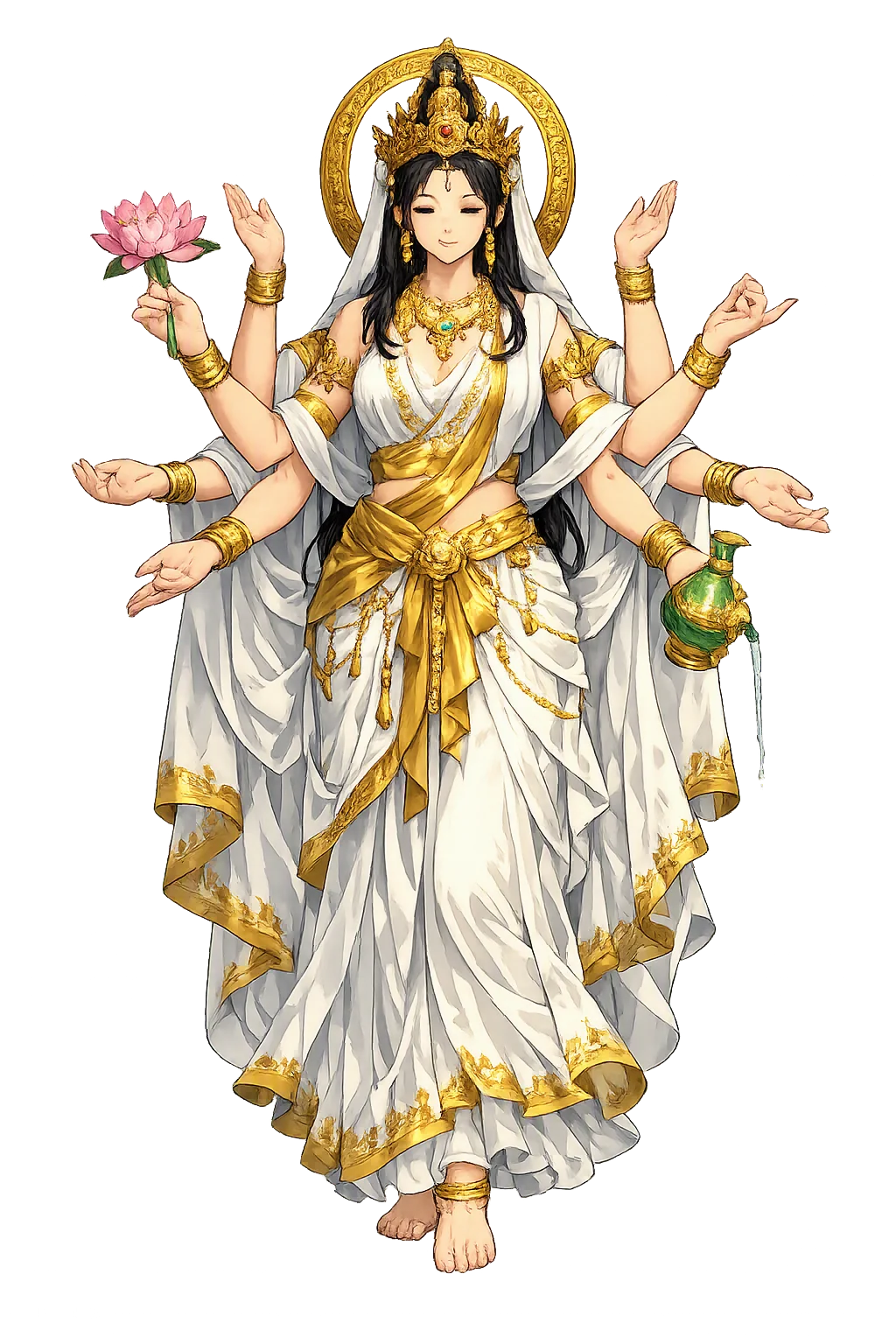
In medieval China the bodhisattva acquired a biography. A temple inscription of 1100 CE at Xiangshan records the legend of Miaoshan, a king's daughter who refused every suitor to follow the Buddha's path. Her father burned her convent and then ordered her beheaded; the executioner's blade would not cut her. Carried to hell, she turned it to paradise by a single teaching; restored to life, she retired to Fragrant Mountain. Years later the king fell mortally ill, needing the willing eyes and arms of one who bore no resentment — and the daughter without hands or eyes was revealed as his healer. When he recognized her, she received a thousand arms with an eye in each palm: the iconography of Senju Kannon born from a daughter's mutilation and a father's belated sight. The legend explains, with Chinese filial logic, how a male Indian bodhisattva became East Asia's goddess of mercy.
Japanese temple tradition dates itself to dreams. In 778 CE the monk Enchin, seeking a hermitage in the hills east of Kyōto, dreamed of a white-haired elder who pointed him to the Otowa waterfall, whose pure water would answer the prayers of the age. There he met the warlord Tamuramaro hunting deer; converted at the spring, Tamuramaro funded the temple, and Enchin enshrined the Kannon image he had carved. The temple took its name from the stream — Kiyomizu, 'pure water' — and its great veranda still hangs over the valley, a stage for twelve centuries of pilgrims drinking from the three channels. The story is late and pious, but it encodes something real about the cult: in Kannon's religion sanctity flows downhill like water, and the first convert is always the strong man with the bow.
Compassion, Mercy, and Salvation
Kannon is the Japanese form of Avalokiteśvara, the bodhisattva of infinite compassion. Kannon hears the cries of all beings and responds in whatever form is needed — male or female, one-faced or thousand-armed, gentle or wrathful — and anchors pilgrimage circuits from Kyōto's Kiyomizu-dera to the island sanctuaries of the coast.
Kannon's defining act is to hear; the name itself means 'perceiver of sounds.'
Senju Kannon wields a thousand arms, each with an eye, to save countless beings.
Juichimen Kannon surveys suffering from every direction at once.
Kannon temples anchor the Saikoku and Bandō pilgrimage circuits walked for a millennium.
From the original script to the living URL
観音
The name in its original Japanese form. Kannon (観音) is attested in the source tradition — “Perceiver of sounds”. Its original diacritics and script distinctions carry the full phonetic and orthographic weight of the source tradition.
kannon
The plain kannon form is identical to the Unicode restoration. Because this name is already written in Latin letters, no diacritics, stress, or script information were lost — only capitalization differs.
Kannon
The Unicode restoration does not need to recover lost marks for Kannon. Its value is canonical spelling and consistent cataloguing, not the reconstruction of erased orthography. The domain is readable as-is to both DNS and humanity.
Kannon.com
This restoration is written entirely in ASCII letters — no Punycode encoding stands between Kannon and the DNS. The domain reads identically to machines and to human eyes.
Owned, ideal, and ASCII forms of Kannon
Kannon
Restores 観音. The full Unicode restoration. kannon.com is not in the PuniCodex collection — it is watched for release; if it drops, this temple upgrades to an owned flagship.
How Kannon was spoken
How Kannon is preserved in writing
A bespoke provenance study for Kannon is being prepared by the PUNICODEX scholarly team.
Contribute scholarly provenance →The lore you have read is the living myth. Extended Lore opens the scholarly vault beneath it: the cult and its material remains, a history of the image, the name after antiquity, a meditation on what the name still means, and the full scholarly apparatus — etymology, orthography, sources.
Enter Extended Lore