PuniCodex

Extended Lore

観音 Kannon

Etymology · Orthography · Cult · Iconography · Reception · Sources

Tier 2 Kannon
Kannon — Compassion, Mercy
01

Quick Facts

Essential information about Kannon, Compassion, Mercy

Original Script観音
Unicode RestorationKannon
Reconstructed Pronunciation/kaɴ.noɴ/
PantheonJapanese
DomainCompassion, Mercy
MeaningPerceiver of sounds
ClassificationTier 2
Primary DomainKannon
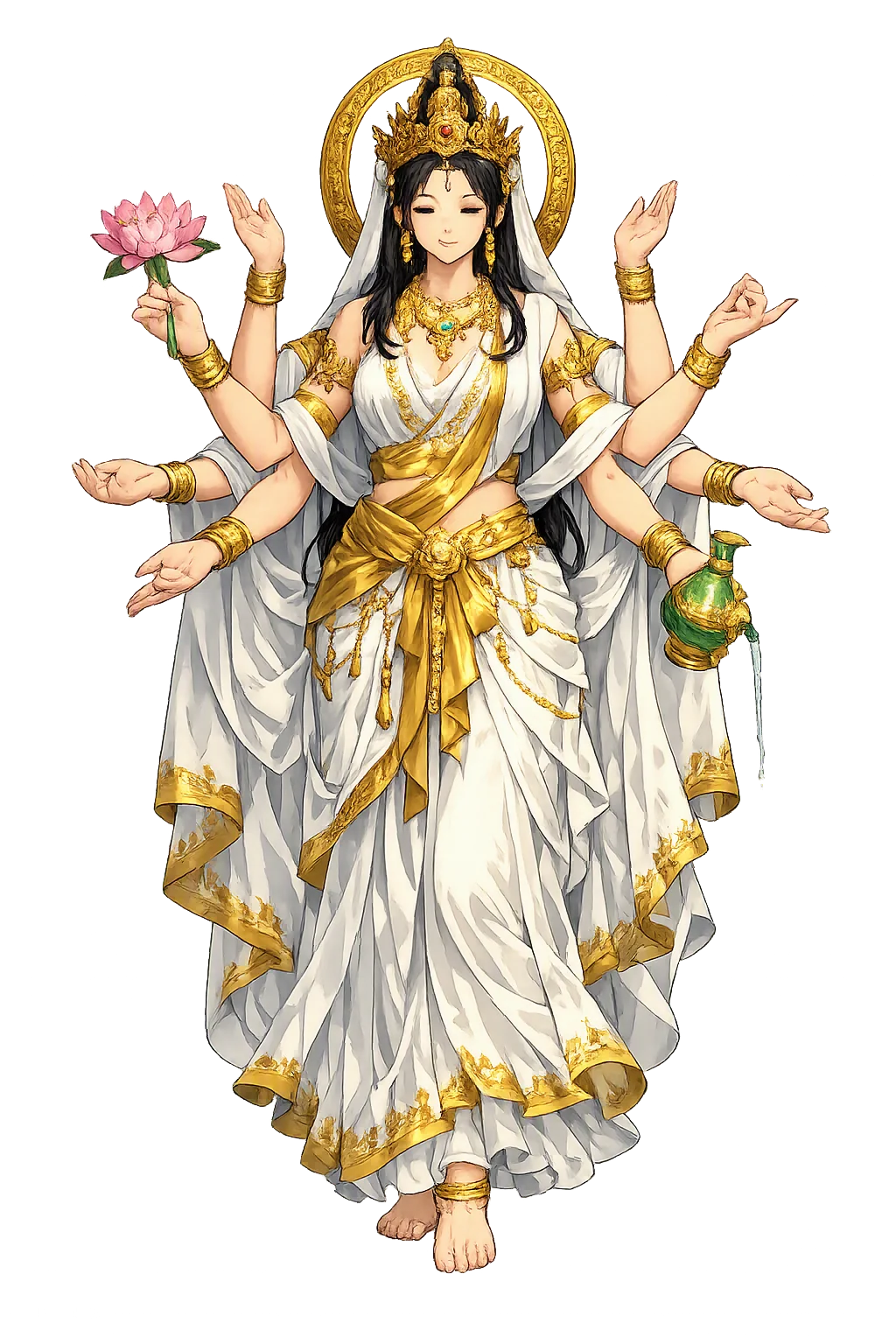
Sacred SymbolsLotus seat, Water vase, Willow branch, Thousand eyes, Amida in the crown
02

Etymology & Word Family

From original script to Unicode restoration

Original Script 観音 Kannon — "Perceiver of sounds"
Unicode Restoration Kannon Canonical scholarly spelling — ASCII-identical
Modern ASCII kannon Plain-ASCII fallback

The name Kannon reaches the modern world through scholarly transliteration of the japanese tradition. Because the conventional spelling uses only Latin letters, its Unicode and ASCII forms coincide — the tradition it carries is in the name itself, not in diacritics.

03

Unicode Character Breakdown

Character-by-character philological analysis

CharacterUnicodeNameBlockPhonetic Role
KU+004BLatin Capital Letter KBasic LatinSame, capitalized
aU+0061Latin Small Letter ABasic LatinSame
nU+006ELatin Small Letter NBasic LatinSame
oU+006FLatin Small Letter OBasic LatinSame
nU+006ELatin Small Letter NBasic LatinSame

The Tier 2 classification here reflects fidelity to the attested tradition, not recovered diacritics: every character of Kannon already survives in ASCII. What the restoration preserves is the canonical spelling itself — the form scholarship standardised.

04

Cult & Worship

How the sacred was kept — rites, sanctuaries, remains

The Cult

Kannon's cult is anchored in the recitation of the Lotus Sūtra's 'Universal Gate' chapter and the invocation of the Namu Kanzeon Bosatsu formula. Pilgrimage circuits — the Saikoku thirty-three, the Bandō thirty-three, and the Chūgoku thirty-three — bind hundreds of temples into a single devotional geography, with Kiyomizu-dera, Hase-dera, and Sanjūsangen-dō among the most visited. Esoteric schools use Kannon-in (Avalokiteśvara halls) and keep secret mandala rituals; the shamanic itako medium tradition of northern Japan also calls upon Kannon to commune with the dead. Modern pilgrims still travel these routes, and the deity's feast days structure the ritual year.

In the Earth

Kannon's material presence is among the richest in Japan. Sanjūsangen-dō (Rengeō-in, Kyōto) preserves 1,001 Kamakura-period Kannon statues arrayed around the central thousand-armed image, regilded after centuries of fire. Hase-dera in Kamakura guards its nine-meter gilded Kannon — by tradition carved in 721 and the temple's reason for being — while Kiyomizu-dera's 1633 stage structure, built without nails, still cantilevers over the Otowa valley. The Saikoku and Bandō circuits anchor dozens more temples with Heian and Kamakura images, votive tablets, and pilgrim registers, whose records let scholars trace the cult's expansion from aristocratic chapel to mass devotion.

05

Iconography

How Kannon was imaged across the ages

The Image

Kannon is the most prolifically imaged bodhisattva in East Asian art. The thousand-armed Senjū Kannon — each hand bearing an eye — dominates Sanjūsangen-dō's wooden regiments, while the eleven-headed Juichimen Kannon and horse-headed Bato Kannon appear in esoteric scrolls and temple iconographic compendia. The gracefully posed 'Pure Land' Kannon, often holding a lotus or water-vase, influenced Heian-period painting and sculpture. Tawaraya Sōtatsu's screens and countless smaller devotional prints fixed a canon of flowing robes and compassionate downward gaze that still governs popular depictions.

06

Reception & Transformation

The name after its own age — transmission, translation, survival

Afterlives

Kannon entered Japan as the Chinese-translation offspring of the Sanskrit Avalokiteśvara, a transmission routed through Kumārajīva's fifth-century Lotus Sūtra and deepened by Tang-dynasty esoterica. The deity was thoroughly domesticated: by the Heian period Kannon had absorbed native kami, female mediums, and mountain ascetic practice, becoming a bridge between Buddhist cosmology and local religion. The Miao-shan legend — a Chinese tale of a princess who mutilates herself to save her father — was translated into Japanese devotional narrative and helped feminize the bodhisattva's reception. In modernity, Kannon persists both as a living object of pilgrimage and as a global icon of Buddhist compassion, reproduced in museum displays, manga, film, and New Age spirituality, yet always looped back to the ancient temple networks.

Identifications Across Traditions

Kannon's absorptive power made the bodhisattva Japan's great religious bridge. Under honji-suijaku the deity was read as the compassionate trace of Amida or of Dainichi; kami of waterfalls, childbirth, and the sea attached themselves to Kannon temples, which often enshrine a Benzaiten or a local kami in the same precinct. Hidden Christians of the Edo period pressed the Virgin Mary into service as 'Maria Kannon,' carving statues with a covert cross. Zen lineages kept the Heart Sūtra's closing mantra — 'gone, gone, gone beyond, gone altogether beyond' — which tradition assigns to Avalokiteśvara's own insight at the apex of the Prajñāpāramitā. Few figures in world religion have worn so many faces so gracefully.

Modern Legacy

The thirty-three-temple Saikoku and Bandō pilgrimage circuits — walked by emperors, warlords, and modern retirees alike — bind Kannon temples into a devotional geography spanning the Kansai and Kantō regions. The 1,001 gilded Kannons of Sanjūsangen-dō in Kyōto, completed in the thirteenth century, remain one of the great spectacles of Buddhist art. After disasters — the 1923 earthquake, 1995, 2011 — Kannon halls became public rooms of mourning, and in manga and anime the thousand arms have become a visual shorthand for overwhelming, many-tasked compassion.

07

The Meditation

What Kannon means — beyond the dictionary

Kannon is the promise that no cry is unheard. The Lotus Sūtra's central claim is not that suffering ends but that attention is infinite: someone is listening, in every tongue, in every guise, immediately. In a century of hotlines, helplines, and emergency broadcasts, the bodhisattva's oldest technology — the heard cry — has not been improved.

Kannon also teaches a subtler lesson about identity. The vow to appear in whatever form saves means the helper is never fixed: the merciful one may arrive as a soldier, a bureaucrat, a fox, a wave. Compassion, properly understood, is protean — it wears the face you can bear to look at, and sometimes the face you cannot.

08

Screen & Culture

Where Kannon echoes through film, television, and games — and how

09

Frequently Asked Questions

Common questions about Kannon, Compassion, Mercy, and Unicode restoration

01How do you pronounce Kannon?

In reconstructed pronunciation, Kannon is /kaɴ.noɴ/ — approximately 'KAHN-nohn' — the first 'n' is a soft nasal; the final syllable closes gently.

02What does Kannon mean?

Kannon means Perceiver of sounds in the japanese tradition.

03What are the symbols of Kannon?

Kannon is associated with Lotus seat (Purity rising unstained from the mud of samsara; the throne of every Kannon image), Water vase (The vase of compassion, holding the healing waters poured over the afflicted), Willow branch (The sprinkler of the medicine-Kannon's rites, touching the sick with blessed water), Thousand eyes (The eyes set in Senju Kannon's thousand palms — hand and sight united, help that sees), Amida in the crown (The small image of Amida in the headdress, marking Kannon as attendant of the Buddha of the Western Paradise).

04Why restore Kannon in Unicode?

Kannon is written entirely in ASCII letters, so its restoration is about canonical fidelity rather than recovered diacritics: the temple fixes the name in its scholarly standard spelling, attested in the source tradition, instead of leaving it to drift.

05What is the most important myth about Kannon?

“The Universal Gate” — the The Vow story that anchors the mythology of Kannon, told in full on the lore page.

10

Scholarly Sources

The philological foundations of this restoration

Every claim on this page is grounded in established scholarship. The orthographic restorations follow disciplinary convention. The etymological chain follows the best available reference works. This is not invention — it is resurrection through scholarship.

◈

Lexicography & Philology

  • Lotus Sutra
  • Buddhist texts
◎

Primary Texts

◉

Archaeology & Art History

  • Material evidence — iconography, inscriptions, and temple archaeology — for Kannon and related cults.
✦

Religious Studies

  • Lotus Sūtra, chapter 25, 'Universal Gate' (Kumārajīva tr.)
  • Kāraṇḍavyūha Sūtra
  • Heart Sūtra
  • Xiangshan inscription (1100 CE), tr. in Dudbridge, The Legend of Miao-shan
  • Saikoku and Bandō pilgrimage records
Return

The Surface Awaits

You have traced the name from its earliest attestation to its Unicode restoration. Now return to the myth. The story is where the name lives.

Back to Lore
Kannon mascot