
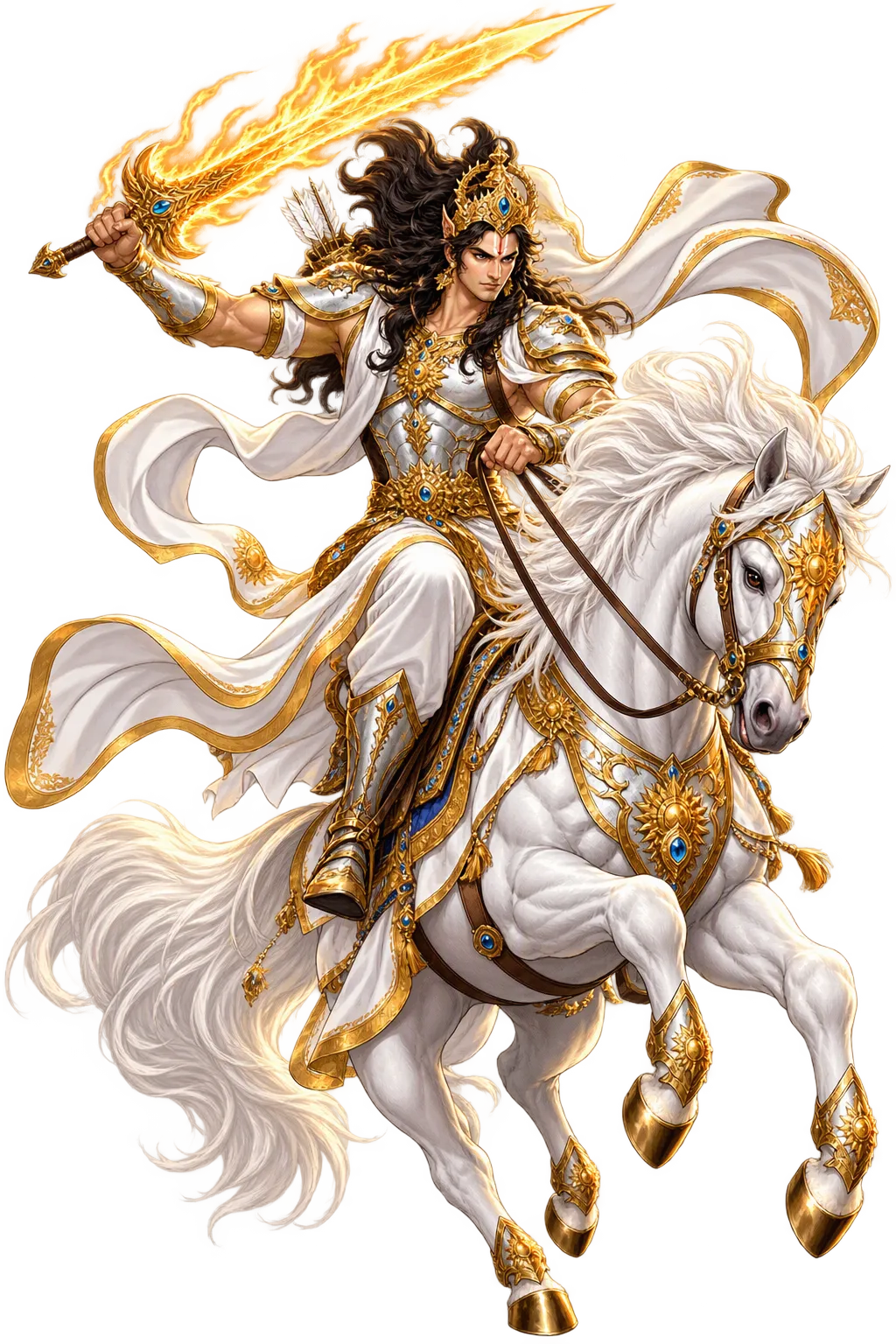
Stress-testing Kalki: do the industry seats hold?
Audit notes, Kalki: we took every seat the atlas claims for this temple and tried to break it against the myths. What survived is below.
At a Glance
- Temple: Kalki
- Pantheon: Sanskrit
- Domain of influence: Prophecy, Renewal, Avatar of Vishnu
- Pattern seats: 3
- Sectors touched: Commerce & Governance · Culture & Entertainment · Society & Spirit
- Strongest seat: Disaster Resilience & Recovery
- Series: The Resonance Files, No. 270 of 597
The Test
Seat 1: Disaster Resilience & Recovery
Claim: The restarter of time — after the sword, the new golden age: recovery as eschatology. Exhibit: The Prophecy of the Horse — The earliest Kalki-passage names the signs: when time decays, a being of immense power will be born to a family of Brahmins, swift as thought, his hand a sword, his steed white as milk, blazing like a comet.
Verdict: stands. Strip both to their function and the functions match.
Seat 2: Gaming, Fantasy & Entertainment IP
Claim: The world-ending rider — eschatology as franchise, the tenth avatāra endlessly re-staged. Exhibit: The Full Biography — The eponymous Purāṇa tells it whole: the child Kalki, mocked by the corrupt, learns the Vedas from Paraśurāma himself, marries the princess Padmāvatī by the sword-contest, and rides out against the mleccha kings.
Verdict: holds under load. The correspondence is functional, not decorative.
Seat 3: Astrology, Tarot & Esoteric Services
Claim: The prophesied one — the Kali Yuga's signs read like an astrologer's long-range forecast. Exhibit: The Diagnosis of the Age — The Purāṇic Kali-Yuga lists read like satire: rulers will be thieves, vows will be sold, the low will govern the high.
Verdict: holds under load. The correspondence is functional, not decorative.
The Control Group
Against the seats that survived, one control: the temple's own summary of its figure — The Kalki myth is the Purāṇic eschaton: the prophecies of the Kali Yuga’s decay — merchants as kings, wealth as virtue, fathers feared by sons — are the diagnosis, and Kalki is the cure. The seats do not drift far from it. That is the audit's cleanest result.
The Method, Stated Plainly
None of this is numerology. A seat exists only where the match can be argued from the deity’s documented domains and deeds — weighted, published, and falsifiable. The derivation, the weights, and the challenge process are public on the methodology page. If a seat in this file reads wrong, the atlas itself tells you how to prove it — and the correction becomes part of the record.
For the Ones Who Work There
For a sponsor in disaster resilience & recovery, the fit here is not adjacency — it is inheritance. Your trade already tells this story every working day; the temple simply holds the original. The patron tier and the advertising terms carry the mechanics; the myths above carry the reason.
The File Continues
This is one of 597 Resonance Files — the third dispatch from every flagship temple, where the myths meet the markets. The temple's founding dispatch tells the name's story; its Restoration File tells the spelling's; the blog index holds the whole archive.
Continue the series — previous: Kālī (read it) · next: Kamapuaa (read it).
The Resonance Files are argued from the same canonical record as the pattern atlas itself: the lexicon, the lore catalog, and the cited sources. Every seat can be challenged at the methodology page — and the challenge is the point.