
The many faces of Kalki
No important name has only one face. Kalki appears as a figure of myth, a scholarly reconstruction, a piece of material culture, a memory carried across languages, and — most recently — a Unicode domain. This post looks at each face in turn: the name and its roots, the Devanagari original, the reconstructed pronunciation, the mythological record, the symbols and sanctuaries, the cross-cultural afterlife, and the engineering that lets the restored spelling resolve in a browser. Taken together, those faces explain why kalki was never going to be enough — and why the restored form is worth a domain of its own.
At a Glance
- Restored name: Kalki
- ASCII form: kalki
- Meaning: "The avatāra yet to come — the tenth and final avatāra of Viṣṇu, who appears at the end of the Kali Yuga riding a white horse to destroy unrighteousness and restore the age of truth"
- Domain of influence: Prophecy, Renewal, Avatar of Vishnu
- Pantheon: Sanskrit
- Restoration: ASCII-equivalent form
- Original script: कल्कि (Devanagari)
Overview
Kalki (kalki) — The Tenth Avatāra, the End of the Kali Yuga · The avatāra yet to come — the tenth and final avatāra of Viṣṇu, who appears at the end of the Kali Yuga riding a white horse to destroy unrighteousness and restore the age of truth — belongs to the Sanskrit tradition, where it is catalogued under the domain "Prophecy, Renewal, Avatar of Vishnu". The name means "The avatāra yet to come — the tenth and final avatāra of Viṣṇu, who appears at the end of the Kali Yuga riding a white horse to destroy unrighteousness and restore the age of truth".
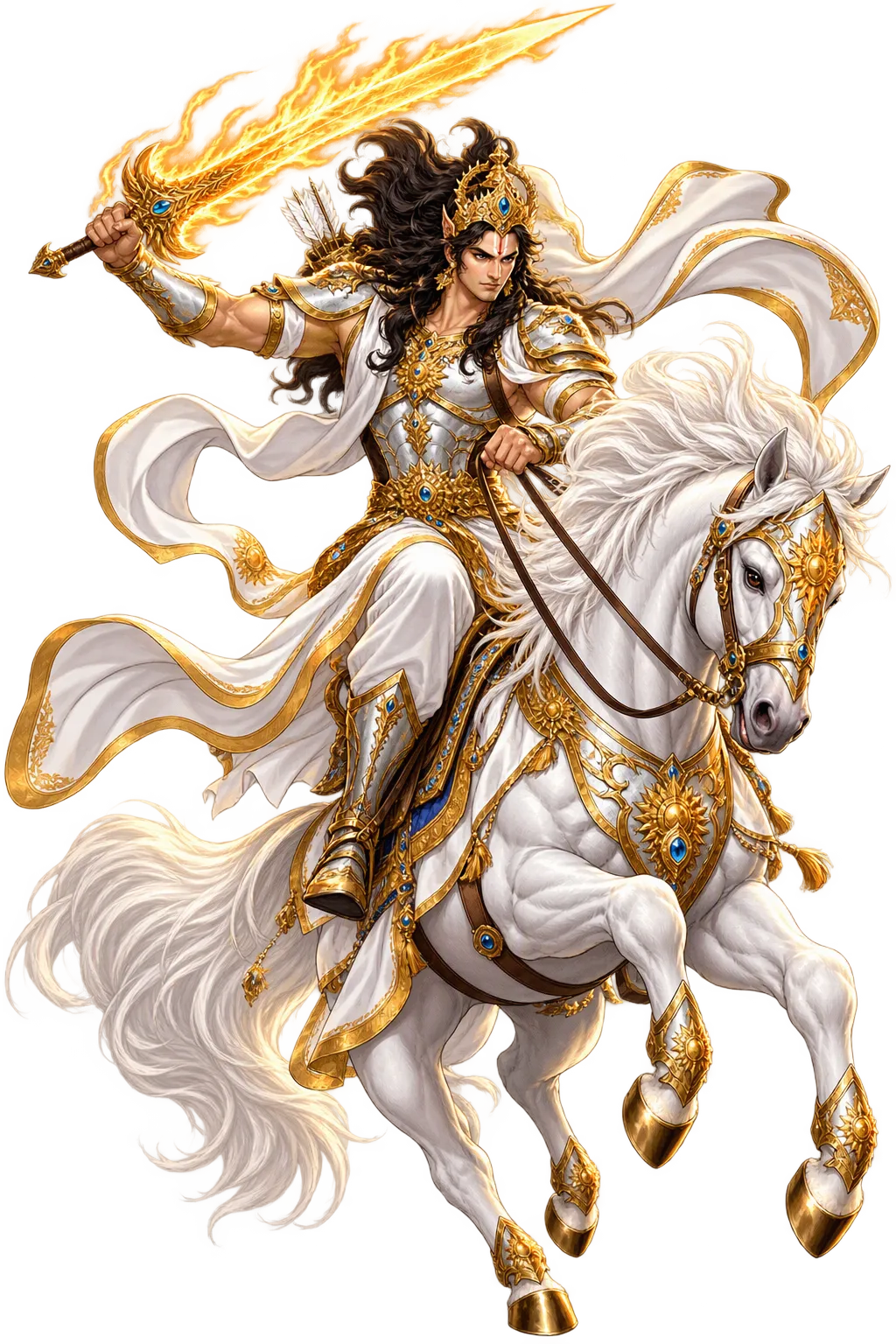
Kalki is Vishnu’s final descent: the warrior on the white horse who will come when the Kali Yuga chokes on its own corruption — sword drawn, comet-marked, born in a village to a Brahmin named Viṣṇuyaśas — to end the age, punish the wicked, and restart the world’s golden wheel. He is the only deity in this pantheon whose myth is a prophecy.
PuniCodex restores the name as Kalki and serves its temple at its temple. The restoration aSCII-equivalent form — a description computed from the displayed form itself. The plain ASCII form kalki survives as a modern convenience imposed by the early domain-name system; the restoration, not the fallback, is the form the project defends as philologically complete.
The Name
The name is attested in Devanagari as कल्कि. Etymologically it means "The avatāra yet to come — the tenth and final avatāra of Viṣṇu, who appears at the end of the Kali Yuga riding a white horse to destroy unrighteousness and restore the age of truth".
The ASCII form kalki survives only because the early domain-name system could not carry diacritics; it is a technological compromise, not an ancient spelling. The Unicode restoration Kalki recovers the full diacritic detail of the scholarly transliteration directly in the address bar. The restoration aSCII-equivalent form — a description computed from the displayed form itself.
The letter-by-letter transformation runs:
- k → K — Same
- a → a — Short /a/
- l → l — Same
- k → k — Same
- i → i — Short /i/
The Original Script
The name is preserved in Devanagari as कल्कि.
The scholarly transliteration is Kalki.
The rendering proceeds step by step:
- Sanskrit Kalki is written in Devanagari as कल्कि
- IAST transliteration maps each Devanagari vowel and consonant to a Latin equivalent
- Macrons mark long vowels (ā, ī, ū); dots beneath consonants mark retroflex articulation (ṭ, ḍ, ṇ, ṣ)
Pronunciation
The reconstructed pronunciation of the name is /ˈkɑːlki/ — Sanskrit (IAST: Kalki).
Phoneme by phoneme:
- Kāl- — Conventionally written Kalki; the name is usually derived from kalikā “white horse” or from Kali, the age he ends.
- -ki — The tenth avatāra of Vishnu, yet to come — the only future god in the lexicon.
For the modern speaker, the closest approximation is: “KAHL-kee”
Kindred and historical forms of the name:
- Kalkin — in some Purāṇic lists
- the — White Horse of the world’s end
A prophecy made flesh in text: the god who has not yet been born, scheduled for the end of the Kali Yuga.
Mythology
The Kalki myth is the Purāṇic eschaton: the prophecies of the Kali Yuga’s decay — merchants as kings, wealth as virtue, fathers feared by sons — are the diagnosis, and Kalki is the cure. He appears in the latest strata of the Mahābhārata and the Purāṇas as the tenth and final avatāra, the one Vishnu keeps in reserve for the world’s last night.
The Prophecy of the Horse (Mahābhārata 3.191)
The earliest Kalki-passage names the signs: when time decays, a being of immense power will be born to a family of Brahmins, swift as thought, his hand a sword, his steed white as milk, blazing like a comet. The passage is embedded in the epic’s cosmological books as Vishnu’s promise to the tormented earth.
The Full Biography (Kalki Purāṇa)
The eponymous Purāṇa tells it whole: the child Kalki, mocked by the corrupt, learns the Vedas from Paraśurāma himself, marries the princess Padmāvatī by the sword-contest, and rides out against the mleccha kings. His campaigns purify the world; the wicked fall to his blade and the earth’s burden lifts at last.
The Diagnosis of the Age (Kali Yuga Doctrines)
The Purāṇic Kali-Yuga lists read like satire: rulers will be thieves, vows will be sold, the low will govern the high. Kalki is the answer to this audit — not a reformer but an ending. The theology is cyclical: he destroys the age as a farmer burns the stubble, so the next golden age can be sown.
The Expected One (Living Traditions)
Kalki remains expected: in Śambhala-legend — Tibetan Buddhism adopted the hidden kingdom wholesale — and in popular Hinduism, where every generation finds the Kali Yuga’s signs fulfilled. He is the only god in this pantheon whose temple is the future, and whose devotees wait rather than celebrate.
Symbols & Iconography
The iconography associated with Kalki concentrates in a small set of recurring attributes, each a compressed statement about the name:
- The White Horse — Devadatta, the winged white steed, given by Śiva; Kalki rides from Śambhala at the age’s end.
- The Sword of the Age — Ratnamaru, the jewelled sword, given by the gods — it ends the Kali Yuga as a blade ends a lie.
- Born in Śambhala — His village, Śambhala, waits hidden; when dharma’s four legs shrink to one, he is born there.
- The Restarter of Time — After the sword, the restart: Kalki inaugurates the next Kṛta Yuga — death midwifing rebirth.
Archaeology & Evidence
The material record for Kalki survives in a small number of securely identified remains, catalogued below; the corpus is thin but unambiguous, and each site is tied to the name by ancient testimony.
No ancient Kalki temples — he has not yet been born. But his images ride through South Indian temple friezes of the Dashavatāra, and the Śambhala iconography of Tibetan thangkas gives his myth a monumental afterlife in paint across the Himalayas.
Realm & Domain
Kalki is Vishnu’s final descent: the warrior on the white horse who will come when the Kali Yuga chokes on its own corruption — sword drawn, comet-marked, born in a village to a Brahmin named Viṣṇuyaśas — to end the age, punish the wicked, and restart the world’s golden wheel. He is the only deity in this pantheon whose myth is a prophecy.
The White Horse
Devadatta, the winged white steed, given by Śiva; Kalki rides from Śambhala at the age’s end.
The Sword of the Age
Ratnamaru, the jewelled sword, given by the gods — it ends the Kali Yuga as a blade ends a lie.
Born in Śambhala
His village, Śambhala, waits hidden; when dharma’s four legs shrink to one, he is born there.
The Restarter of Time
After the sword, the restart: Kalki inaugurates the next Kṛta Yuga — death midwifing rebirth.
Across Cultures
The Kalki cycle absorbed apocalyptic expectations from every quarter: the White Horse echoes the sun-horse of Indo-Iranian myth; the sword of the age borrows Paraśurāma’s axe; and Śambhala, his hidden kingdom, became the axis of Tibetan Buddhism’s Kalacakra — the wheel of time teachings centred on the king who will come.
Within the Sanskrit tradition, closely related names in the corpus include Aditi, Agni, Ambikā, Aṃśa, Arjuna, and Bhakti.
Cultural Legacy
Kalki is eschatology’s most durable prophetic figure in the living world: films, novels, and comics re-stage his coming endlessly, and ‘waiting for Kalki’ is an idiom for expecting the end of a corrupt order. The Śambhala legend seeded Theosophy’s Shambhala and, through it, a century of Western occult geography.
The Scholarly Record
The account of Kalki given in this edition rests on the witnesses and reference works listed below. Lexica and etymological dictionaries secure the form and meaning of the name; the literary and religious texts supply the narrative evidence.
- Mahābhārata 3.191 (the earliest Kalki prophecy).
- Kalki Purāṇa (the full biography).
- Bhaviṣya Purāṇa (the Kali Yuga lists).
- Kalacakra tradition (Śambhala).
A Meditation
Kalki: a name that is a countdown. Restored plainly, it stands at the lexicon’s far edge — the god who has no past tense. Every other entry in this temple restores what was; this one restores what will be, and the plain letters are appropriate: the last avatāra needs no decoration on his way to end the age.
The Unicode Restoration
Kalki aSCII-equivalent form. The ASCII fallback kalki still resolves everywhere, but it is the restored form that carries the name's full information. That is the whole thesis of this temple: the marks are the message.
Character by Character
The journey from kalki to Kalki, one character at a time:
- k → K — Same
- a → a — Short /a/
- l → l — Same
- k → k — Same
- i → i — Short /i/
The Sanskrit Pantheon
Kalki is one of 102 entries the PuniCodex lexicon catalogues under the Sanskrit pantheon. The Pantheon page gathers the tradition's major figures in one place, and the Lexicon lets you filter all 983 restorations by tradition or script — the fastest way to see where this name sits among its kin.
Frequently Asked Questions
What does Kalki mean? The traditional gloss is "The avatāra yet to come — the tenth and final avatāra of Viṣṇu, who appears at the end of the Kali Yuga riding a white horse to destroy unrighteousness and restore the age of truth."
Which tradition does Kalki belong to? Kalki is catalogued in the Sanskrit pantheon of the PuniCodex lexicon.
What does Kalki preserve that ASCII cannot show? The form itself answers: Kalki aSCII-equivalent form — and the marks in the restored spelling are exactly that evidence.
Can I use Kalki in a normal browser? Yes. The DNS resolves the punycode form automatically, and the type tool on this site converts kalki to Kalki for copying and pasting.
Where does the scholarly information come from? The entry is built from lexica, inscriptional evidence, and reviewed scholarly sources listed in the Scholarly Edition. Every claim is traceable to a canonical source.
Typing Kalki
You do not need a special keyboard to use this restoration. The PuniCodex Type Tool converts the ASCII form kalki into Kalki as you type, and the browser extension offers the same conversion inside any text field. Copy the restored form, paste it into the address bar, and the DNS does the rest.
Sister Temples
Other temples in the Sanskrit pantheon include Ambikā, and Arjuna — each with its own restoration story, its own scholarly record, and its own place in the lexicon.
Why This Restoration Matters
Myth, script, sound, cult, legacy, domain: the faces of Kalki add up to a single argument — that a name is a record, and records deserve fidelity. The PuniCodex restoration keeps that record in working order: the temple presents it, the Scholarly Edition footnotes it, the lexicon catalogs it, and the domain makes it addressable. kalki will always exist as a fallback. But fallback is not identity. Kalki is the name; everything else is a convenience.
Explore Further
This post is one doorway into the temple. The home page carries the full character breakdown and the ambient canvas; the lore page tells the myths in long form; the Scholarly Edition preserves the sources, pronunciation data, and revision history; and the patron wall supports the restoration directly. For the wider map, browse the Lexicon, explore the Pantheon, or return to the PuniCodex blog.
A Closer Look at the Marks
A restored name is a small map. In the case of Kalki, the map does not lead through diacritics or special letters, because the source tradition wrote the name in Devanagari rather than in the Latin alphabet. The ASCII form kalki and the restored form share the same letters; the restoration is a decision about which conventional spelling should serve as the public reference.
That decision is not cosmetic. The original script attestation carries semantic and phonetic information that no romanization can fully reproduce. By fixing one conventional spelling as the canonical domain form, the project prevents the drift that happens when a name is romanized differently in every article, map, and database. The breakdown still lists each character — k, a, l, k, i — so visitors can see exactly what is being carried forward and what is not. What looks like "no change" is, in fact, a deliberate choice to keep the name stable, searchable, and addressable.
Kalki in Its Tradition
Kalki does not stand alone. It belongs to the Sanskrit tradition, where it is counted among 102 names in the PuniCodex lexicon. Its sphere — Prophecy, Renewal, Avatar of Vishnu — places it beside other figures who govern similar aspects of experience. The restored spelling is therefore not only a philological decision; it is a way of keeping the name in the company of its kin. When the address bar shows Kalki, it marks the boundary between a generic search term and a named entry in a living catalog of myth. That catalog is the point of the project. Every restored name is a vote for specificity: the web should know the difference between a figure and a keyword, between a tradition and a trend. Kalki is one such vote.
What You Will Find in the Temple
The temple page for Kalki is more than a landing page. The home tab presents the character breakdown, the pronunciation guide, and the live domain status in a single view. The lore tab gathers the myths and narratives that give the name its depth. The Scholarly Edition tab publishes the sources, variant forms, and review history that justify the restoration. Industry patterns show where the name appears in modern commerce and culture, while the gallery and creatives tabs collect visual and sponsor material. The patron wall lets visitors support the restoration directly. Each tab is generated from the same canonical sources, so the domain, the blog, the scholars page, and the search index all agree. The result is a single source of truth about a name, delivered through several doors.
The Restoration on the Live Web
A domain name is a kind of publication. When Kalki resolves, it proves that the restored spelling is not a theoretical exercise; it is a working address on the public internet. Search engines can index it, language models can encounter it, and anyone who copies it from a manuscript can paste it into a browser. That practical reality changes the status of the restoration. Before Unicode domains, a scholar could write the name correctly in an article while the public web flattened it to kalki. Now the public web can carry the correct form end to end. The punycode translation happens silently, so the infrastructure remains compatible while the visible name keeps its marks. That compromise — human-readable restoration, machine-readable encoding — is the foundation of every PuniCodex temple.
Restoration Notes
Restoring a name is not a single decision; it is a sequence of smaller decisions, each backed by a different kind of evidence. For Kalki, the chain begins with the attested form in Devanagari, continues through the standard scholarly romanizations, and ends with the DNS-compatible Unicode spelling used by this temple. The meaning "The avatāra yet to come — the tenth and final avatāra of Viṣṇu, who appears at the end of the Kali Yuga riding a white horse to destroy unrighteousness and restore the age of truth" anchors the name in its semantic field; without that anchor, the marks would float free of the figure they name. The restored form Kalki and the ASCII form kalki share the same Latin letters; the restoration here is a conventional capitalization rather than a recovery of lost diacritics or special characters. Those adjustments are not arbitrary styling. They follow the restoration logic the displayed form wears openly: Kalki aSCII-equivalent form. The rule is mechanical, not editorial, which means the same standard applies to every entry in the lexicon. A visitor who disagrees with the classification can at least see exactly which evidence produced it, because every step is recorded in the Scholarly Edition. That transparency is the difference between a restoration project and a branding exercise. The name is being put back, not invented.
Related Names
Sources
The full scholarly apparatus — every citation, revision, and review — lives in the Scholarly Edition. Key references for this post:
- Mahābhārata 3.191 (the earliest Kalki prophecy).
- Kalki Purāṇa (the full biography).
- Bhaviṣya Purāṇa (the Kali Yuga lists).
- Monier-Williams Sanskrit-English Dictionary.
- Lexicon authorities for this entry: Mahabharata, Puranas, Bhagavata, MW.