
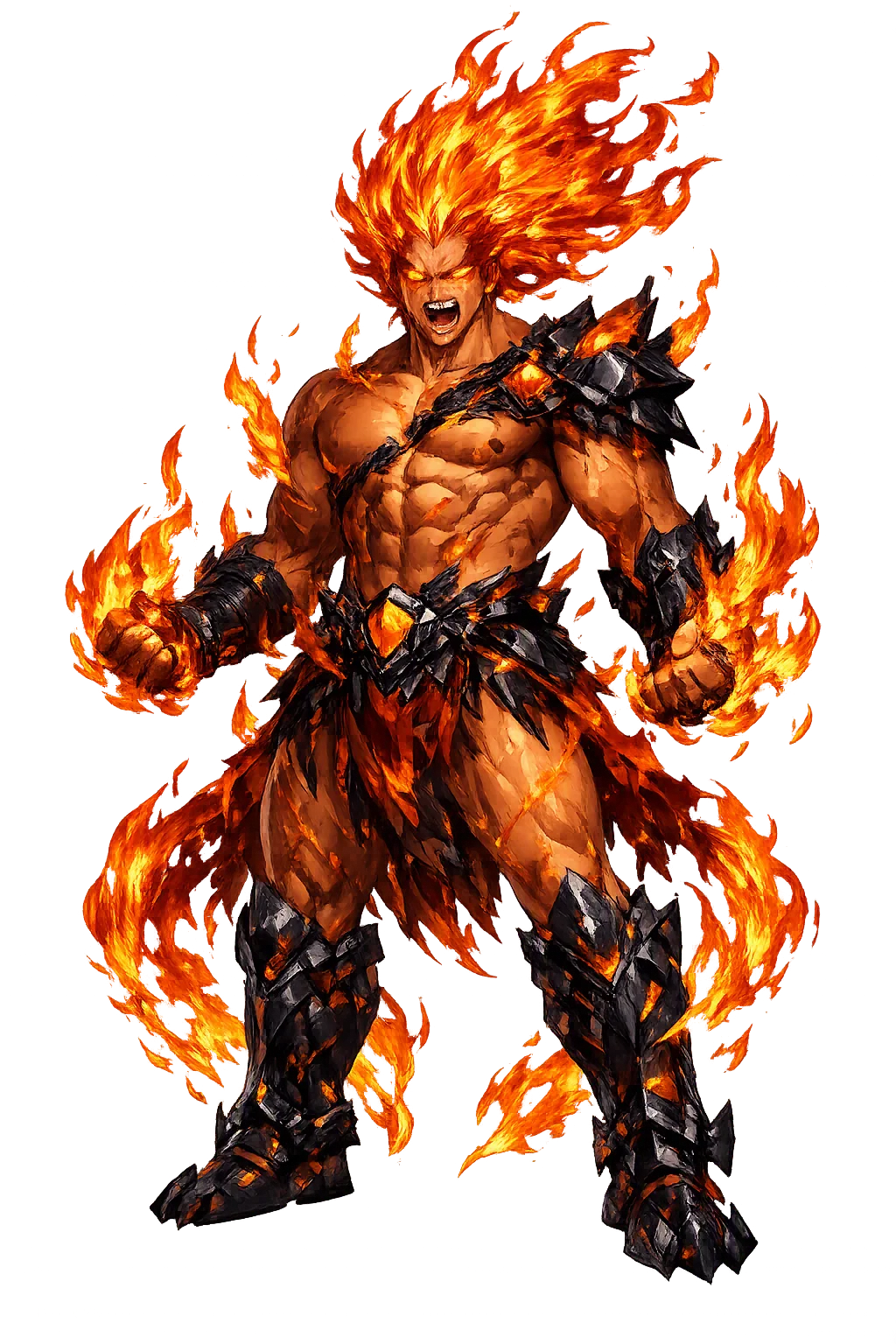
The many faces of Kagutsuchi
No important name has only one face. Kagutsuchi appears as a figure of myth, a scholarly reconstruction, a piece of material culture, a memory carried across languages, and a digital temple. This post looks at each face in turn: the name and its roots, the Japanese characters original, the reconstructed pronunciation, the symbols and sanctuaries, and the afterlife that brought the canonical spelling into the present.
At a Glance
- Canonical name: Kagutsuchi
- ASCII form: kagutsuchi
- Meaning: "The burning force"
- Domain of influence: Fire, Volcanoes
- Pantheon: Japanese
- Restoration: ASCII-equivalent form
- Original script: 迦具土 (Japanese characters)
Overview
Kagutsuchi (kagutsuchi) — Fire, Volcanoes · The burning force — belongs to the Japanese tradition, where it is catalogued under the domain "Fire, Volcanoes". The name means "The burning force".
Kagutsuchi is the fire god whose birth burned his mother Izanami to death, introducing mortality into the mythic world. He is creation and destruction in one figure: the flame that forges and the flame that consumes. After his death at the hands of Izanagi, his scattered body became the volcanoes and hot springs of Japan.
PuniCodex records the canonical scholarly spelling Kagutsuchi and serves its temple at its temple. The displayed form is ASCII-equivalent — a description computed from the displayed form itself. The plain ASCII form kagutsuchi contains the same letters: no recovered diacritics or special encoding is claimed. The work here is consistent citation, capitalization, provenance, and cultural context.
The Name
The name is attested in Japanese characters as 迦具土. Etymologically it means "The burning force".
The canonical spelling Kagutsuchi matches the conventional scholarly romanization. The plain ASCII form kagutsuchi contains the same letters, so no lost diacritics or encoding transition is claimed. The editorial work is to fix one reviewed reference spelling, preserve capitalization and provenance, and keep the original evidence visible. The displayed form is ASCII-equivalent — a description computed from the displayed form itself.
The letter-by-letter transformation runs:
- k → K — Same, capitalized
- a → a — Same
- g → g — Same
- u → u — Same
- t → t — Same
- s → s — Same
- u → u — Same
- c → c — Same
- h → h — Same
- i → i — Same
The Original Script
The name is written in Japanese characters as 迦具土. That attested script remains the primary evidence for the conventional romanization Kagutsuchi. The canonical Latin spelling does not pretend to recover marks it never contained: it fixes one reviewed reference form while leaving the original script visible for comparison.
The name is written 迦具土 — phonetic man'yōgana whose characters ('add', 'tool', 'soil') were chosen for sound, not sense. Later tradition sometimes writes the fire deity with the more transparent 火産霊 (Homusubi, 'fire-producing spirit').
Pronunciation
The reconstructed pronunciation of the name is /ka.ɡɯ.tsɯ.tɕi/ — Modern Standard Japanese (Hepburn).
Phoneme by phoneme:
- Ka- — Voiceless velar stop [k] plus open central [a]
- -gu- — Voiced velar stop [ɡ] plus close back unrounded [ɯ]
- -tsu- — Voiceless alveolar affricate [ts] plus close back unrounded [ɯ]
- -chi — Voiceless alveolo-palatal affricate [tɕ] plus close front [i]
For the modern speaker, the closest approximation is: 'KAH-goo-tsoo-chee' — the 'tsu' is crisp, and the final 'chi' is like 'chee'.
Kindred and historical forms of the name:
- Japanese — 迦具土 (Kagutsuchi), the fire kami whose birth killed Izanami
- Alternative names — Hi-no-Kagutsuchi and Homusubi, 'fire-producer' — both attested for the same deity
- Parents — Last-born child of Izanagi and Izanami
Kagutsuchi keeps its restoration plain: plain Hepburn. He is the volatile fire god whose birth marks the beginning of death in the world.
Mythology
Kagutsuchi's mythology is brief and absolute: a birth that kills, a death that multiplies life, and a legacy of fire that Japan's volcanoes still preach. The Kojiki spends little more than a page on him — yet that page is the hinge of the whole cosmogony, for it is at his birth that the creator goddess dies and the world divides into the living and the dead.
The Burning Birth (Kojiki I.8)
After the islands were born, Izanami bore the last child of the creation — the fire kami Kagutsuchi — and his birth burned her. The Kojiki (I.8) tells it with terrible economy: the fire from the child's body scorched her, and from the agony of the wound the dying goddess brought forth still more kami — Kanayamabiko and Kanayamabime, the kami of metal, from her vomit; Haniyasubiko and Haniyasubime, the kami of clay and pottery, from her feces; and Midorikonomikami from her urine. Then, her body spent, Izanami died. She who had borne the islands and the thirty-odd kami of the land was destroyed by her final child: creation consuming its maker is the first law the new world teaches, and the fire god learned it in the only way a newborn can — by being it.
The Blade of Grief (Kojiki I.9)
Izanagi's grief turned to rage — 'Why must I lose my beloved for this one child?' — and drawing the Totsuka-no-Tsurugi, the ten-handled sword of the brine, he cut the fire kami down. What fell from the blade was life. From the blood on its point came Iwasaku and Nesaku, the 'stone-cutting' kami; from the blood on its hilt came Mizuhanome, the goddess of water who quenches fire; and from the severed body came the mountain kami whose peaks still steam along the Japanese chain (Kojiki I.9). The Nihon Shoki preserves variant versions of the same burning-birth and gives the child the parallel names Homusubi and Hi-no-Kagutsuchi. Kagutsuchi thus dies the only death in the cosmogony struck by a god's own hand — and the dismemberment, like the birth, manufactures gods: fire destroys, and destruction is revealed as one of generation's ordinary forms.
The Child Who Created Death (Kojiki I.10–11)
Because Izanami died, Izanagi followed her down to the land of Yomi; because he followed, he saw her body corrupted, guarded by the eight Thunder Kami; because he fled from the sight, Izanami cursed him, and the world split in two at the Even Pass of Yomi — Izanagi swearing to give life its thousand generations, Izanami to take a thousand a day. Then, purifying himself in the river of the plain, Izanagi washed from his left eye Amaterasu, from his right eye Tsukuyomi, from his nose Susano-o — the three sovereign children of the later pantheon (Kojiki I.10–11). None of it happens without the fire child's birth. Kagutsuchi is the pivot of the entire Japanese cosmogony: the instant at which the world of undying creators ends and the world of birth and death begins. One page of story carries every assumption the later shrines and epics must make — the sun included, for even Amaterasu exists because a fire once killed a mother.
Homusubi, the Hearth (Folk tradition)
The Kojiki gives Kagutsuchi no cult and no further adventures — his worship was the ordinary reverence of fire itself. Under the names Hi-no-Kagutsuchi and Homusubi, 'fire-producer,' he was honored at the hearth and the forge, where fire cooked, warmed, and smelted; fittingly, the metal and clay kami born from Izanami's dying body minister to the same fireplace and furnace. Folk tradition kept a careful double feeling toward him: fire was the gift no household could live without and the force that could erase the household in an hour, and in parts of Japan a prayer was still spoken before the first fire of the new year. This is the myth reduced to its element — no temples, no epics, only the daily negotiation between human beings and the one power in the house that must never be insulted. The volcanoes are his body; the kitchen fire is his ghost; both demand the same attention.
Symbols & Iconography
The iconography associated with Kagutsuchi concentrates in a small set of recurring attributes, each a compressed statement about the name:
- Flame — The elemental fire he embodies — the one power in the house that must never be insulted.
- The Totsuka-no-Tsurugi — The 'ten-handled sword of the brine' with which the grieving Izanagi cut him down.
- Volcano — His dismembered body became the mountains and steaming springs of Japan.
- Forge — Hearth and smithy — the domesticated half of his double nature.
Archaeology & Evidence
Kagutsuchi left no temples, inscriptions, or cult images — the evidence for him is textual and geological. The textual witness is the eighth-century manuscript tradition of the Kojiki (712 CE) and the Nihon Shoki (720 CE), whose compilers fixed the story; the Shinpukuji-bon and the Urabe recension are its principal witnesses. The 'archaeology' of his body is the archipelago itself: the volcanic chain from Fuji to Aso to Sakurajima, with its crater shrines and steam vents, and the hot-spring country the Kojiki already reads as the fire kami's remains. And beneath the myth lie the oldest controlled fires on earth: the hearths of Jōmon pit-dwellings (from c. 14,000 BCE), where a culture learned to keep the exact double attitude the myth prescribes — fire fed daily, and feared daily. That hearths older than any shrine in Japan still govern his cult is the most honest monument he has.
Realm & Domain
Kagutsuchi is the fire god whose birth burned his mother Izanami to death, introducing mortality into the mythic world. He is creation and destruction in one figure: the flame that forges and the flame that consumes. After his death at the hands of Izanagi, his scattered body became the volcanoes and hot springs of Japan.
Birth of Fire
His birth from Izanami introduced both fire and death into the world.
Slain by Izanagi
Izanagi avenged Izanami's death by cutting Kagutsuchi into pieces with the Totsuka-no-Tsurugi.
Volcano God
His dismembered body became the volcanoes and geothermal springs of the land.
Forge and Hearth
Fire for cooking, warmth, and metalwork descends from his power.
Across Cultures
Comparisons come readily — Hephaistos and Vulcan as smith-fire, Agni as the god born who must be handled with care, Prometheus as the power that costs its bearer everything — but Kagutsuchi's closest relatives are his own siblings and victims: Izanami, whom his birth killed, and the metal and clay kami born from her dying body, who made his fire usable. Within Japan his identity overlapped with the folk hearth deity Kōjin and with the volcano kami of the great peaks; Buddhist Japan did not canonically adopt him, but shrine and temple practice alike made offerings to the hearth fire. His theology stays pointedly Japanese: not a forge-god of artisans nor a fire-thief of the gods, but the tragedy of fire itself — the child whose birth introduced death into the world and whose dismembered body is the landscape. Where other traditions send fire to humanity as a gift or a theft, Japan keeps it at home as a birth, and mourns it.
Kindred figures in the PuniCodex cross-tradition index include Brigid, Hēphaistos, Hoderi, Logi, Pele, and Promētheús, each linked through fire / forge / craft.
Cultural Legacy
Kagutsuchi survives wherever Japan's volcanoes are in the news — the country that monitors its peaks for eruption is, in the old language, watching over the scattered body of a god. His name circulates widely in modern fantasy and games as a volcanic or destructive kami, sometimes flattened into a monster, though the original story is more tragic than fearsome: a child destroyed for being born what he was. The geothermal energy industry has quietly theologized him in reverse, tapping the heat his body left in the mountains as power. And at every hearth and every forge the oldest layer of his cult persists without shrines — the simple, ancient caution that fire is a guest who must be fed, watched, and never insulted. His is the only major Japanese cult whose temple is a kitchen.
The Scholarly Record
The account of Kagutsuchi given in this edition rests on the witnesses and reference works listed below. Lexica and etymological dictionaries secure the form and meaning of the name; the literary and religious texts supply the narrative evidence.
- Kojiki I.8–11 (tr. Philippi; tr. Chamberlain).
- Nihon Shoki I (tr. Aston).
- Philippi, Norito.
- Aston, Nihongi.
A Meditation
Kagutsuchi is the fire we cannot live without and cannot safely hold. His birth is the moment the mythic world loses its innocence: before him, Izanagi and Izanami created without dying; after him, creation has a price, and the price is death. His father kills him for it, and even that punishment backfires into generation — the blood and body make more gods than the birth destroyed.
He asks the question every technology asks. Fire is the first machine, and the myth encodes the entire human history of machines in a single page: power that cooks and warms, that forges tools and razes houses, that makes and unmakes on the same breath. Japan, sitting on his dismembered body, knows this geology literally. To honor Kagutsuchi is to keep a respectful distance from the flame — close enough to cook, far enough to survive the spark.
The Canonical Spelling
Kagutsuchi is the canonical spelling used by this temple. The plain ASCII form kagutsuchi contains the same letters, so there are no lost diacritics to recover and no special encoding transition to explain. What the temple preserves is the reviewed reference form: capitalization, conventional romanization, original evidence, and a stable place to inspect them. The value here is not added decoration; it is fidelity to the attested record.
Character by Character
The canonical form Kagutsuchi and the plain ASCII form kagutsuchi share the same letters. The character list therefore documents continuity rather than recovery: every character is carried forward deliberately, with capitalization serving as the proper-noun convention. No additional mark is inserted merely to make the restoration appear more elaborate.
The Japanese Pantheon
Kagutsuchi is one of 45 entries the PuniCodex lexicon catalogues under the Japanese pantheon. The Pantheon page gathers the tradition's major figures in one place, and the Lexicon lets you filter all 983 restorations by tradition or script — the fastest way to see where this name sits among its kin.
Frequently Asked Questions
What does Kagutsuchi mean? The traditional gloss is "The burning force."
Which tradition does Kagutsuchi belong to? Kagutsuchi is catalogued in the Japanese pantheon of the PuniCodex lexicon.
Does this name need recovered diacritics? No. Kagutsuchi is already an ASCII-form canonical spelling. The scholarly work is to preserve the attested convention and its evidence, not to add marks.
Can I use Kagutsuchi in a normal browser? Yes. The spelling works directly in an ordinary browser, and the type tool can confirm and copy the canonical form.
Where does the scholarly information come from? The entry is built from lexica, inscriptional evidence, and reviewed scholarly sources listed in the Scholarly Edition.
Typing Kagutsuchi
You do not need a special keyboard to use this name. Kagutsuchi already uses ordinary Latin letters. The PuniCodex Type Tool lets you confirm the canonical spelling and copy it cleanly, while the original-script notes in the temple show the evidence behind the romanization.
Sister Temples
Other temples in the Japanese pantheon include Kannon, Kyūshū, and Ōkuninushi — each with its own restoration story, its own scholarly record, and its own place in the lexicon.
Why This Record Matters
Myth, script, sound, cult, legacy, and digital address add up to a single argument: a name is a record, and records deserve fidelity. The PuniCodex temple keeps that record in working order through the home page, the Scholarly Edition, the lexicon, and the living address. Kagutsuchi is already whole. The task is not to embellish it, but to keep its evidence attached.
Explore Further
This post is one doorway into the temple. The home page carries the full character breakdown and the ambient canvas; the lore page tells the myths in long form; the Scholarly Edition preserves the sources, pronunciation data, and revision history; and the patron wall supports the restoration directly. For the wider map, browse the Lexicon, explore the Pantheon, or return to the PuniCodex blog.
A Closer Look at the Spelling
A canonical name is a small map. In the case of Kagutsuchi, the route does not lead through diacritics or special letters, because the conventional scholarly spelling already uses the Latin alphabet. The original evidence — 迦具土 in Japanese characters — carries semantic and phonetic information that no romanization can fully reproduce.
By fixing one reviewed spelling as the public reference, the project prevents the drift that occurs when a name is romanized differently in every article, map, and database. The character list shows exactly what is carried forward. "No change" here means a deliberate choice to keep the name stable, searchable, and faithful to the record.
Related Names
Sources
The full scholarly apparatus — every citation, revision, and review — lives in the Scholarly Edition. Key references for this post:
- Kojiki I.8–11 (tr. Philippi; tr. Chamberlain).
- Nihon Shoki I (tr. Aston).
- Philippi, Norito.
- Aston, Nihongi.
- Lexicon authorities for this entry: Kojiki, Nihon Shoki.