PuniCodex

Extended Lore

迦具土 Kagutsuchi

Etymology · Orthography · Cult · Iconography · Reception · Sources

Tier 2 Kagutsuchi
Kagutsuchi — Fire, Volcanoes
01

Quick Facts

Essential information about Kagutsuchi, Fire, Volcanoes

Original Script迦具土
Unicode RestorationKagutsuchi
Reconstructed Pronunciation/ka.ɡɯ.tsɯ.tɕi/
PantheonJapanese
DomainFire, Volcanoes
MeaningThe burning force
ClassificationTier 2
Primary DomainKagutsuchi
Sacred SymbolsFlame, The Totsuka-no-Tsurugi, Volcano, Forge
02

Etymology & Word Family

From original script to Unicode restoration

Original Script 迦具土 Kagutsuchi — "The burning force"
Unicode Restoration Kagutsuchi Canonical scholarly spelling — ASCII-identical
Modern ASCII kagutsuchi Plain-ASCII fallback

The name Kagutsuchi reaches the modern world through scholarly transliteration of the japanese tradition. Because the conventional spelling uses only Latin letters, its Unicode and ASCII forms coincide — the tradition it carries is in the name itself, not in diacritics.

03

Unicode Character Breakdown

Character-by-character philological analysis

CharacterUnicodeNameBlockPhonetic Role
KU+004BLatin Capital Letter KBasic LatinSame, capitalized
aU+0061Latin Small Letter ABasic LatinSame
gU+0067Latin Small Letter GBasic LatinSame
uU+0075Latin Small Letter UBasic LatinSame
tU+0074Latin Small Letter TBasic LatinSame
sU+0073Latin Small Letter SBasic LatinSame
uU+0075Latin Small Letter UBasic LatinSame
cU+0063Latin Small Letter CBasic LatinSame
hU+0068Latin Small Letter HBasic LatinSame
iU+0069Latin Small Letter IBasic LatinSame

The Tier 2 classification here reflects fidelity to the attested tradition, not recovered diacritics: every character of Kagutsuchi already survives in ASCII. What the restoration preserves is the canonical spelling itself — the form scholarship standardised.

04

Cult & Worship

How the sacred was kept — rites, sanctuaries, remains

The Cult

Kagutsuchi's cult is the most honest in this catalog: there was none, and the chronicles admit it. No classical shrine bore his name, no Engishiki festival kept his day, and no votive invokes him — the god who killed the mother of the land seems to have been honored by being left unhoused. Japan's fire worship attached elsewhere: to the kamado-gami, the hearth deities who guarded each stove, and to Atago, the mountain kami of fire prevention whose great pilgrimage climbed Kyoto's western hill through the last night of July. What Kagutsuchi had instead of a temple was a rule, kept in every household for two thousand years: fire is fed first and never insulted, and the flame that cooks the rice is the same one that took the goddess. His sanctuary is the kitchen; his priesthood is everyone who has ever cooked.

In the Earth

Kagutsuchi left no temples, inscriptions, or cult images — the evidence for him is textual and geological. The textual witness is the eighth-century manuscript tradition of the Kojiki (712 CE) and the Nihon Shoki (720 CE), whose compilers fixed the story; the Shinpukuji-bon and the Urabe recension are its principal witnesses. The 'archaeology' of his body is the archipelago itself: the volcanic chain from Fuji to Aso to Sakurajima, with its crater shrines and steam vents, and the hot-spring country the Kojiki already reads as the fire kami's remains. And beneath the myth lie the oldest controlled fires on earth: the hearths of Jōmon pit-dwellings (from c. 14,000 BCE), where a culture learned to keep the exact double attitude the myth prescribes — fire fed daily, and feared daily. That hearths older than any shrine in Japan still govern his cult is the most honest monument he has.

05

Iconography

How Kagutsuchi was imaged across the ages

The Image

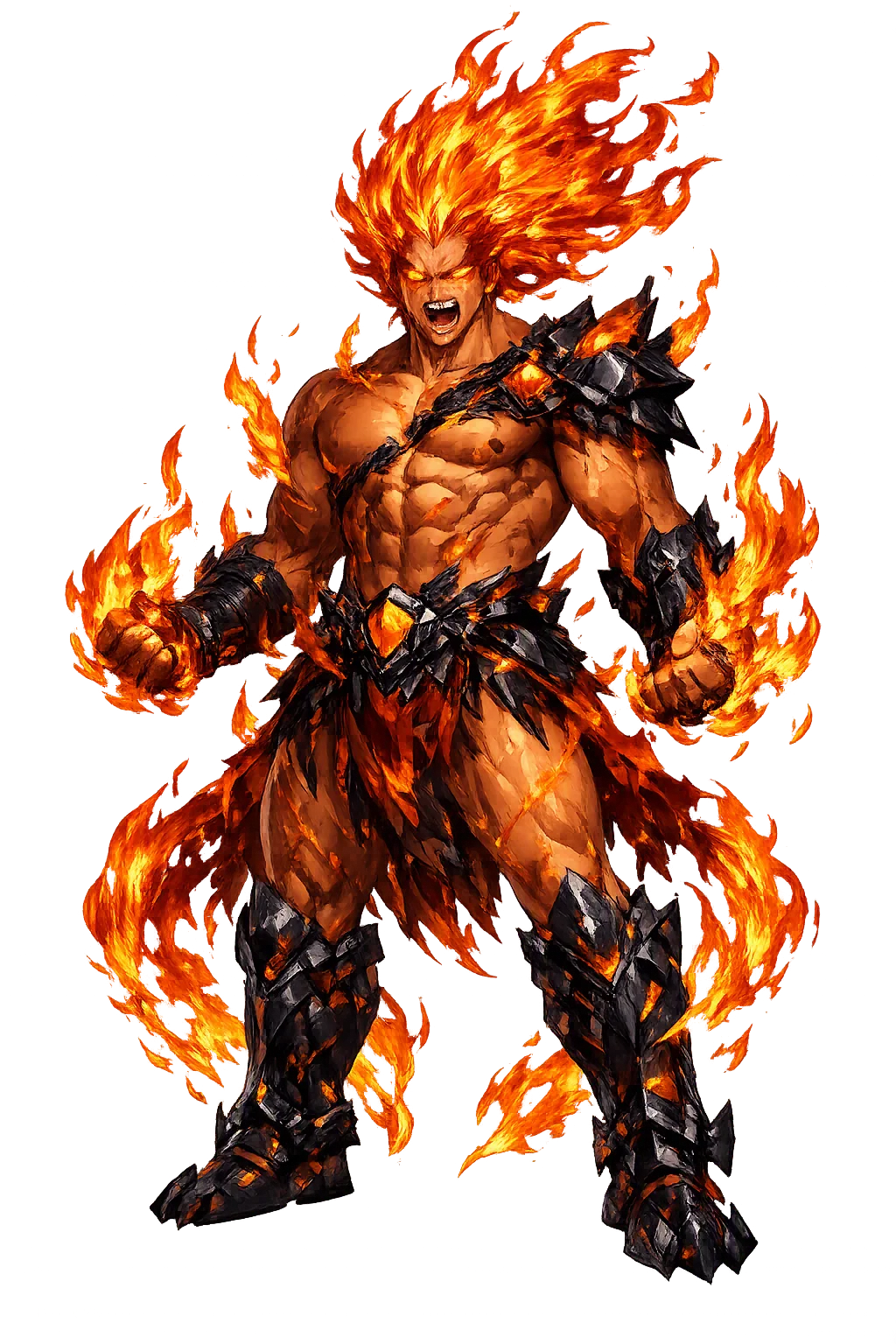
No image of Kagutsuchi is older than the story that killed him. The chronicles give him attributes instead of a body: the scorching flame of his own birth, and the ten-handled sword of brine that cut him down — fire and its executioner, the whole theology in two props. Japanese art obeyed the silence: for a thousand years he has no face, no statue, no temple icon, and even the medieval painting traditions that gave the underworld its kings never gave him a portrait. When pictures of him finally appear — in early-modern illustrated retellings of the chronicles — they show a figure wreathed in his own fire, more flame than god. The absence is itself the iconography. Every Japanese who has watched a hearth or a volcano has seen exactly what Kagutsuchi looks like, and no sculptor has ever improved on it.

06

Reception & Transformation

The name after its own age — transmission, translation, survival

Afterlives

Kagutsuchi travelled lightly, because his whole estate is one page of the Kojiki and a variant page of the Nihon Shoki. The first scholars to receive him were the eighth-century compilers themselves, and they were already arguing: the Nihon Shoki's parallel names — Homusubi, Hi-no-Kagutsuchi — are the oldest commentary on record, an attempt to settle what the fire child should be called. Buddhist Japan read him through its own fire theology, folding hearth offerings into temple practice without ever granting him a sūtra of his own. The kokugaku scholars of the Edo period made his birth sacred history: Hirata Atsutane's line-by-line Koshiden treated the burning of Izanami as literal fact and moral lesson, and the nativist school built on that reading set the episode at the center of what it meant to be Japanese. Modern scholarship demoted him to data — comparative mythologists shelved his birth beside the fire-gods of three continents, folklorists read him against living hearth customs — but the schoolbooks kept him: no survey of the world's fire myths can skip the child who killed creation's mother.

Identifications Across Traditions

Comparisons come readily — Hephaistos and Vulcan as smith-fire, Agni as the god born who must be handled with care, Prometheus as the power that costs its bearer everything — but Kagutsuchi's closest relatives are his own siblings and victims: Izanami, whom his birth killed, and the metal and clay kami born from her dying body, who made his fire usable. Within Japan his identity overlapped with the folk hearth deity Kōjin and with the volcano kami of the great peaks; Buddhist Japan did not canonically adopt him, but shrine and temple practice alike made offerings to the hearth fire. His theology stays pointedly Japanese: not a forge-god of artisans nor a fire-thief of the gods, but the tragedy of fire itself — the child whose birth introduced death into the world and whose dismembered body is the landscape. Where other traditions send fire to humanity as a gift or a theft, Japan keeps it at home as a birth, and mourns it.

Modern Legacy

Kagutsuchi survives wherever Japan's volcanoes are in the news — the country that monitors its peaks for eruption is, in the old language, watching over the scattered body of a god. His name circulates widely in modern fantasy and games as a volcanic or destructive kami, sometimes flattened into a monster, though the original story is more tragic than fearsome: a child destroyed for being born what he was. The geothermal energy industry has quietly theologized him in reverse, tapping the heat his body left in the mountains as power. And at every hearth and every forge the oldest layer of his cult persists without shrines — the simple, ancient caution that fire is a guest who must be fed, watched, and never insulted. His is the only major Japanese cult whose temple is a kitchen.

07

The Meditation

What Kagutsuchi means — beyond the dictionary

Kagutsuchi is the fire we cannot live without and cannot safely hold. His birth is the moment the mythic world loses its innocence: before him, Izanagi and Izanami created without dying; after him, creation has a price, and the price is death. His father kills him for it, and even that punishment backfires into generation — the blood and body make more gods than the birth destroyed.

He asks the question every technology asks. Fire is the first machine, and the myth encodes the entire human history of machines in a single page: power that cooks and warms, that forges tools and razes houses, that makes and unmakes on the same breath. Japan, sitting on his dismembered body, knows this geology literally. To honor Kagutsuchi is to keep a respectful distance from the flame — close enough to cook, far enough to survive the spark.

08

Frequently Asked Questions

Common questions about Kagutsuchi, Fire, Volcanoes, and Unicode restoration

01How do you pronounce Kagutsuchi?

In reconstructed pronunciation, Kagutsuchi is /ka.ɡɯ.tsɯ.tɕi/ — approximately 'KAH-goo-tsoo-chee' — the 'tsu' is crisp, and the final 'chi' is like 'chee'.

02What does Kagutsuchi mean?

Kagutsuchi means The burning force in the japanese tradition.

03What are the symbols of Kagutsuchi?

Kagutsuchi is associated with Flame (The elemental fire he embodies — the one power in the house that must never be insulted.), The Totsuka-no-Tsurugi (The 'ten-handled sword of the brine' with which the grieving Izanagi cut him down.), Volcano (His dismembered body became the mountains and steaming springs of Japan.), Forge (Hearth and smithy — the domesticated half of his double nature.).

04Why restore Kagutsuchi in Unicode?

Kagutsuchi is written entirely in ASCII letters, so its restoration is about canonical fidelity rather than recovered diacritics: the temple fixes the name in its scholarly standard spelling, attested in the source tradition, instead of leaving it to drift.

05What is the most important myth about Kagutsuchi?

“The Burning Birth” — the Kojiki I.8 story that anchors the mythology of Kagutsuchi, told in full on the lore page.

09

Scholarly Sources

The philological foundations of this restoration

Every claim on this page is grounded in established scholarship. The orthographic restorations follow disciplinary convention. The etymological chain follows the best available reference works. This is not invention — it is resurrection through scholarship.

◈

Lexicography & Philology

  • Lexical and philological sources for Kagutsuchi.
◎

Primary Texts

  • Kojiki
  • Nihon Shoki
  • Kojiki I.8–11 (tr. Philippi; tr. Chamberlain)
  • Nihon Shoki I (tr. Aston)
◉

Archaeology & Art History

  • Material evidence — iconography, inscriptions, and temple archaeology — for Kagutsuchi and related cults.
✦

Religious Studies

  • Philippi, Norito
  • Aston, Nihongi
Return

The Surface Awaits

You have traced the name from its earliest attestation to its Unicode restoration. Now return to the myth. The story is where the name lives.

Back to Lore
Kagutsuchi mascot