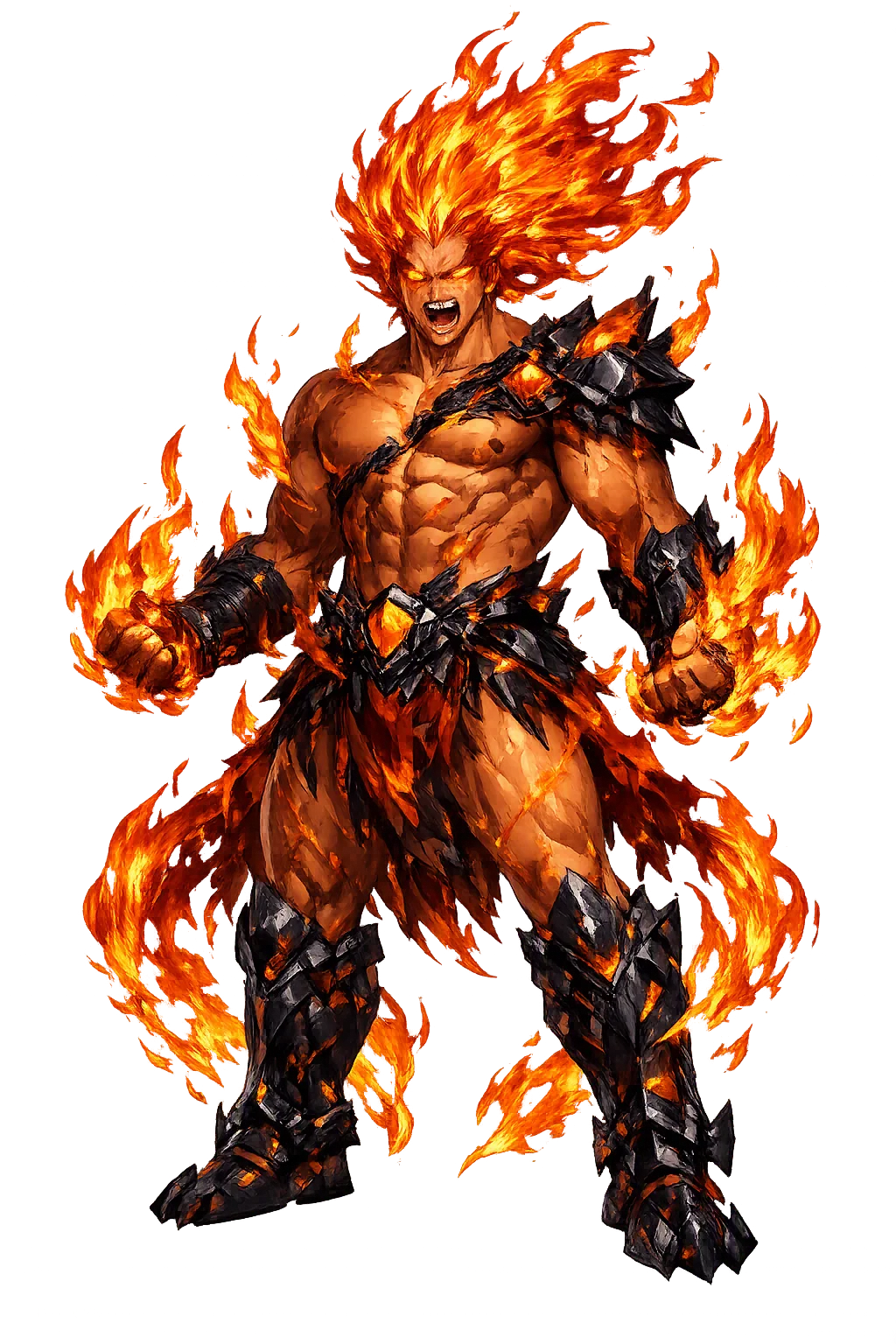
Stories of Kagutsuchi
Kagutsuchi's mythology is brief and absolute: a birth that kills, a death that multiplies life, and a legacy of fire that Japan's volcanoes still preach. The Kojiki spends little more than a page on him — yet that page is the hinge of the whole cosmogony, for it is at his birth that the creator goddess dies and the world divides into the living and the dead.
After the islands were born, Izanami bore the last child of the creation — the fire kami Kagutsuchi — and his birth burned her. The Kojiki (I.8) tells it with terrible economy: the fire from the child's body scorched her, and from the agony of the wound the dying goddess brought forth still more kami — Kanayamabiko and Kanayamabime, the kami of metal, from her vomit; Haniyasubiko and Haniyasubime, the kami of clay and pottery, from her feces; and Midorikonomikami from her urine. Then, her body spent, Izanami died. She who had borne the islands and the thirty-odd kami of the land was destroyed by her final child: creation consuming its maker is the first law the new world teaches, and the fire god learned it in the only way a newborn can — by being it.
Izanagi's grief turned to rage — 'Why must I lose my beloved for this one child?' — and drawing the Totsuka-no-Tsurugi, the ten-handled sword of the brine, he cut the fire kami down. What fell from the blade was life. From the blood on its point came Iwasaku and Nesaku, the 'stone-cutting' kami; from the blood on its hilt came Mizuhanome, the goddess of water who quenches fire; and from the severed body came the mountain kami whose peaks still steam along the Japanese chain (Kojiki I.9). The Nihon Shoki preserves variant versions of the same burning-birth and gives the child the parallel names Homusubi and Hi-no-Kagutsuchi. Kagutsuchi thus dies the only death in the cosmogony struck by a god's own hand — and the dismemberment, like the birth, manufactures gods: fire destroys, and destruction is revealed as one of generation's ordinary forms.
Because Izanami died, Izanagi followed her down to the land of Yomi; because he followed, he saw her body corrupted, guarded by the eight Thunder Kami; because he fled from the sight, Izanami cursed him, and the world split in two at the Even Pass of Yomi — Izanagi swearing to give life its thousand generations, Izanami to take a thousand a day. Then, purifying himself in the river of the plain, Izanagi washed from his left eye Amaterasu, from his right eye Tsukuyomi, from his nose Susano-o — the three sovereign children of the later pantheon (Kojiki I.10–11). None of it happens without the fire child's birth. Kagutsuchi is the pivot of the entire Japanese cosmogony: the instant at which the world of undying creators ends and the world of birth and death begins. One page of story carries every assumption the later shrines and epics must make — the sun included, for even Amaterasu exists because a fire once killed a mother.
The Kojiki gives Kagutsuchi no cult and no further adventures — his worship was the ordinary reverence of fire itself. Under the names Hi-no-Kagutsuchi and Homusubi, 'fire-producer,' he was honored at the hearth and the forge, where fire cooked, warmed, and smelted; fittingly, the metal and clay kami born from Izanami's dying body minister to the same fireplace and furnace. Folk tradition kept a careful double feeling toward him: fire was the gift no household could live without and the force that could erase the household in an hour, and in parts of Japan a prayer was still spoken before the first fire of the new year. This is the myth reduced to its element — no temples, no epics, only the daily negotiation between human beings and the one power in the house that must never be insulted. The volcanoes are his body; the kitchen fire is his ghost; both demand the same attention.
Creation, Destruction, and the Origin of Death
Kagutsuchi is the fire god whose birth burned his mother Izanami to death, introducing mortality into the mythic world. He is creation and destruction in one figure: the flame that forges and the flame that consumes. After his death at the hands of Izanagi, his scattered body became the volcanoes and hot springs of Japan.
His birth from Izanami introduced both fire and death into the world.
Izanagi avenged Izanami's death by cutting Kagutsuchi into pieces with the Totsuka-no-Tsurugi.
His dismembered body became the volcanoes and geothermal springs of the land.
Fire for cooking, warmth, and metalwork descends from his power.
From the original script to the living URL
迦具土
The name in its original Japanese form. Kagutsuchi (迦具土) is attested in the source tradition — “The burning force”. Its original diacritics and script distinctions carry the full phonetic and orthographic weight of the source tradition.
kagutsuchi
The plain kagutsuchi form is identical to the Unicode restoration. Because this name is already written in Latin letters, no diacritics, stress, or script information were lost — only capitalization differs.
Kagutsuchi
The Unicode restoration does not need to recover lost marks for Kagutsuchi. Its value is canonical spelling and consistent cataloguing, not the reconstruction of erased orthography. The domain is readable as-is to both DNS and humanity.
Kagutsuchi.com
This restoration is written entirely in ASCII letters — no Punycode encoding stands between Kagutsuchi and the DNS. The domain reads identically to machines and to human eyes.
Owned, ideal, and ASCII forms of Kagutsuchi
Kagutsuchi
Restores 迦具土. The full Unicode restoration. kagutsuchi.com is not in the PuniCodex collection — it is watched for release; if it drops, this temple upgrades to an owned flagship.
How Kagutsuchi was spoken
How Kagutsuchi is preserved in writing
A bespoke provenance study for Kagutsuchi is being prepared by the PUNICODEX scholarly team.
Contribute scholarly provenance →The lore you have read is the living myth. Extended Lore opens the scholarly vault beneath it: the cult and its material remains, a history of the image, the name after antiquity, a meditation on what the name still means, and the full scholarly apparatus — etymology, orthography, sources.
Enter Extended Lore