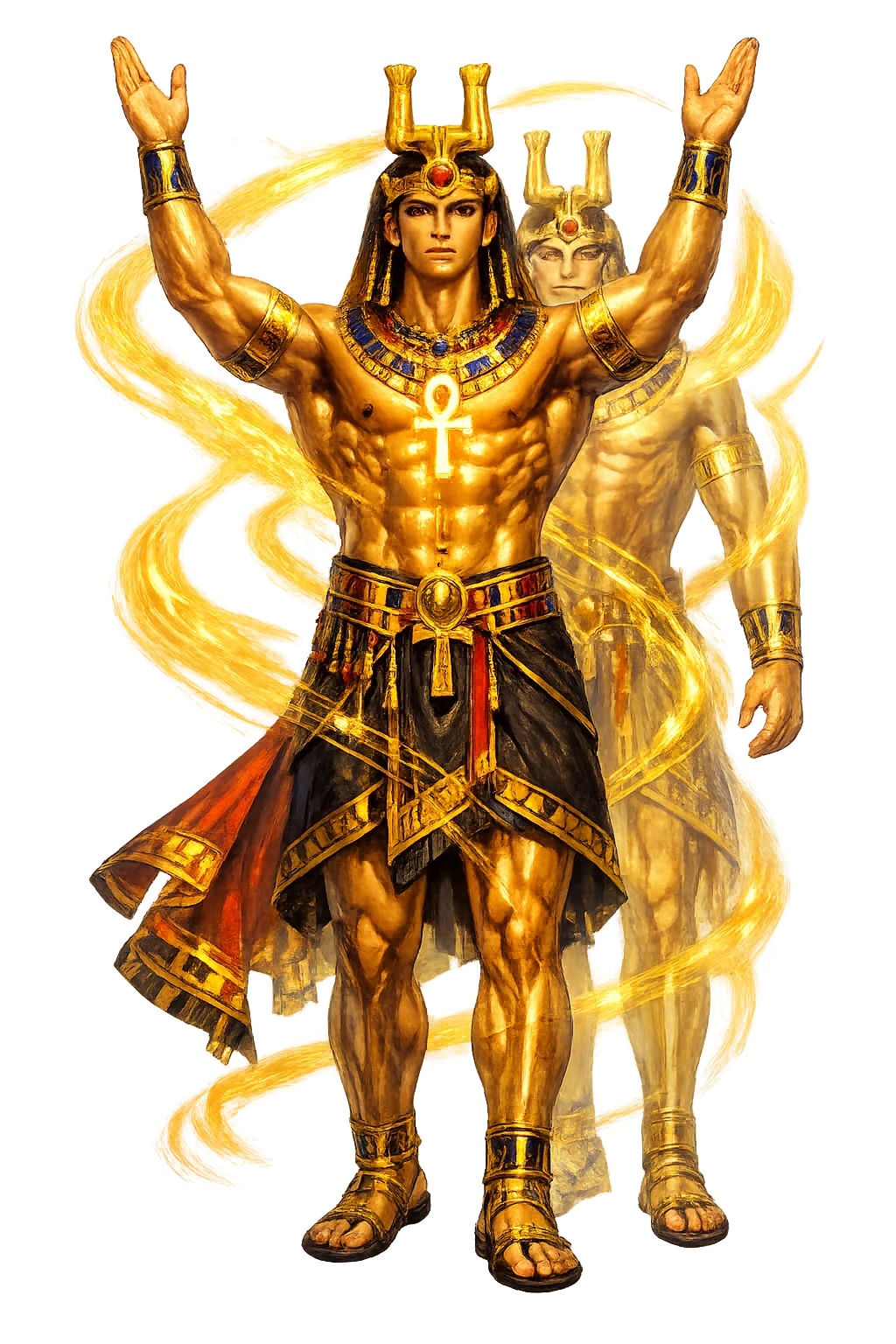
Stories of Kꜣ
The Egyptian ka is the vital double, the life-force that makes a person alive and that continues after death. Born with the body, shaped by the creator god, and sustained by offerings, the ka links the living, the dead, and the divine — existence understood as a maintained relationship, not a possession.
Egyptian texts make the ka a companion formed together with the body itself. In the divine-birth scenes at Deir el-Bahari and Luxor, the ram-headed Khnum fashions the royal child and its ka on the potter's wheel while the frog-headed Heket breathes life into the finished form. The idea is far older than these New Kingdom reliefs: Pyramid Texts utterances already promise the king that his ka will stand at his side among the gods (Pyramid Texts, Utterance 213), and Coffin Texts Spell 80 bears the title 'for making the ka live'. To have a ka is simply to be alive — the word glosses 'vital essence, double, sustenance' — yet the ka is also a relationship: it belongs to the person, but it is made by a god, must be fed by a family, and will be judged among the dead. Egyptian anthropology never imagined life as a closed possession; it was a gift kept in circulation from the wheel of Khnum to the offering table of the tomb.
Death divides the person but does not dismiss the ka. The vital force leaves the corpse yet remains bound to it, returning to the mummy or to a statue made in the deceased's likeness — which is why every fine tomb of the Old Kingdom sets a reserve head or ka-statue in the serdab, a sealed chamber with an eye-slot through which the image could watch the sun rise and the offerings arrive. The rite that made this habitation lawful was the Opening of the Mouth, performed before mummy and statue alike: the adze touched the lips, and the ka could again receive breath, water, and bread. Letters to the dead from the Middle Kingdom — the Heqanakht correspondence — address the dead as powers who can be petitioned, reproached, and offended. The tomb chapel, the false door, the offering slab: all are engineering for a single need, that the ka never be cut off from its maintenance, because an unfed ka is not a soul in torment but a creditor at the door.
Kings possess not one ka but many: the royal titulary itself is ka-stuff, and the Horus-name lives as the king's divine double on earth, while Pyramid Texts utterances multiply the king's kas before Atum and the Ennead. The gods keep kas as well — 'Amun, his ka' is a standing formula of the Theban theology, and the ka of Ptah is invoked across the Memphite tradition. This is the ka's deepest office: it is the theological machinery of presence. A god is not in one place but in every temple that houses his image; not one being but as many as the names and cult statues that carry him. Long before later theologies wrestled with how the infinite can be present in many places, Egypt solved the problem practically — by giving power a double, and the double as many houses as piety could build. The ka is therefore not only personal but constitutional: the device by which authority becomes habitable.
Every Egyptian offering invokes the ka by name. The formula ḥtp-di-nsw — 'an offering which the king gives' — routes bread, beer, oxen, and fowl through the king's generosity to the ka of god or dead, so that temple cult and tomb cult run on the same sentence. Book of the Dead Spell 105, 'for satisfying the ka in the necropolis', turns the meal into a speech-act with teeth: the ka swears it will not seize what is unlawful nor touch the offerings of another dead. Spell 110 admits the deceased to the Field of Iaru, where the ka eats of a harvest that grows cubits tall and the reaping is easy. The Egyptians understood with a clarity modern religion rarely matches that the dead are dependents — that survival is a budget. A society is measured, the spells imply, not by the height of its pyramids but by how faithfully it feeds what it claims to honor, year after year, when the feeding has stopped being spectacular.
Life-Force · Sustenance · Divine Presence
The Egyptian kꜣ is the life-force that makes a person alive, the vital double created at birth and sustained by offerings. Where the ba is the mobile personality, the ka remains tethered to the body and the tomb, consuming the spiritual essence of bread, beer, and meat.
Khnum shapes the infant and its ka on the potter's wheel; Heket breathes life into the finished form.
Tombs are 'houses of the ka'; the formula 'an offering which the king gives' feeds it after death.
A ka-statue in the serdab provides a form for the ka if the body perishes, its eyes on the sun.
Kings possess multiple kas; gods extend their presence into every temple through ka-doubles.
From the original script to the living URL
𓂓𓏤
The name in its original Egyptian form. Kꜣ (𓂓𓏤) is attested in the source tradition — “The vital essence, life force, or double of a person. Created at birth and surviving death.”. Its Egyptological ain and alef letters carry the full phonetic and orthographic weight of the source tradition.
ka
Reduced to plain ka, the name loses everything that made it specific: Egyptological ain and alef letters. What remains is an ASCII string that machines can parse but that no longer speaks with its original voice.
Kꜣ
The Unicode restoration recovers what ASCII flattened. Kꜣ restores Egyptological ain and alef letters, returning the name to its original written dignity. The domain encodes to Punycode, but the browser displays the truth.
Kꜣ.com → xn--k-yw3e.com
The non-ASCII characters in Kꜣ are encoded while the ASCII remains visible. To the DNS, it is Punycode. To humanity, it is Kꜣ.
Owned, ideal, and ASCII forms of Kꜣ
Kꜣ
Restores 𓂓𓏤. The live temple domain — kꜣ.com.
ka
Flattens 𓂓𓏤. The plain ASCII fallback — what DNS and legacy systems see.
How Kꜣ was spoken
How Kꜣ travels from ancient script to the modern URL
Egyptian kꜣ “vital essence, life-force"; the double created at birth and sustained by offerings.
Vital Essence, Life Force
The Unicode restoration Kꜣ uses Egyptological characters registrable in .com; hieroglyphs are outside the .com IDN table.
The lore you have read is the living myth. Extended Lore opens the scholarly vault beneath it: the cult and its material remains, a history of the image, the name after antiquity, a meditation on what the name still means, and the full scholarly apparatus — etymology, orthography, sources.
Enter Extended Lore