PuniCodex

Extended Lore

𓂓𓏤 Kꜣ

Etymology · Orthography · Cult · Iconography · Reception · Sources

Tier 1 Kꜣ.com
Kꜣ — Vital Essence, Life Force
01

Quick Facts

Essential information about Kꜣ, Vital Essence, Life Force

Original Script𓂓𓏤
Unicode RestorationKꜣ
Reconstructed Pronunciation/kaːʔ/
PantheonEgyptian
DomainVital Essence, Life Force
MeaningThe vital essence, life force, or double of a person. Created at birth and surviving death.
ClassificationTier 1
Primary DomainKꜣ.com
Sacred SymbolsOffering table, Ka-statue, Ankh, False door, Two upraised arms
02

Etymology & Word Family

From original script to Unicode restoration

Original Script 𓂓𓏤 Kꜣ — "The vital essence, life force, or double of a person. Created at birth and surviving death."
Unicode Restoration Kꜣ Restored stress, length, and script
Modern ASCII ka Plain-ASCII fallback

From Egyptian kꜣ, a term for the life-force or 'double' created with a person; the hieroglyphic spelling records consonants only.

03

Unicode Character Breakdown

Character-by-character philological analysis

CharacterUnicodeNameBlockPhonetic Role
KU+004BLatin Capital Letter KBasic LatinSame, capitalized
ꜣU+A723Latin Small Letter Egyptological AlefLatin Extended-DEgyptological aleph — glottal stop or specific vocalic quality

The Tier 1 classification reflects how much of the original phonology this restoration preserves — stress and vowel length for Greek names, distinctive letters and diacritics for every other tradition.

04

Cult & Worship

How the sacred was kept — rites, sanctuaries, remains

The Cult

The cult of the ka was domestic and funerary rather than civic. Every tomb required an offering chapel with a false door through which the ka could receive bread, beer, fowl, and incense, and a serdab holding one or more ka-statues to serve as alternative bodies if the corpse decayed. The daily offering formula, repeated by the deceased's heirs or by mortuary priests, named the ka as beneficiary. The Opening of the Mouth ritual reanimated statues so that the ka could inhabit them, and kings were thought to be united with their ka at coronation, binding the life-force to legitimacy.

In the Earth

Ka-statues and offering chapels dominate the archaeological record. The reserve heads of the Fourth Dynasty from Giza and the wooden statue of the official Kaaper (Fifth Dynasty, Saqqara; the so-called 'Sheikh el-Beled' companion) provided alternative bodies for the ka, while the many ka-statues of officials from Saqqara and Giza filled their serdabs. Offering tables and false doors in the tomb chapels of Thebes and Memphis — the mastabas of Ti and Mereruka preserve whole processions of offering-bearers approaching the tomb owner's ka — directed food to the life-force. Middle Kingdom letters to the dead (the Heqanakht archive) show the cult operating in real families, and the New Kingdom divine-birth colonnades at Deir el-Bahari carve Khnum at his wheel in stone.

05

Iconography

How Kꜣ was imaged across the ages

The Image

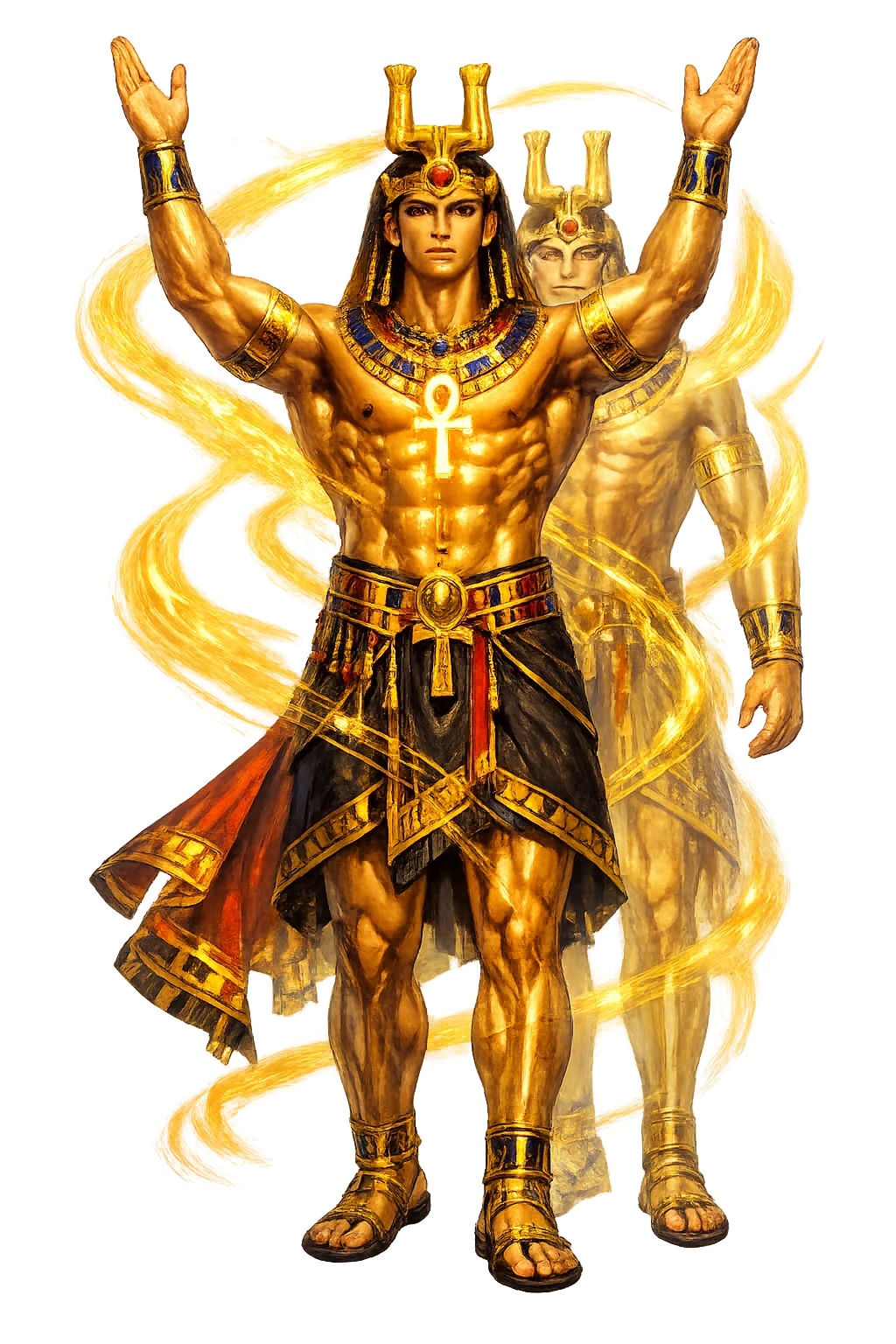
The ka was rarely shown as a separate figure. Its usual sign is the hieroglyph of upraised arms, sometimes perched on the king's head like an embrace. Reserve heads of the Fourth Dynasty from Giza and the wooden statue of the official Kaaper from Saqqara were intended to house the ka, not to depict it. In later religious art the ka could be represented as a smaller duplicate figure accompanying the deceased, but the dominant visual expression remained the offering table, false door, and statue that sustained it rather than any icon of the ka itself.

06

Reception & Transformation

The name after its own age — transmission, translation, survival

Afterlives

The Egyptian ka was transmitted through Greek and Roman encounters with Egypt, contributing to discussions of the soul, the double, and the afterlife in Hermetic and Neoplatonic circles. After hieroglyphs were forgotten, the concept was recovered in the nineteenth century by decipherment and by scholars such as Champollion and Lepsius, who translated Pyramid Texts and Coffin Texts. The idea of a life-force or double has since entered popular vocabulary, often loosely translated as "spirit" or "soul," and it remains a standard topic in Egyptology courses and museum labels. Its survival depends almost entirely on the monumental tomb record rather than on continuous living tradition.

Identifications Across Traditions

The ka has no direct counterpart in Greek or Roman religion, but related ideas circulated.

Greek authors sometimes interpreted Egyptian ka-statues as 'doubles' or 'guardian spirits,' and the Roman genius and Juno concepts may have faintly echoed the idea of a personal life-force. In Coptic Christianity, the old vocabulary of ka and ba was largely replaced by Greek pneuma and psychē, though the practice of offering food at tombs survived in modified forms. Modern Theosophy and Hermeticism revived the ka as the 'etheric double,' an energetic body that sustains the physical form. In Kemetic reconstruction, the ka remains a central concept: the life-force that must be fed, remembered, and honored.

Modern Legacy

The ka survives wherever people speak of a life-force or energy body.

From Theosophical 'etheric doubles' to New Age 'auras,' from Chinese qi to Hindu prāṇa, modern seekers have repeatedly rediscovered the Egyptian intuition that physical life depends on an invisible sustaining power. The ka's need for offerings has been reinterpreted as the need for attention, memory, and ritual care. In museums, ka-statues stand as reminders that the Egyptians imagined survival as a social act: the dead continue only if the living continue to feed them. The ka is thus ancestor to every modern practice that treats the dead as ongoing participants in family life.

07

The Meditation

What Kꜣ means — beyond the dictionary

The Egyptian ka quietly contradicts every modern theory of the self. It is not the body, since it can abandon the corpse and inhabit a statue; not the personality, since that office belongs to the ba, the bird that comes and goes; not the soul in the Christian sense, since a ka can be hungry, offended, and fed with bread. The ka is the simple and radical claim that to be alive is to be accompanied — that a person is not a closed unit but an open circuit requiring sustenance, attention, and a dwelling. The tomb stelae that beg passers-by to speak the dead's name, the offering tables renewed at festivals, the ka-statue standing in the serdab with a slot for the gaze: all are engineering for this maintenance. To read the ka rightly is to see why the Egyptians feared the nameless dead more than the dangerous ones, and why their deepest prayer was so modest — that the ka be satisfied, and the name continue.

08

Frequently Asked Questions

Common questions about Kꜣ, Vital Essence, Life Force, and Unicode restoration

01How do you pronounce Kꜣ?

In reconstructed pronunciation, Kꜣ is /kaːʔ/ — approximately 'KAH-ah' — say a firm ka, hold the vowel, then close with a soft glottal catch.

02What does Kꜣ mean?

Kꜣ means The vital essence, life force, or double of a person. Created at birth and surviving death. in the egyptian tradition.

03What are the symbols of Kꜣ?

Kꜣ is associated with Offering table (The material focus of ka-sustenance, heaped with bread, beer, and meat), Ka-statue (A substitute body for the life-force, standing in the sealed serdab behind an eye-slot), Ankh (The breath of life that the ka receives and perpetuates), False door (The chapel stela through which the ka passes between the worlds of the dead and the living), Two upraised arms (The ka-hieroglyph itself — the gesture of one who reaches for, and receives, sustenance).

04Why restore Kꜣ in Unicode?

Plain ASCII ka strips the stress, length, and script that make the name specific. Unicode restoration returns the name to its original written dignity.

05What is the most important myth about Kꜣ?

“The Ka Created at Birth” — the Creation story that anchors the mythology of Kꜣ, told in full on the lore page.

09

Scholarly Sources

The philological foundations of this restoration

Every claim on this page is grounded in established scholarship. The orthographic restorations follow disciplinary convention. The etymological chain follows the best available reference works. This is not invention — it is resurrection through scholarship.

◈

Lexicography & Philology

  • Faulkner, R. O. A Concise Dictionary of Middle Egyptian. Oxford: Griffith Institute, 1962.
  • Gardiner
  • Allen
◎

Primary Texts

  • Pyramid Texts, esp. Utterance 213 (the king's ka before Atum), trans. R. O. Faulkner
  • Coffin Texts, Spell 80 (for making the ka live)
  • Book of the Dead, Spell 105 (for satisfying the ka) and Spell 110 (the ka in the Field of Iaru)
  • Taylor, John H. (ed.), Journey through the Afterlife: Ancient Egyptian Book of the Dead, British Museum Press, 2010
◉

Archaeology & Art History

  • Material evidence — iconography, inscriptions, and temple archaeology — for Kꜣ and related cults.
✦

Religious Studies

  • Erman, Adolf, and Hermann Grapow, Wörterbuch der ägyptischen Sprache, s.v. kꜣ
  • Kemp, Barry J., Ancient Egypt: Anatomy of a Civilization, Routledge, 1989
Return

The Surface Awaits

You have traced the name from its earliest attestation to its Unicode restoration. Now return to the myth. The story is where the name lives.

Back to Lore
Kꜣ mascot