Stories of Jǫrð
Jǫrð has no saga of her own — the Norse sources never give her a deed. Her 'myths' are her genealogy, her marriage, her three names, and the silence where her temple should be; read together they are the Norse answer to the question of what the ground is.
The Prose Edda (Gylfaginning ch. 9–10) gives Jǫrð the strangest pedigree in the pantheon: she is the daughter of Anarr and Nótt — of Anarr and Night. Her mother Nótt is the giantess who drives the black chariot across the night sky, ancestress of every dawn; her father Anarr is little more than a name in the margin. From Night comes the earth, and from Night also comes Dagr, Day, born of the bright Dellingr — so the earth's brother is daylight itself, and the two are ever turning over the same horizon. The genealogy is a compact cosmology stated as a family tree: darkness precedes and engenders both the ground we stand on and the light that crosses it. When the skalds called Þórr kin of Nótt they were keeping the whole system inside one kenning — the thunder's pedigree runs back past Óðinn to the Night that came before the gods.
Snorri lists Jǫrð among Óðinn's wives — Gylfaginning ch. 9 names her in the tally of nine — and the whole mythology leans on the match. Their son is Þórr, strongest of the gods, and the skalds' standard style for him is the double patronymic: son of Óðinn and of Jǫrð. The union is the Norse sky-father/earth-mother formula compressed into a single household — the storm is literally what happens when heaven touches ground. Nowhere do the sources narrate the courtship, and none is needed: this is not a love story but a standing fact, like gravity. Þórr's hammer-fall is the marriage still being consummated; every thunderstorm is the myth told again in weather, and the skalds, who never tired of the kenning, understood that a formula repeated a thousand times is a cult.
Þórr's mother wears three names. The skaldic handbook Skáldskaparmál lists the thunderer as son of Óðinn and of Jǫrð, Fjǫrgyn, and Hlóðyn — and Völuspá (v. 56) calls him 'Hlóðyn's glorious son' at the world's end, when he strides out to meet the wolf. Whether Fjǫrgyn and Hlóðyn are bynames of Jǫrð or older, separate earth-goddesses folded into her by the skalds, the sources never say; Cleasby–Vigfusson treats Fjǫrgyn as an earth-goddess in her own right, and the element's own meaning is disputed (mountain? the living world?) — fitting for a name whose owner is disputed too. The three-name pattern is the tradition's honest way of admitting that the earth is one goddess wearing as many faces as terrain: field, fell, and the grave-dark loam. Þórr, asked, could have named three mothers; the skalds answered for him by never choosing.
No temple of Jǫrð is recorded anywhere in the Norse world — no altar, no image, no dedication — and the silence is the loudest thing the sources say about her. Worship of the earth ran beneath cult rather than through it: the graves were dug into her, the fields cut out of her, every hof stood on her, and the first gesture of the rites was to face or touch the ground. The law approached her the only way law can — as the commons, the unowned ground and the open pathways that belong to everyone, which is to say to the earth herself. Her 'temple' is thus the entire archaeological record of the North: every longhouse floor, every barrow, every field-wall. A goddess without a sanctuary is not a forgotten goddess; she is the one sanctuary everything is built in, and the North never stopped holding services.
Earth, Mother of Thor
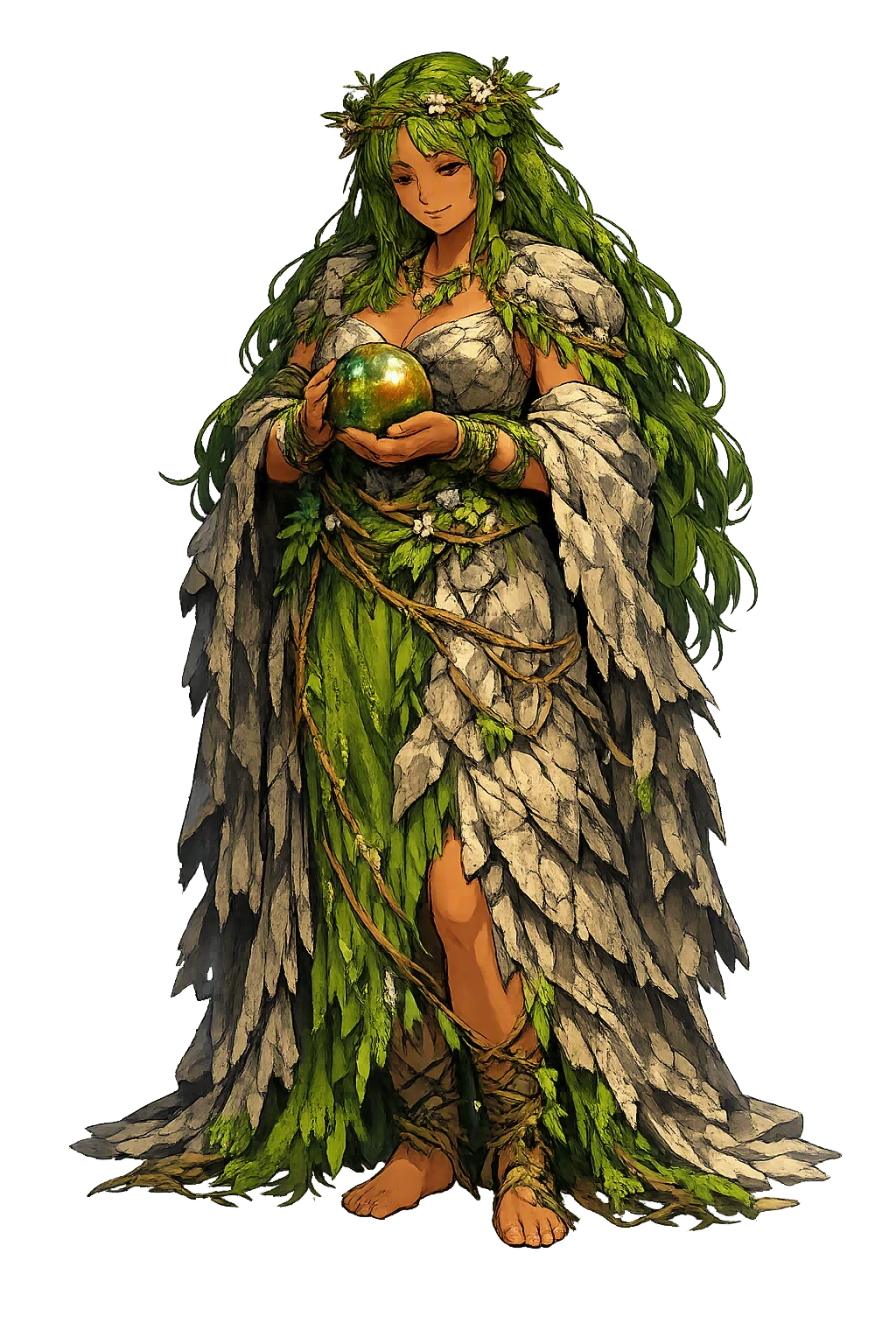
Jǫrð is the Norse earth — not a character with adventures but the ground itself personified: daughter of Night, wife of Óðinn, and mother of Þórr, the mightiest of the gods. The skalds need no stories about her; they call the very land by her name, and every thunder-clap is her son walking.
Her domain is the ground itself — fields, mountains, graves; she is the oldest of the ásynjur because everything stands on her.
By Óðinn she bears Þórr, strongest of the gods — the storm literally born of the earth (Gylfaginning ch. 9; Skáldskaparmál).
Jǫrð recovers the ǫ and ð that plain ASCII jord flattens; the restoration is the name as the skalds wrote it.
Listed among the ásynjur and invoked in kennings — 'son of Jǫrð' is Þórr's standard style from Bragi to the late skalds.
From the original script to the living URL
ᛁᚬᚱᚦ
The name in its original Norse form. Jǫrð (ᛁᚬᚱᚦ) is attested in the source tradition — “Earth”. Its original diacritics and script distinctions carry the full phonetic and orthographic weight of the source tradition.
jord
Reduced to plain jord, the name loses everything that made it specific: original diacritics and script distinctions. What remains is an ASCII string that machines can parse but that no longer speaks with its original voice.
Jǫrð
The Unicode restoration recovers what ASCII flattened. Jǫrð restores original diacritics and script distinctions, returning the name to its original written dignity. The domain encodes to Punycode, but the browser displays the truth.
Jǫrð.com → xn--jr-xja61h.com
The non-ASCII characters in Jǫrð are encoded while the ASCII remains visible. To the DNS, it is Punycode. To humanity, it is Jǫrð.
Owned, ideal, and ASCII forms of Jǫrð
Jǫrð
Restores ᛁᚬᚱᚦ. The live temple domain — jǫrð.com.
jord
Flattens ᛁᚬᚱᚦ. The plain ASCII fallback — what DNS and legacy systems see.
How Jǫrð was spoken
How Jǫrð travels from ancient script to the modern URL
Old Norse jǫrð 'earth'; cognate with English earth and Gothic airþa.
Earth, land, fertility; mother of Thor and consort of Óðinn.
The lore you have read is the living myth. Extended Lore opens the scholarly vault beneath it: the cult and its material remains, a history of the image, the name after antiquity, a meditation on what the name still means, and the full scholarly apparatus — etymology, orthography, sources.
Enter Extended Lore