PuniCodex

Extended Lore

ᛁᚬᚱᚦ Jǫrð

Etymology · Orthography · Cult · Iconography · Reception · Sources

Tier 1 Jǫrð.com
Jǫrð — Earth, Mother of Thor
01

Quick Facts

Essential information about Jǫrð, Earth, Mother of Thor

Original Scriptᛁᚬᚱᚦ
Unicode RestorationJǫrð
Reconstructed Pronunciation/jɔrð/
PantheonNorse
DomainEarth, Mother of Thor
MeaningEarth
ClassificationTier 1
Primary DomainJǫrð.com
Sacred SymbolsThe land itself, Þórr, Fjǫrgyn and Hlóðyn, The dark lineage
02

Etymology & Word Family

From original script to Unicode restoration

Proto-germanic *erþō earth
Original Script ᛁᚬᚱᚦ Jǫrð — "Earth"
Unicode Restoration Jǫrð Restored stress, length, and script
Modern ASCII jord Plain-ASCII fallback

Old Norse Jǫrð, from Proto-Germanic *erþō 'earth'; personified as a jötunn and mother of Thor by Odin.

03

Unicode Character Breakdown

Character-by-character philological analysis

CharacterUnicodeNameBlockPhonetic Role
JU+004ALatin Capital Letter JBasic LatinSame, capitalized
ǫU+01EBLatin Small Letter O with OgonekLatin Extended-BO with ogonek: nasalized vowel
rU+0072Latin Small Letter RBasic LatinSame
ðU+00F0Latin Small Letter EthLatin-1 SupplementEth: voiced dental fricative

The Tier 1 classification reflects how much of the original phonology this restoration preserves — stress and vowel length for Greek names, distinctive letters and diacritics for every other tradition.

04

Cult & Worship

How the sacred was kept — rites, sanctuaries, remains

The Cult

No sanctuary, festival, or priesthood of Jǫrð is recorded anywhere in the sources — her cult, if the word even applies, was ubiquitous and undedicated. Every outdoor rite in Scandinavia happened on her body, and blót was poured on the ground itself, yet no text assigns the earth's portion to her by name. The skalds show reverence rather than cult: she is the standard kenning-base for the land, invoked as Þórr's mother whenever the thunderer's strength must be praised. That is the whole ancient record, honestly stated. Modern Ásatrú's pouring to Jǫrð builds on this silence rather than on any recovered rite — a revival, not a survival.

In the Earth

Jǫrð has no temple, altar, or image, and that absence is itself the archaeological fact: no site in Scandinavia can be assigned to her cult, and even the great wagon procession of the earth-goddess described by Tacitus (Germania ch. 40) belongs to Nerthus, her continental Germanic cousin, not to Jǫrð by name. The closest material kin are the procession finds of the Vendel and Viking periods — wagons and horse-gear that belong to the vanir cult Tacitus describes. What can be dated is her son: runestones across Scandinavia invoke Þórr (the ninth-century Rök stone calls on Þórr for protection), and the skaldic corpus keeps her name in constant grammatical use — jǫrð, 'earth' — down to every modern Scandinavian tongue. Her monument is the land itself and the language that never stopped naming it.

05

Iconography

How Jǫrð was imaged across the ages

The Image

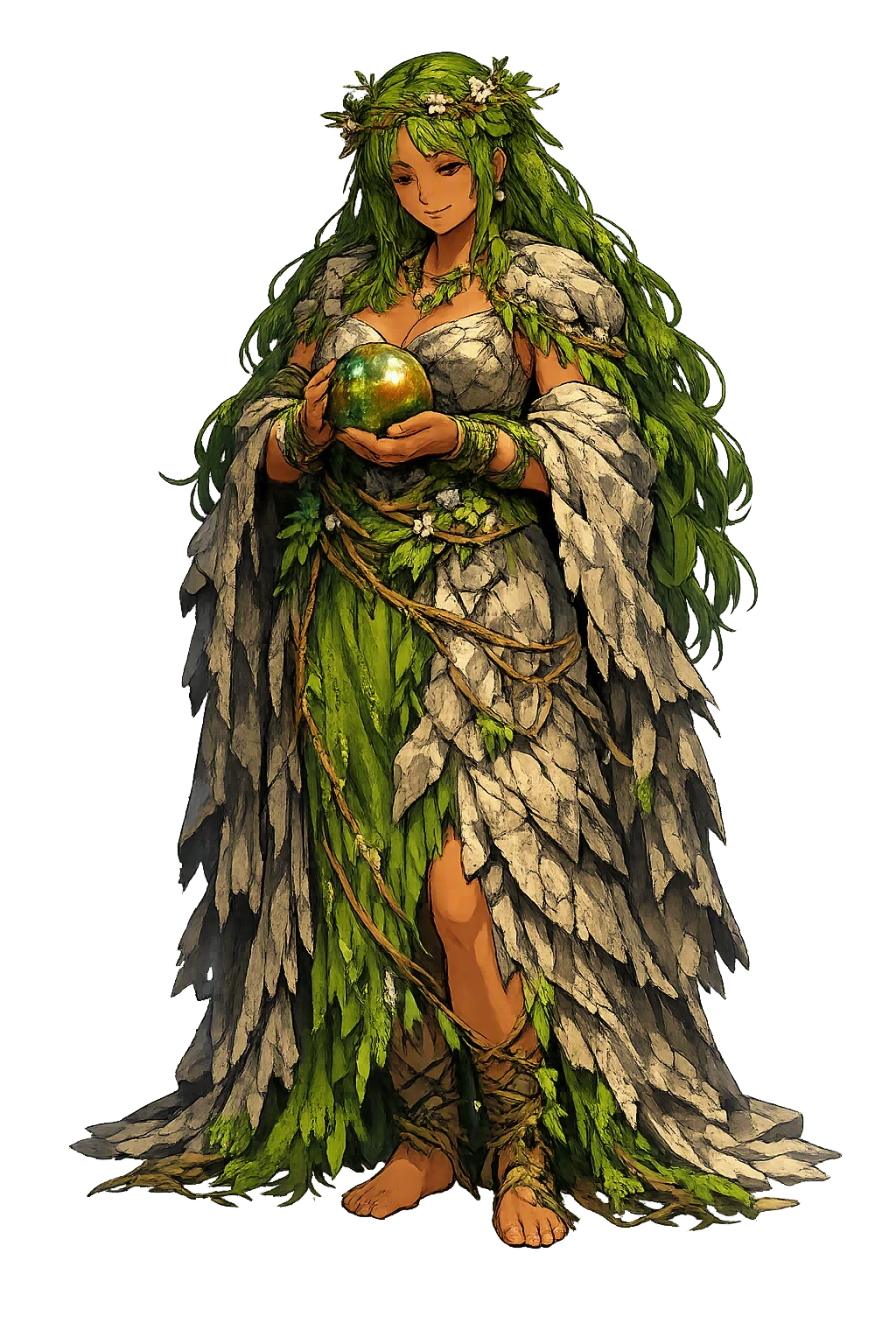
Jǫrð was never pictured: no image, amulet, or carving that can be called hers survives, and nothing in Viking art personifies the earth as a standing figure — she is the ground-line on which everything else is drawn. Her attributes exist only in the poets' grammar: the kennings make her mother of Þórr, daughter of Night, wife of Óðinn, and dress the land itself in her bynames, Fjǫrgyn and Hlóðyn. If the skalds gave her a body, they never wrote it down, and no carver cut one. The absence is principled rather than accidental: a goddess who is the whole ground cannot be drawn standing upon it.

06

Reception & Transformation

The name after its own age — transmission, translation, survival

Afterlives

Jǫrð's transmission is the transmission of the skaldic diction that kept her alive. Her name runs through the kenning-catalogue Snorri compiled in Skáldskaparmál (c. 1220), and her stanzas rode the same vellum as the rest of the Eddas — Codex Regius, Codex Upsaliensis — into the hands of seventeenth-century antiquarians; Peder Resen's 1665 edition put Jarðar sonr, son of Earth, into European print. The nineteenth century filed her in the handbooks: Grimm treated the Germanic earth-mother in Deutsche Mythologie, and the Cleasby–Vigfússon dictionary (1874), s.v. jörð, gave English readers the full skaldic evidence. Twentieth-century scholarship — de Vries's Altgermanische Religionsgeschichte, then Simek and Lindow in the reference tradition — debated whether she is a goddess or a personified noun. The debate itself is her afterlife: the skaldic machine that generated kennings kept one mother's name turning for centuries after the last skald was dead.

Identifications Across Traditions

Jǫrð's closest relative is Tacitus' Nerthus, the Terra Mater whose wagon processed among the Germanic tribes (Germania ch. 40) — the same earth-mother function on the mainland, though the sources never equate the names. Medieval Icelanders, translating classical texts, rendered Gaia and Tellus as Jǫrð, making her the Norse face of the universal earth-mother, an equation that survived into the scholarly Latin of the Edda commentaries. Modern reception has been generous and careless by turns: Marvel's comics make Thor the son of Gaea and the films of Frigga, splitting the ancient sky-father/earth-mother pairing into two rival cosmologies, while modern Heathenry restores Jǫrð herself to worship, blót and all — the rare case where a goddess' cult was revived not from archaeology but from grammar, her name having never stopped meaning 'earth.'

Modern Legacy

Jǫrð never died because she never lived anywhere but underfoot. Her name is the ordinary word for earth in Icelandic, Norwegian, Danish, and Swedish jord; English 'earth' descends from her Old English cognate eorþe. 'Mother Earth' — the phrase behind Earth Day, Gaia theory, and a whole modern environmental iconography — is, linguistically, Jǫrð's daughter. In Scandinavia her name has returned as a given name, and in Ásatrú blot she receives the first or final pouring, for the oldest reason: every rite that happens on the ground happens on her. Even her son's weekday carries the lineage quietly into English — Þórr's day, Thursday, is her family name worn by the calendar.

07

The Meditation

What Jǫrð means — beyond the dictionary

Jǫrð is the goddess who needs no biography. The Norse sources give her no adventure, no speech, no conflict — only a genealogy, a marriage, and a son; and then, in the kennings, something better than deeds: a body that is the world. To call the land 'Jǫrð' is to keep a person in the grammar of geography, to refuse the idea that the ground is dead matter. Her marriage to Óðinn is the oldest cosmological sentence in the language — the sky bestrides the earth, and the child of their union is the storm, Þórr, whose hammer-crash is the sound of his parents still touching. And her three names are the tradition's confession that the earth is one goddess wearing as many faces as terrain. A goddess without a temple is not a forgotten goddess. She is the one temple everything is built in.

08

Frequently Asked Questions

Common questions about Jǫrð, Earth, Mother of Thor, and Unicode restoration

01How do you pronounce Jǫrð?

In reconstructed pronunciation, Jǫrð is /jɔrð/ — approximately YORTH — the first sound is English 'y', the vowel the open 'o' of 'thought', and the name ends on the voiced 'th' of 'this'.

02What does Jǫrð mean?

Jǫrð means Earth in the norse tradition.

03What are the symbols of Jǫrð?

Jǫrð is associated with The land itself (She needs no emblem: in skaldic kennings the ground is her body, and 'the meal of Jǫrð' is a kenning for the dust of the earth), Þórr (Her son by Óðinn: the thunder-god's strength is earth-strength, and 'Jǫrð's son' is among his commonest titles), Fjǫrgyn and Hlóðyn (Her twin names in the poetry — Völuspá calls the thunderer 'Hlóðyn's glorious son' (v. 56) — three masks for a single mother), The dark lineage (As daughter of Anarr and Nótt (Night) she belongs to the old giant layer of the cosmos, older than Óðinn's race).

04Why restore Jǫrð in Unicode?

Plain ASCII jord strips the stress, length, and script that make the name specific. Unicode restoration returns the name to its original written dignity.

05What is the most important myth about Jǫrð?

“Daughter of Night” — the Genealogy story that anchors the mythology of Jǫrð, told in full on the lore page.

09

Scholarly Sources

The philological foundations of this restoration

Every claim on this page is grounded in established scholarship. The orthographic restorations follow disciplinary convention. The etymological chain follows the best available reference works. This is not invention — it is resurrection through scholarship.

◈

Lexicography & Philology

  • Cleasby-Vigfusson
◎

Primary Texts

  • Poetic Edda
  • Prose Edda
  • Snorri Sturluson, Gylfaginning ch. 9–10
  • Snorri Sturluson, Skáldskaparmál (kennings for Þórr)
  • Poetic Edda, Völuspá v. 56
◉

Archaeology & Art History

  • Material evidence — iconography, inscriptions, and temple archaeology — for Jǫrð and related cults.
✦

Religious Studies

  • Tacitus, Germania ch. 40 (Nerthus)
  • Cleasby-Vigfusson, An Icelandic-English Dictionary, s.v. jörð, Fjörgyn
  • de Vries, Altgermanische Religionsgeschichte
Return

The Surface Awaits

You have traced the name from its earliest attestation to its Unicode restoration. Now return to the myth. The story is where the name lives.

Back to Lore
Jǫrð mascot