
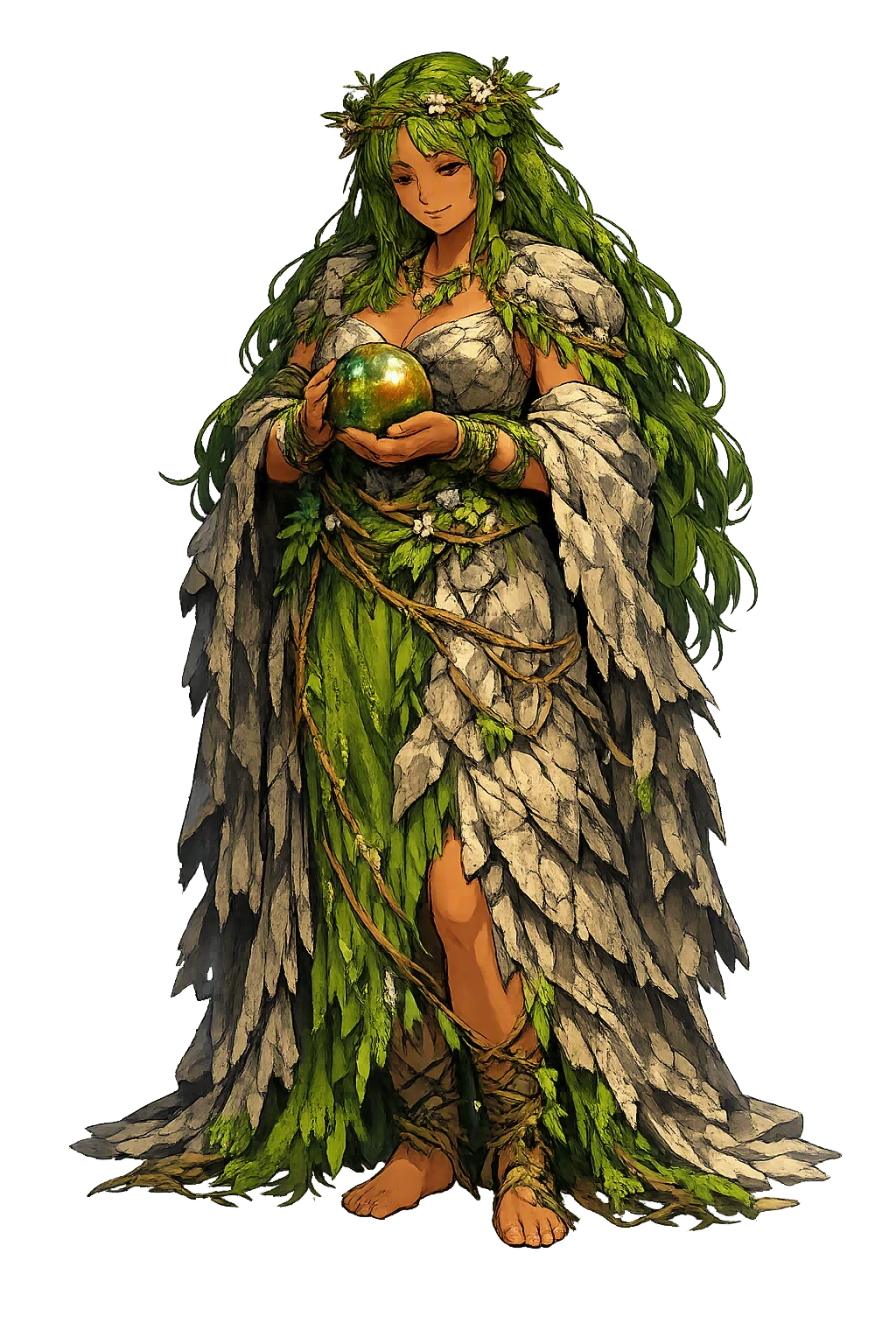
Why Jǫrð is spelled that way — and what it costs to get it right
There is a version of this name the early internet had to settle for: jord. This is the file on how Jǫrð replaced it.
Jǫrð has no saga of her own — the Norse sources never give her a deed. Her 'myths' are her genealogy, her marriage, her three names, and the silence where her temple should be; read together they are the Norse answer to the question of what the ground is.
At a Glance
- Restored name: Jǫrð
- ASCII form: jord
- Meaning: "Earth"
- Domain of influence: Earth, Mother of Thor
- Pantheon: Norse
- Classification: Tier 1
- Original script: ᛁᚬᚱᚦ
- Series: The Restoration Files, No. 247 of 548
The Name Before the Marks
Spoken, the name runs `/jɔrð/` — yORTH — the first sound is English 'y', the vowel the open 'o' of 'thought', and the name ends on the voiced 'th' of 'this'.
The Temple That Stands Now
The restored name is not a plaque; it is an address. The temple of Jǫrð lives at /jord/, with its mythology in the lore halls, its peer-reviewed record in the Scholarly Edition, and its place in the pattern atlas on the patterns floor.
Tier-1 is not a compliment; it is a measurement. This restoration keeps something the ASCII form provably loses, and the measurement is repeatable.
Where the Name Stood First
Jǫrð has no temple, altar, or image, and that absence is itself the archaeological fact: no site in Scandinavia can be assigned to her cult, and even the great wagon procession of the earth-goddess described by Tacitus (Germania ch. 40) belongs to Nerthus, her continental Germanic cousin, not to Jǫrð by name. The closest material kin are the procession finds of the Vendel and Viking periods — wagons and horse-gear that belong to the vanir cult Tacitus describes. What can be dated is her son: runestones across Scandinavia invoke Þórr (the ninth-century Rök stone calls on Þórr for protection), and the skaldic corpus keeps her name in constant grammatical use — jǫrð, 'earth' — down to every modern Scandinavian tongue. Her monument is the land itself and the language that never stopped naming it. The temple on the web is the newest of these addresses — the first one that fits in a pocket.
The Archetype at Work
The pattern atlas seats this temple in 7 industries, each match argued and weighted: Agriculture, Food & Harvest (earth personified and mother of Þórr; the soil from which every harvest grows.); Mythic Name Restoration (old Norse earth, whose ǫ distinguishes it from modern Jörð.); Diacritic-First Domains (the Old Norse ǫ in Jǫrð distinguishes it from modern Jörð.). The Resonance File reads those seats through the myths themselves.
In the Sacred Texts
The Norse tradition is not a vibe; it is a library. The Sacred Texts collection holds Poetic Edda and Prose Edda — the primary sources the temple's scholarship is built on. The temple is the argument; the texts are the evidence.
The File Continues
The temple's founding dispatch tells the name's story; its Resonance File reads the myths into the industries; the blog index holds the whole archive.
Continue the series — previous file: Jizō (read it here) · next file: Jǫrmungandr (read it here).
The Restoration Files are written from the same canonical record as the temples themselves: the lexicon, the lore catalog, the pattern atlas, and the cited scholarly sources. If a file ever disagrees with its temple, the temple is right — tell us, and the file will be corrected.