The Living Myth
Lord of the World, Puri, Devotion · Form of Krishna beloved at Puri
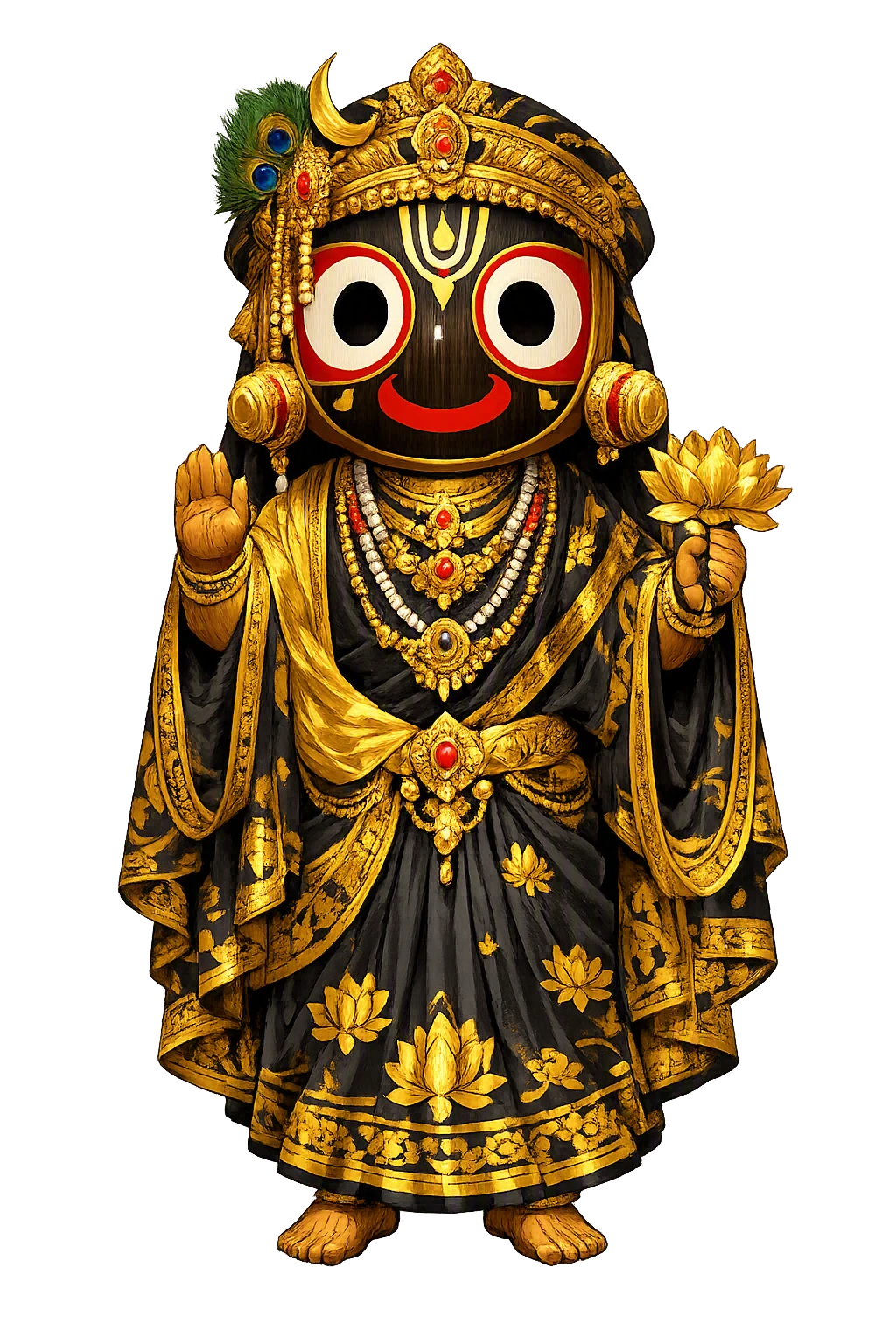
Stories of Jagannātha
Jagannātha's mythology is a foundation epic told in temple chronicles and Purāṇic chapters rather than in any single scripture. It tells how the Lord of the World came to the Odia coast: hidden among tribal worshippers, sought by a king, carved by a carpenter who vanished, and carried in person through his own city once every year.
King Indradyumna of Malwa heard whispers of a wonder: on the remote Blue Mountain of the eastern coast, the tribal chief Viśvavāsu worshipped in secret a form of Viṣṇu called Nīlamādhava, the Blue Lord. The king sent his priest Vidyāpati to find him. Vidyāpati lived among the Sabaras, won the chief's trust, and married his daughter Lalitā; when he was led at last to the hidden shrine, he scattered mustard seed along the path so the king could follow. But a storm swept down and carried the Blue Lord away before Indradyumna arrived. The king fasted on the shore, performed the horse sacrifice at Puruṣottama-kṣetra, and waited. In a dream the god spoke: build a temple, and I will come to you as a log from the sea. The Puruṣottama-khaṇḍa of the Skanda Purāṇa tells the tale, and the temple chronicle Mādala Pāñjī keeps it. The myth absorbs without erasing: the Sabara chief's line holds to this day the hereditary right to touch the god before anyone else.
One dawn a great log of fragrant reddish wood drifted in from the sea — dāru-brahman, Brahman come as timber, bearing the marks of conch, discus, mace, and lotus. An old carpenter arrived unasked and promised the king three images in twenty-one days, on one condition: no one might open the workshop door. Day by day the king waited; on the fourteenth day — the nineteenth in some tellings — the door was opened, and the carpenter was gone. On the platform stood three figures with huge round eyes and no arms: Jagannātha, his brother Balabhadra, his sister Subhadrā. Indradyumna was stricken, but the sage Nārada consoled him: the Lord had chosen the form his people would love, and the unfinished state was no accident but an invitation. The Mādala Pāñjī preserves the story; the Skanda Purāṇa tells a shorter form. A god who cannot hold anything must be held by his people — which is exactly what happens to him every single year.
Each summer, in the bright half of the month Āṣāḍha, the three images leave the great temple. Servants carry them swaying down the Bada Dānda, the Grand Road, and set them on three towered wooden chariots — Nandighoṣa for Jagannātha, some twenty metres tall with sixteen wheels — rebuilt from raw timber every year by hereditary carpenters. Hundreds of thousands pull the ropes, and the Gajapati, the king of Puri, sweeps the chariot platform with a golden broom, performing the duty of the humblest sweeper in his own kingdom. For nine days the Lord stays at the Gundicha temple, the house of his aunt Gundicha, and then the whole road walks him home. The temple chronicles record the festival across the centuries, and seventeenth- and eighteenth-century European travellers gave English a new word for an unstoppable mass — juggernaut. Once a year the Lord of the World, who has no feet, travels farther than any god who does.
The oldest question about Jagannātha is whose god he is, and the sources disagree by design. The Purāṇic tradition makes him Puruṣottama, Viṣṇu-Kṛṣṇa himself; the founding myth gives him a tribal cradle, the Sabara people of the Blue Mountain. Nineteenth- and twentieth-century scholarship added a Buddhist candidate: K. C. Panigrahi and others argued that the great mound of Puri had once been a stupa, the Buddha's tooth relic its treasure, and the Jagannātha cult a Brahmanical conversion of a Buddhist shrine. The landmark study of Eschmann, Kulke, and Tripathi (1978) refused to choose, reading the god as a layered negotiation — tribal deity, royal legitimation under the Eastern Ganga kings, and finally full Vaiṣṇava identity sealed when Jayadeva's Gītagovinda made Puri a center of Kṛṣṇa devotion in the twelfth century. The debate never closed because it cannot: Puri's god was assembled from all his claimants, and each layer still worships him. A god built by negotiation belongs to everyone who negotiated.
Lord of the World, Puri, Devotion
Jagannātha is Viṣṇu as the Lord of the World, worshipped at Puri in Odisha in a form older than any scripture about him: a great-eyed wooden god with no arms, who rides out once a year on a towered chariot pulled by human hands. His mythology is the story of how the world came to Puri — a tribal deity, a king's vow, a carpenter who vanished, and a journey that never stopped.
Puri, the sacred field where the Lord owns the land itself — in 1238 CE King Anangabhima III dedicated his entire kingdom to him.
The icons have no arms and no legs: the carpenter of the gods vanished before finishing them, and the tradition kept them unfinished on purpose.
Jagannātha with Balabhadra and Subhadrā on one platform — Kṛṣṇa, his brother, and his sister, worshipped as one household.
Once a year the Lord leaves the temple and rides a city-high wooden chariot pulled by thousands of hands down the Grand Road to his aunt's house.
From the original script to the living URL
जगन्नाथ
The name in its original Sanskrit form. Jagannātha (जगन्नाथ) is attested in the source tradition — “Lord of the universe”. Its macron-length vowels carry the full phonetic and orthographic weight of the source tradition.
jagannatha
Reduced to plain jagannatha, the name loses everything that made it specific: macron-length vowels. What remains is an ASCII string that machines can parse but that no longer speaks with its original voice.
Jagannātha
The Unicode restoration recovers what ASCII flattened. Jagannātha restores macron-length vowels, returning the name to its original written dignity. The domain encodes to Punycode, but the browser displays the truth.
Jagannātha.com → xn--jaganntha-bcb.com
The non-ASCII characters in Jagannātha are encoded while the ASCII remains visible. To the DNS, it is Punycode. To humanity, it is Jagannātha.
Owned, ideal, and ASCII forms of Jagannātha
Jagannātha
Restores जगन्नाथ. The live temple domain — jagannātha.com.
jagannatha
Flattens जगन्नाथ. The plain ASCII fallback — what DNS and legacy systems see.
How Jagannātha was spoken
How Jagannātha travels from ancient script to the modern URL
The lore you have read is the living myth. Extended Lore opens the scholarly vault beneath it: the cult and its material remains, a history of the image, the name after antiquity, a meditation on what the name still means, and the full scholarly apparatus — etymology, orthography, sources.
Enter Extended Lore