PuniCodex

Extended Lore

जगन्नाथ Jagannātha

Etymology · Orthography · Cult · Iconography · Reception · Sources

Tier 1 Jagannātha.com
Jagannātha — Lord of the World, Puri, Devotion
01

Quick Facts

Essential information about Jagannātha, Lord of the World, Puri, Devotion

Original Scriptजगन्नाथ
Unicode RestorationJagannātha
Reconstructed Pronunciation/dʒɐ.ɡɐnː.naː.t̪ʰɐ/
PantheonSanskrit
DomainLord of the World, Puri, Devotion
MeaningLord of the universe
ClassificationTier 1
Primary DomainJagannātha.com
Sacred SymbolsThe armless form, The dāru-brahman, the log of Brahman, The chariot rope, The Nīlācala, Blue Mountain, Mahāprasāda
02

Etymology & Word Family

From original script to Unicode restoration

Original Script जगन्नाथ Jagannātha — "Lord of the universe"
Unicode Restoration Jagannātha Restored stress, length, and script
Modern ASCII jagannatha Plain-ASCII fallback

Sanskrit Jagannātha, from jagat 'world, universe' + nātha 'lord, protector'; the form of Krishna worshipped at Puri.

03

Unicode Character Breakdown

Character-by-character philological analysis

CharacterUnicodeNameBlockPhonetic Role
JU+004ALatin Capital Letter JBasic LatinSame, capitalized
aU+0061Latin Small Letter ABasic LatinSame
gU+0067Latin Small Letter GBasic LatinSame
aU+0061Latin Small Letter ABasic LatinSame
nU+006ELatin Small Letter NBasic LatinSame
āU+0101Latin Small Letter A with MacronLatin Extended-AMacron: long vowel
tU+0074Latin Small Letter TBasic LatinSame
hU+0068Latin Small Letter HBasic LatinSame
aU+0061Latin Small Letter ABasic LatinSame

The Tier 1 classification reflects how much of the original phonology this restoration preserves — stress and vowel length for Greek names, distinctive letters and diacritics for every other tradition.

04

Cult & Worship

How the sacred was kept — rites, sanctuaries, remains

The Cult

Jagannātha's cult is a machine of ritual run by hereditary specialists. The temple keeps a fixed daily round of nitis — bathing, dressing, and food offerings from dawn to mid-afternoon — performed by sevāyats drawn from a closed roster of hereditary offices, among them the daitas, descendants of the Sabaras, who alone may touch the unfinished gods. The great kitchen cooks mahāprasāda in stacked earthen pots over wood fires, feeding tens of thousands daily, to be eaten by all without caste distinction. In the Snāna Yātrā the gods are bathed in public, fall 'ill,' and vanish behind the temple for the invalid days, repainted in secret before they emerge. Those who may not cross the threshold — the low-born and the foreign — are granted the patita-pāvana image's darshan from beyond the lion gate, a theological loophole centuries old. Everything in the cult obeys one logic: a god who cannot move must be moved, and a god who cannot feed himself must be fed by a city.

In the Earth

The present great temple was begun by the Eastern Ganga king Anantavarman Chodaganga Deva (r. 1078–1150 CE) and completed under his successors, above all Anangabhima III (r. 1211–1238 CE), whose inscriptions of 1238 declare the kingdom itself the property of Puruṣottama-Jagannātha — a rare case of a state legally deeding itself to its god. The Nīlācala hill beneath the temple held older, humbler shrines remembered in the Purāṇic chapters, and the Skanda Purāṇa's Puruṣottama-kṣetra mahātmya claims sanctity far older than any surviving masonry. The images themselves are perishable by design: neem wood, repainted and repaired on a fixed cycle and wholly replaced at the Nabakalebara rite, so the god's body is a documented sequence of bodies. The chariot-yard, the Grand Road, and the Gundicha temple complete a ritual city-plan without parallel — a town whose main street exists so that its god can leave home once a year.

05

Iconography

How Jagannātha was imaged across the ages

The Image

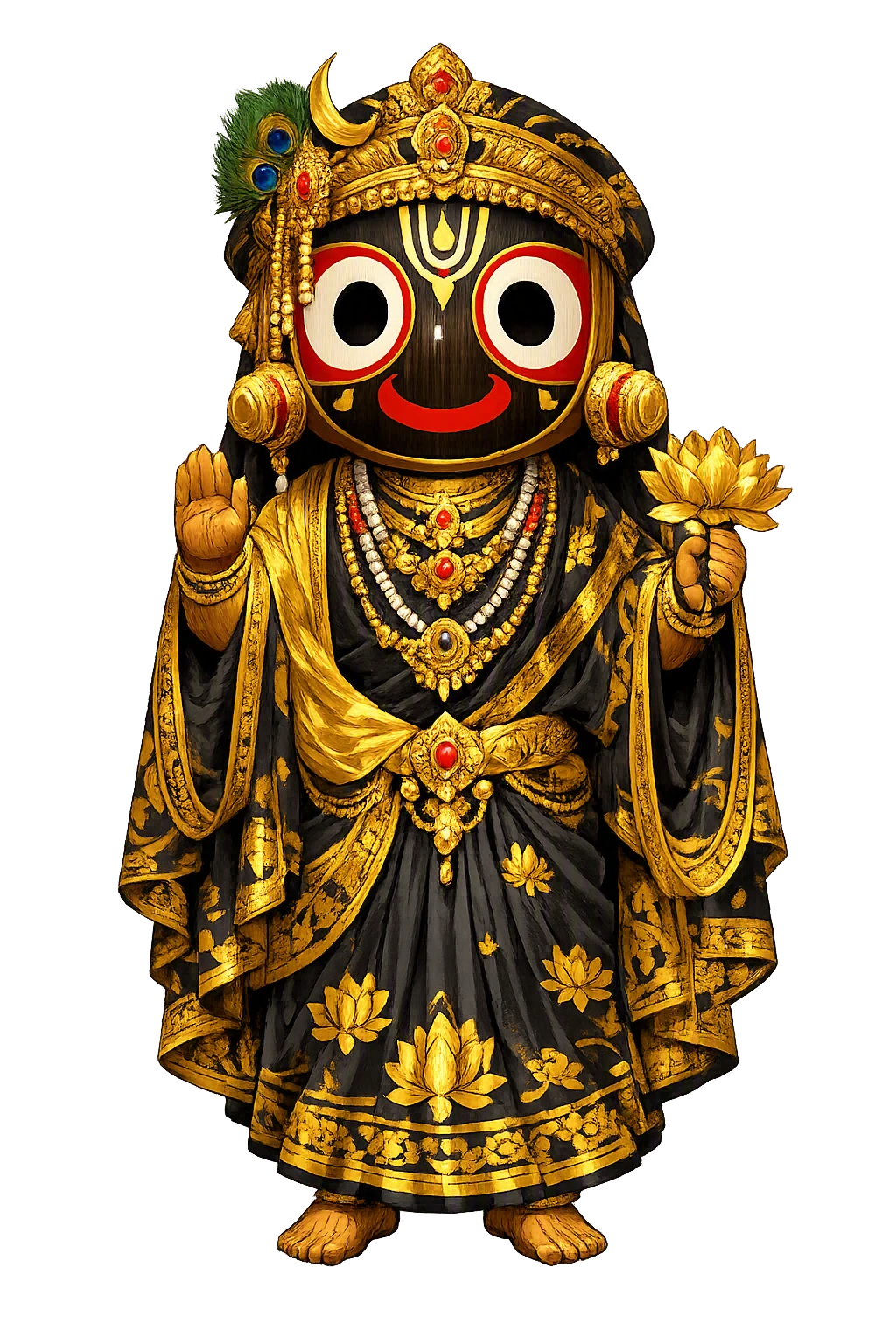
There is one way to draw Jagannātha, and Odisha has drawn it for a thousand years: a black face like the plank it is, two huge round eyes rising like suns, a curving white smile, and nothing else — no arms, no legs, no modelling anywhere. Beside him Balabhadra, the white oval-eyed brother; between them Subhadrā, small, ochre, almond-eyed, the only one permitted gentleness. The iconography is deliberately pre-sculptural — a god who cannot gesture, only gaze. Because the images are wood, repainted on a fixed cycle and wholly reborn when the neem logs are renewed, no original survives to argue with; the canon lives in the painters' hands. It radiates into every Odia medium — the patāchitra scrolls of the temple town, the carved chariots, the painted ratha panels — until the triad reads less as statue than as sign: one of the most recognizable silhouettes in Hindu art, a face that is also a flag.

06

Reception & Transformation

The name after its own age — transmission, translation, survival

Afterlives

Jagannātha's fame travelled outward in widening rings. The Puruṣottama-khaṇḍa of the Skanda Purāṇa first argued his place into scripture; then the bhakti centuries made him singable. Jayadeva's Gītagovinda, by tradition composed in the twelfth century within the temple's orbit, became so bound to him that its verses entered the god's own liturgy, and when Caitanya settled at Puri in the sixteenth century, devotion from Bengal poured through the temple like trade. Europeans carried the report westward: Odoric of Pordenone described the chariot rite around 1321, and three centuries of travellers — Fitch, Tavernier, Bernier — refined the spectacle into the English word 'juggernaut.' The colonial surveyors measured the temple, W. W. Hunter's Orissa (1872) carried the temple chronicle's claims into English scholarship, and the modern academy — Eschmann, Kulke, Tripathi, Starza — turned a roadside marvel into one of the best-documented regional cults in India.

Identifications Across Traditions

Jagannātha is syncretism made architecture. The tribal layer survives in the Sabaras' hereditary service; the Buddhist hypothesis — stupa, tooth relic, converted shrine — hung over the temple through two centuries of scholarship before the Eschmann–Kulke–Tripathi study (1978) reframed the god as a deliberate layering rather than a conversion. Jain memory claims the early mathas of Puri; the Brahmanical settlement made him Puruṣottama, and the devotional revolution of the Gītagovinda made him Kṛṣṇa. Colonial travellers turned his chariot into an English common noun — juggernaut — and the crown of his modern reception belongs to ISKCON: since 1967–68, Prabhupāda's disciples have staged the Ratha Yātrā in San Francisco, London, and every major city on earth, so that the armless god of one Odia town now rides annually through most of the world's capitals. In Puri itself the Gajapati king still sweeps the chariot floor with a golden broom — a living kingship rite older than every republic around it.

Modern Legacy

Jagannātha anchors one of Hinduism's four great pilgrimages — the Char Dham — and Puri's kitchen is the largest in the world, feeding upward of a hundred thousand people a day with mahāprasāda eaten without caste distinction, a daily sacrament of equality run on firewood and hereditary cooks. Every twelve to nineteen years the wooden gods are ceremonially buried and replaced with new neem logs in the rite of Nabakalebara, 'new embodiment' — perhaps the only major cult in which the deity's body is periodically allowed to die. For Odisha, Jagannātha is more than a god: royal inscriptions from 1238 declare him the owner of the kingdom, and modern Odia identity still speaks of the land as his household. And through ISKCON's global Ratha Yātrās and the word juggernaut, the Lord of the World has become, accidentally and thoroughly, a citizen of every city on earth.

07

The Meditation

What Jagannātha means — beyond the dictionary

Jagannātha is the god who cannot do anything for himself — cannot walk, cannot hold, cannot see without the huge painted eyes — and is therefore the most thoroughly loved god in India. His incompleteness is the theology: a finished god would be finished with us. The carpenter vanished so that the people could take over, and every year they do, rebuilding the chariots, hauling the ropes, sweeping the platform with a golden broom in the king's hands. Sovereignty, in Puri, is redefined as the right to be carried.

To name a domain Jagannātha is to claim that the world's lordship is exercised through other people's hands. The institution that understands this stops polishing its own image and starts building chariots — heavy, wooden, temporary, pulled by strangers. The god returns to his temple each year, but only because the road remembers him. Devotion, the temple says, is not what the god has; it is what the god is missing.

08

Frequently Asked Questions

Common questions about Jagannātha, Lord of the World, Puri, Devotion, and Unicode restoration

01How do you pronounce Jagannātha?

In reconstructed pronunciation, Jagannātha is /dʒɐ.ɡɐnː.naː.t̪ʰɐ/ — approximately JUH-gun-NAH-thuh — hold the long aa on 'nah', keep the rhythm trochaic, and let the final th be a soft, breathy 'tuh'.

02What does Jagannātha mean?

Jagannātha means Lord of the universe in the sanskrit tradition.

03What are the symbols of Jagannātha?

Jagannātha is associated with The armless form (Sovereignty that receives rather than grasps — the Lord needs no hands, because his people's hands are his), The dāru-brahman, the log of Brahman (The Lord came to Puri not as an idol but as fragrant timber floating from the sea), The chariot rope (To pull it is to be pulled — grace transmitted through the shoulder, not the eye), The Nīlācala, Blue Mountain (The hill of Puri the Lord chose as his seat, where the Sabara chief first kept him in secret), Mahāprasāda (The sacred food from the world's largest kitchen, eaten by all together without distinction of caste).

04Why restore Jagannātha in Unicode?

Plain ASCII jagannatha strips the stress, length, and script that make the name specific. Unicode restoration returns the name to its original written dignity.

05What is the most important myth about Jagannātha?

“The Blue Lord of the Sabaras” — the Skanda Purāṇa story that anchors the mythology of Jagannātha, told in full on the lore page.

09

Scholarly Sources

The philological foundations of this restoration

Every claim on this page is grounded in established scholarship. The orthographic restorations follow disciplinary convention. The etymological chain follows the best available reference works. This is not invention — it is resurrection through scholarship.

◈

Lexicography & Philology

  • Puranas
  • Jagannath tradition
◎

Primary Texts

  • Skanda Purāṇa, Puruṣottama-khaṇḍa (Puri mahātmya)
◉

Archaeology & Art History

  • O. M. Starza, The Jagannatha Temple at Puri: Its Architecture, Art and Cult (1993)
✦

Religious Studies

  • Mādala Pāñjī, the temple chronicle of Puri (English tr. A. B. Mohanty)
  • A. Eschmann, H. Kulke, G. C. Tripathi, eds., The Cult of Jagannath and the Regional Tradition of Orissa (1978)
  • K. C. Panigrahi, History of Orissa (Hindu Period) (1960)
  • Monier-Williams, Sanskrit-English Dictionary, s.v. jagannātha
Return

The Surface Awaits

You have traced the name from its earliest attestation to its Unicode restoration. Now return to the myth. The story is where the name lives.

Back to Lore
Jagannātha mascot