
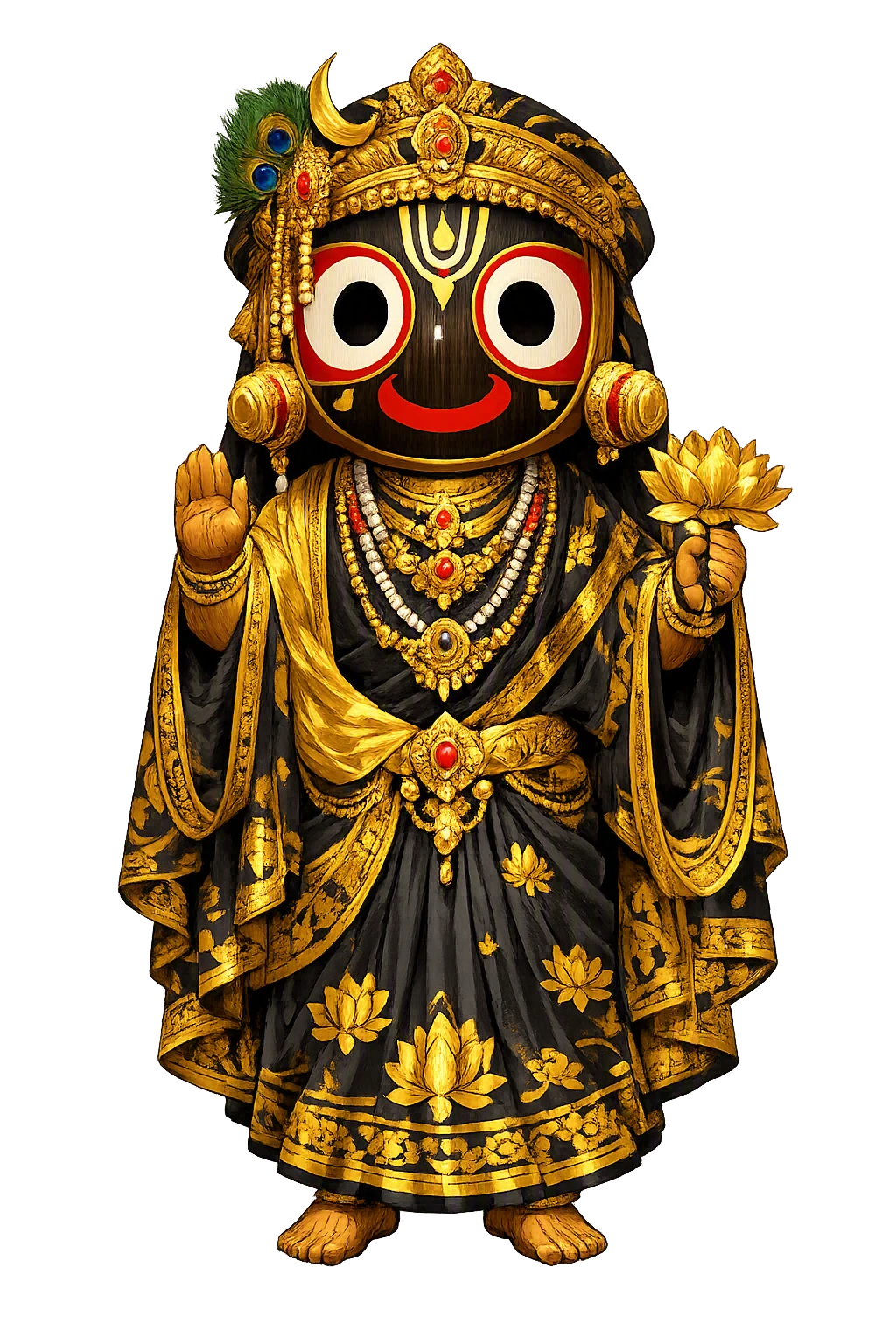
How Jagannātha was rebuilt, mark by mark
The workshop file for Jagannātha. Every rejected form is recorded here too — that is the point of keeping notes.
What We Found
The attestation runs through the tradition's own sources: जगन्नाथ. Meaning: "Lord of the universe".
The figure behind the name: Jagannātha's mythology is a foundation epic told in temple chronicles and Purāṇic chapters rather than in any single scripture.
What the Name Carried In
The Blue Lord of the Sabaras. King Indradyumna of Malwa heard whispers of a wonder: on the remote Blue Mountain of the eastern coast, the tribal chief Viśvavāsu worshipped in secret a form of Viṣṇu called Nīlamādhava, the Blue Lord. The king sent his priest Vidyāpati to find him.
The Carpenter Who Never Finished. One dawn a great log of fragrant reddish wood drifted in from the sea — dāru-brahman, Brahman come as timber, bearing the marks of conch, discus, mace, and lotus. An old carpenter arrived unasked and promised the king three images in twenty-one days, on one condition: no one might open the workshop door.
A spelling that has to carry stories like these is not a label. It is equipment.
Where It Stood Before Us
The present great temple was begun by the Eastern Ganga king Anantavarman Chodaganga Deva (r. 1078–1150 CE) and completed under his successors, above all Anangabhima III (r. 1211–1238 CE), whose inscriptions of 1238 declare the kingdom itself the property of Puruṣottama-Jagannātha — a rare case of a state legally deeding itself to its god. The Nīlācala hill beneath the temple held older, humbler shrines remembered in the Purāṇic chapters, and the Skanda Purāṇa's Puruṣottama-kṣetra mahātmya claims sanctity far older than any surviving masonry. The images themselves are perishable by design: neem wood, repainted and repaired on a fixed cycle and wholly replaced at the Nabakalebara rite, so the god's body is a documented sequence of bodies. The chariot-yard, the Grand Road, and the Gundicha temple complete a ritual city-plan without parallel — a town whose main street exists so that its god can leave home once a year. The bench inherits all of it — the web temple is the newest site, not the first.
What We Kept
The evidence, mark by mark — 1 feature the keyboard form jagannatha cannot hold:
- a → ā — Macron: long vowel. Kept.
What We Rejected
The plain ASCII jagannatha — admissible as a fallback, never as the primary. A wrong accent would have been worse: the rulebook is explicit that a misplaced mark is worse than none.
What We Set Down
Jagannātha — The restoration preserves more than the ASCII form can express — stress, length, or a letter the Latin keyboard lost — which places it, mechanically, in Tier-1.
For the voice: jUH-gun-NAH-thuh — hold the long aa on 'nah', keep the rhythm trochaic, and let the final th be a soft, breathy 'tuh'.
The temple stands at /jagannatha/ — the notes above are public in its Scholarly Edition, sources and all.
At a Glance
- Restored name: Jagannātha
- ASCII form: jagannatha
- Meaning: "Lord of the universe"
- Domain of influence: Lord of the World, Puri, Devotion
- Pantheon: Sanskrit
- Classification: Tier 1
- Original script: जगन्नाथ
- Series: The Restoration Files, No. 245 of 548
The File Continues
The temple's founding dispatch tells the name's story; its Resonance File reads the myths into the industries; the blog index holds the whole archive.
Continue the series — previous file: Izanami (read it here) · next file: Jizō (read it here).
The Restoration Files are written from the same canonical record as the temples themselves: the lexicon, the lore catalog, the pattern atlas, and the cited scholarly sources. If a file ever disagrees with its temple, the temple is right — tell us, and the file will be corrected.