
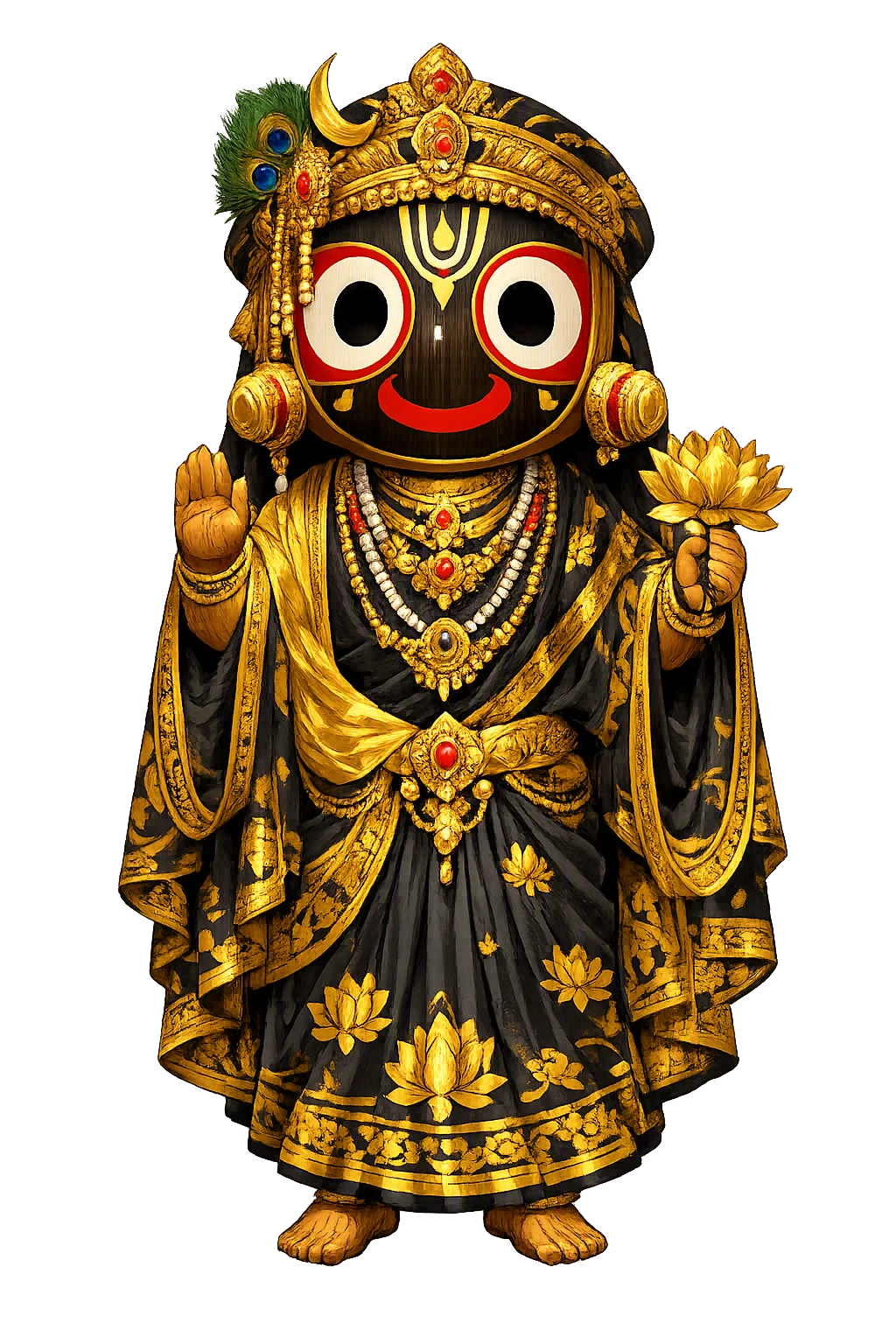
Pronouncing Jagannātha: a guide for the curious
Saying Jagannātha aloud is harder than reading it on a screen, and more rewarding. The restored spelling is a compressed pronunciation guide: every accent and macron is an instruction. This post unpacks those instructions — the reconstructed sound, the phoneme-by-phoneme record, the kindred forms in neighboring languages — and then zooms out to the full record around the name: its Devanagari writing, its mythology, its cult, and its modern life as a Unicode domain. Whether you arrive as a linguist, a reader of myth, or a domainer, you will leave able to say the name the way the evidence suggests it was said — and able to type it the way it was written.
At a Glance
- Restored name: Jagannātha
- ASCII form: jagannatha
- Meaning: "Lord of the universe"
- Domain of influence: Lord of the World, Puri, Devotion
- Pantheon: Sanskrit
- Restoration: Preserves vowel length
- Original script: जगन्नाथ (Devanagari)
- Live domain: jagannātha.com
Overview
Jagannātha (jagannatha) — Lord of the World, Puri, Devotion · Lord of the universe — belongs to the Sanskrit tradition, where it is catalogued under the domain "Lord of the World, Puri, Devotion". The name means "Lord of the universe".
Jagannātha belongs to the Sanskrit tradition, where it is associated with lord of the world, puri, devotion.
PuniCodex restores the name as Jagannātha and serves its temple at jagannatha.com. The restoration preserves at least one distinctive feature — a diacritic or a distinctive letter — that the ASCII form loses, and exactly one historically valid Unicode restoration exists. The plain ASCII form jagannatha survives as a modern convenience imposed by the early domain-name system; the restoration, not the fallback, is the form the project defends as philologically complete.
The Name
The name is attested in Devanagari as जगन्नाथ. Etymologically it means "Lord of the universe".
Sanskrit Jagannātha, from jagat 'world, universe' + nātha 'lord, protector'; the form of Krishna worshipped at Puri.
The ASCII form jagannatha survives only because the early domain-name system could not carry diacritics; it is a technological compromise, not an ancient spelling. The Unicode restoration Jagannātha recovers the vowel length of the original directly in the address bar. The restoration preserves at least one distinctive feature — a diacritic or a distinctive letter — that the ASCII form loses, and exactly one historically valid Unicode restoration exists.
The letter-by-letter transformation runs:
- j → J — Same, capitalized
- a → a — Same
- g → g — Same
- a → a — Same
- n → n — Same
- n → n — Same
- a → ā — Macron: long vowel
- t → t — Same
- h → h — Same
- a → a — Same
The canonical temple for this name is served at jagannatha.com.
Etymology & Roots
The recorded derivation reads: Sanskrit Jagannātha, from jagat 'world, universe' + nātha 'lord, protector'; the form of Krishna worshipped at Puri.
The root gloss is "lord of the world."
The reconstruction is classed as attested.
The Original Script
The name is preserved in Devanagari as जगन्नाथ.
The scholarly transliteration is Jagannātha.
The rendering proceeds step by step:
- Sanskrit Jagannātha is written in Devanagari as जगन्नाथ
- IAST transliteration maps each Devanagari vowel and consonant to a Latin equivalent
- Macrons mark long vowels (ā, ī, ū); dots beneath consonants mark retroflex articulation (ṭ, ḍ, ṇ, ṣ)
Pronunciation
The reconstructed pronunciation of the name is /jagannatha/ — Sanskrit Reconstruction.
Phoneme by phoneme:
- J — Initial character of the restored form Jagannātha.
- agannātha — Remainder of the name, preserving the distinctive marks of the Sanskrit tradition.
For the modern speaker, the closest approximation is: 'JAGANNATHA' — pronounce the restored form with attention to the preserved diacritics and length.
Kindred and historical forms of the name:
- Sanskrit — Jagannātha, the restored Unicode form of the name
Jagannātha preserves both features because the Sanskrit form preserves distinctive features that ASCII loses: stress, length, or special characters.
Mythology
The stories of Jagannātha circulate within the Sanskrit corpus, where the figure embodies lord of the world, puri, devotion.
Primary Attestation (Sources)
Jagannātha is attested in the canonical Sanskrit sources as a figure associated with lord of the world, puri, devotion.
Name and Meaning (Etymology)
The name means "Lord of the universe" and reflects the figure's role in the tradition. Jagannātha, "Lord of the World," is a form of Viṣṇu/Kṛṣṇa worshipped at the great temple in Purī, Odisha. He appears with his siblings Balabhadra and Subhadrā in the famous Rathayātrā festival, when enormous chariots carry the deities through the city. The cult integrates Vaiṣṇava, Śaiva, tribal, and tantric elements. The annual Rathayātrā attracts millions of pilgrims, who consider touching the ropes of the god's chariot a supreme spiritual blessing.
The Blue Lord of the Sabaras (Skanda Purāṇa)
King Indradyumna of Malwa heard whispers of a wonder: on the remote Blue Mountain of the eastern coast, the tribal chief Viśvavāsu worshipped in secret a form of Viṣṇu called Nīlamādhava, the Blue Lord. The king sent his priest Vidyāpati to find him. Vidyāpati lived among the Sabaras, won the chief's trust, and married his daughter Lalitā; when he was led at last to the hidden shrine, he scattered mustard seed along the path so the king could follow. But a storm swept down and carried the Blue Lord away before Indradyumna arrived. The king fasted on the shore, performed the horse sacrifice at Puruṣottama-kṣetra, and waited. In a dream the god spoke: build a temple, and I will come to you as a log from the sea. The Puruṣottama-khaṇḍa of the Skanda Purāṇa tells the tale, and the temple chronicle Mādala Pāñjī keeps it. The myth absorbs without erasing: the Sabara chief's line holds to this day the hereditary right to touch the god before anyone else.
The Carpenter Who Never Finished (Mādala Pāñjī)
One dawn a great log of fragrant reddish wood drifted in from the sea — dāru-brahman, Brahman come as timber, bearing the marks of conch, discus, mace, and lotus. An old carpenter arrived unasked and promised the king three images in twenty-one days, on one condition: no one might open the workshop door. Day by day the king waited; on the fourteenth day — the nineteenth in some tellings — the door was opened, and the carpenter was gone. On the platform stood three figures with huge round eyes and no arms: Jagannātha, his brother Balabhadra, his sister Subhadrā. Indradyumna was stricken, but the sage Nārada consoled him: the Lord had chosen the form his people would love, and the unfinished state was no accident but an invitation. The Mādala Pāñjī preserves the story; the Skanda Purāṇa tells a shorter form. A god who cannot hold anything must be held by his people — which is exactly what happens to him every single year.
The Journey to Gundicha's House (Temple chronicles)
Each summer, in the bright half of the month Āṣāḍha, the three images leave the great temple. Servants carry them swaying down the Bada Dānda, the Grand Road, and set them on three towered wooden chariots — Nandighoṣa for Jagannātha, some twenty metres tall with sixteen wheels — rebuilt from raw timber every year by hereditary carpenters. Hundreds of thousands pull the ropes, and the Gajapati, the king of Puri, sweeps the chariot platform with a golden broom, performing the duty of the humblest sweeper in his own kingdom. For nine days the Lord stays at the Gundicha temple, the house of his aunt Gundicha, and then the whole road walks him home. The temple chronicles record the festival across the centuries, and seventeenth- and eighteenth-century European travellers gave English a new word for an unstoppable mass — juggernaut. Once a year the Lord of the World, who has no feet, travels farther than any god who does.
Symbols & Iconography
The iconography associated with Jagannātha concentrates in a small set of recurring attributes, each a compressed statement about the name:
- Restored Name — The Unicode form Jagannātha carries the original marks of the Sanskrit tradition.
- Source Script — Preserved through scholarly transliteration and canonical sources.
- Domain — Lord of the World, Puri, Devotion
- Etymology — Lord of the universe
- The armless form — Sovereignty that receives rather than grasps — the Lord needs no hands, because his people's hands are his
- The dāru-brahman, the log of Brahman — The Lord came to Puri not as an idol but as fragrant timber floating from the sea
- The chariot rope — To pull it is to be pulled — grace transmitted through the shoulder, not the eye
- The Nīlācala, Blue Mountain — The hill of Puri the Lord chose as his seat, where the Sabara chief first kept him in secret
- Mahāprasāda — The sacred food from the world's largest kitchen, eaten by all together without distinction of caste
Archaeology & Evidence
The material record for Jagannātha survives in a small number of securely identified remains, catalogued below; the corpus is thin but unambiguous, and each site is tied to the name by ancient testimony.
Jagannātha is attested in the textual and iconographic record of the Sanskrit tradition.
Realm & Domain
Jagannātha belongs to the Sanskrit tradition, where it is associated with lord of the world, puri, devotion.
Lord of the World
The central domain of Jagannātha in the sanskrit tradition.
Lord of the universe
The name signifies "Lord of the universe".
Unicode Restoration
The restoration Jagannātha recovers what plain ASCII jagannatha flattens.
Original Attestation
Attested in the sources as —.
Puruṣottama-kṣetra
Puri, the sacred field where the Lord owns the land itself — in 1238 CE King Anangabhima III dedicated his entire kingdom to him.
The Unfinished Hands
The icons have no arms and no legs: the carpenter of the gods vanished before finishing them, and the tradition kept them unfinished on purpose.
The Three Siblings
Jagannātha with Balabhadra and Subhadrā on one platform — Kṛṣṇa, his brother, and his sister, worshipped as one household.
The Ratha Yātrā
Once a year the Lord leaves the temple and rides a city-high wooden chariot pulled by thousands of hands down the Grand Road to his aunt's house.
Across Cultures
Jagannātha appears within the Sanskrit tradition and has influenced later retellings, artistic depictions, and scholarly study. The Unicode restoration preserves the name's distinctive orthography for contemporary use.
Within the Sanskrit tradition, closely related names in the corpus include Aṃśa, Dakṣa, Dhātṛ, Durgā, Gaṇeśa, and Gaṅgā.
Cultural Legacy
Jagannātha continues to appear in scholarship, art, and popular reception as a significant figure of the Sanskrit tradition. Restoring the name in Unicode returns the original marks that ASCII removes. The English word "juggernaut" derives from the massive Jagannātha chariot, symbolizing unstoppable force.
The Scholarly Record
The account of Jagannātha given in this edition rests on the witnesses and reference works listed below. Lexica and etymological dictionaries secure the form and meaning of the name; the literary and religious texts supply the narrative evidence.
- Monier Monier-Williams, A Sanskrit-English Dictionary, Oxford; Cologne Digital Sanskrit Dictionaries, 1899. Full text
- Bhagavata Purana.
- Rāmāyaṇa, Vālmīki; translated by Hari Prasad Shastri, 500 BCE. Full text
A Meditation
Jagannātha embodies lord of the world, puri, devotion in the Sanskrit imagination. The name's restoration is not merely cosmetic: it recovers the stress, length, and script that make the figure recognizable in the source tradition.
The Unicode Restoration
Jagannātha preserves vowel length. The ASCII fallback jagannatha still resolves everywhere, but it is the restored form that carries the name's full information. Across the 10 characters of the name, the restoration adjusts 1: 1 mark of length (ā). That is the whole thesis of this temple: the marks are the message.
Character by Character
The journey from jagannatha to Jagannātha, one character at a time:
- j → J — Same, capitalized
- a → a — Same
- g → g — Same
- a → a — Same
- n → n — Same
- n → n — Same
- a → ā — Macron: long vowel
- t → t — Same
- h → h — Same
- a → a — Same
The Domain Name
The restored name is live as a working domain: jagannātha.com, which the DNS carries in punycode form as xn--jaganntha-bcb.com — an ASCII-compatible encoding that lets a non-ASCII name travel the global network without breaking older infrastructure. The visitor sees Jagannātha; the machines see the encoding. That duality is the engineering compromise on which the entire restoration rests, and it is why a name written the way its own tradition wrote it in Devanagari can now be typed into any browser on earth.
The Sanskrit Pantheon
Jagannātha is one of 102 entries the PuniCodex lexicon catalogues under the Sanskrit pantheon. The Pantheon page gathers the tradition's major figures in one place, and the Lexicon lets you filter all 983 restorations by tradition or script — the fastest way to see where this name sits among its kin.
Frequently Asked Questions
What does Jagannātha mean? The traditional gloss is "Lord of the universe."
Which tradition does Jagannātha belong to? Jagannātha is catalogued in the Sanskrit pantheon of the PuniCodex lexicon.
What does Jagannātha preserve that ASCII cannot show? The form itself answers: Jagannātha preserves vowel length — and the marks in the restored spelling are exactly that evidence.
Is Jagannātha a working domain? Yes — jagannātha.com resolves today and routes to this temple.
What is the punycode for jagannātha.com? The DNS encoding is xn--jaganntha-bcb.com; browsers perform the translation automatically, so visitors only ever see the restored name.
Can I use Jagannātha in a normal browser? Yes. The DNS resolves the punycode form automatically, and the type tool on this site converts jagannatha to Jagannātha for copying and pasting.
Where does the scholarly information come from? The entry is built from lexica, inscriptional evidence, and reviewed scholarly sources listed in the Scholarly Edition. Every claim is traceable to a canonical source.
Typing Jagannātha
You do not need a special keyboard to use this restoration. The PuniCodex Type Tool converts the ASCII form jagannatha into Jagannātha as you type, and the browser extension offers the same conversion inside any text field. Copy the restored form, paste it into the address bar, and the DNS does the rest.
Sister Temples
Other temples in the Sanskrit pantheon include Gaurī, Jñāna, and Kaṃsa — each with its own restoration story, its own scholarly record, and its own place in the lexicon.
Why This Restoration Matters
Pronunciation turns out to be the heart of the matter. The marks in Jagannātha are instructions for the voice, and a web that strips them is a web that mispronounces the past at scale. The restoration hands the instructions back: say it as the evidence suggests, type it as the tradition wrote it, and let the punycode machinery do the quiet translation in between. That is all the PuniCodex project asks of the infrastructure — and everything it asks of you, the reader, is to use the whole name.
Explore Further
This post is one doorway into the temple. The home page carries the full character breakdown and the ambient canvas; the lore page tells the myths in long form; the Scholarly Edition preserves the sources, pronunciation data, and revision history; and the patron wall supports the restoration directly. For the wider map, browse the Lexicon, explore the Pantheon, or return to the PuniCodex blog.
A Closer Look at the Marks
A restored name is a small map. In Jagannātha, the journey from the ASCII fallback jagannatha to the Unicode form can be read letter by letter, and each letter tells a story. Of the 10 characters, 9 remain unchanged; they anchor the name to its modern shape. The remaining adjustments recover marks the source tradition used to distinguish this name from every other word built from the same letters.
The j stays as it is — Same, capitalized.
The a stays as it is — Same.
The g stays as it is — Same.
The a stays as it is — Same.
The n stays as it is — Same.
The n stays as it is — Same.
The a becomes ā — Macron: long vowel.
The t stays as it is — Same.
The h stays as it is — Same.
The a stays as it is — Same.
Together these changes are not decoration. They are the minimum set of marks needed to keep the name legible in its own tradition. Remove them and you still have a string of letters; you no longer have the name as it was written.
Related Names
Sources
The full scholarly apparatus — every citation, revision, and review — lives in the Scholarly Edition. Key references for this post:
- Monier Monier-Williams, A Sanskrit-English Dictionary, Oxford; Cologne Digital Sanskrit Dictionaries, 1899.
- Rāmāyaṇa, Vālmīki; translated by Hari Prasad Shastri, 500 BCE.
- Ṛgveda Saṃhitā (Puruṣa Sūkta).
- Brāhmaṇas (ritual context).
- Upaniṣads.
- Jagannath tradition.
- Bhagavata Purana.
- Monier-Williams Sanskrit-English Dictionary.
- Macdonell, Sanskrit Grammar for Students.
- Lexicon authorities for this entry: Puranas, Jagannath tradition.