
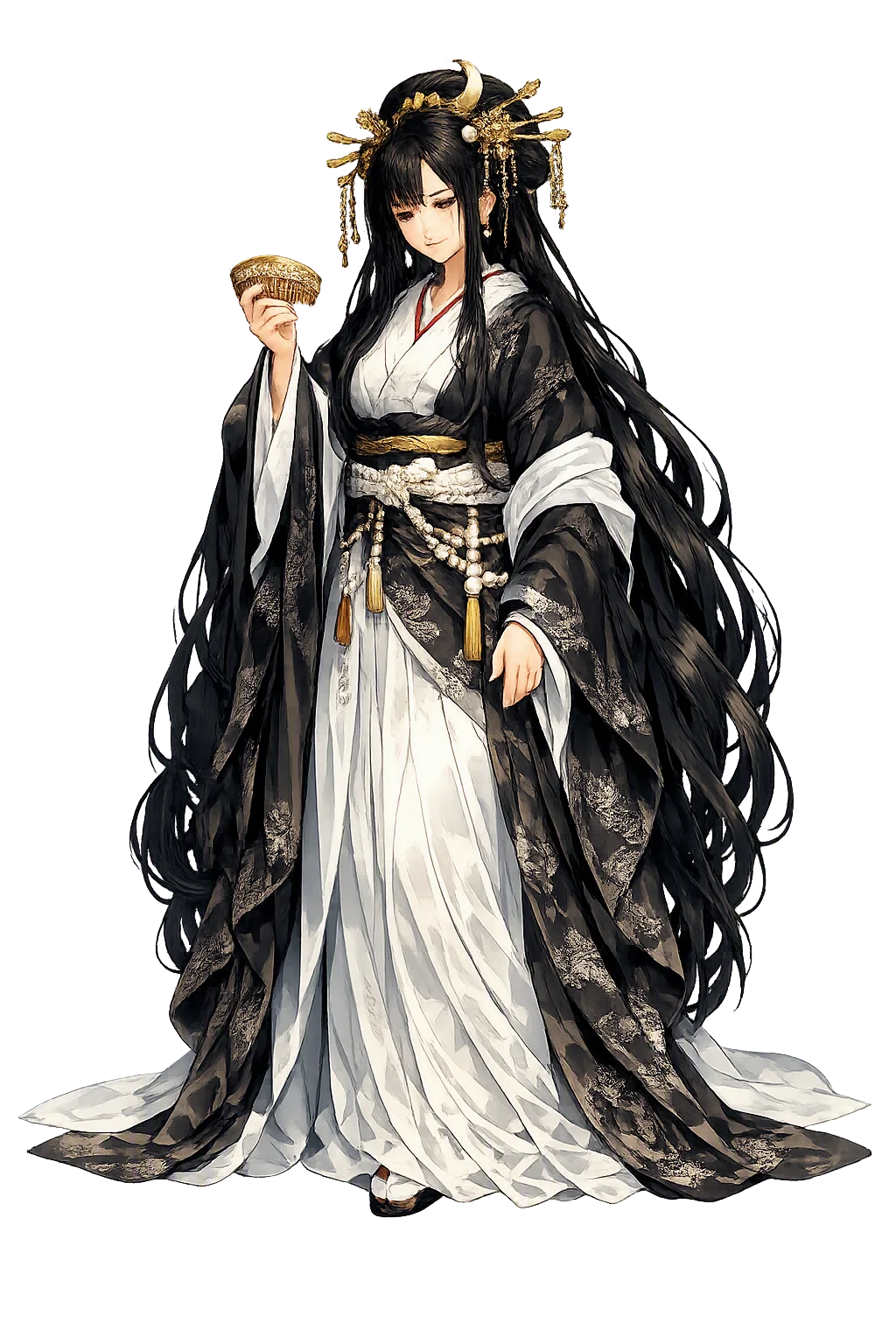
How Izanami was rebuilt, mark by mark
From the restoration bench — the working notes on Izanami, kept because the process is the proof.
What We Found
The attestation, as Kojiki 1 (creation, hiruko, death, Yomi, curse) and Nihon Shoki 1 (parallel creation accounts) record: 伊邪那美. Meaning: "She-who-invites".
The figure behind the name: Izanami's mythology is central to Japanese understandings of creation, death, and the boundary between the living and the dead — and it never forgives her for speaking first at the pillar.
What the Name Carried In
She Who Stirred the Brine. The heavenly kami gave the command to the pair, but it was Izanami who set her hand on the spear. Standing upon the Floating Bridge of Heaven, she and Izanagi lowered the jeweled Ame-no-Nuboko into the formless ocean and stirred; the brine dripping from its tip congealed into Onogoroshima, and upon that first island the couple founded their union and their hall (Kojiki 1).
Hiruko, the Leech-Child. When the couple circled the heavenly pillar to greet each other and beget, Izanami spoke first; their firstborn, Hiruko, was a boneless child who could not stand even at the age of three, and they set him adrift in a reed boat (Kojiki 1). Consulting the heavenly kami, they learned the error — the man's voice must come first — and repeated the rite in the proper order; Izanami then bore the eight great islands and the gods of wind, river, sea, and mountain.
A spelling that has to carry stories like these is not a label. It is equipment.
Where It Stood Before Us
Izanami's cult geography clusters where the myth's geography points. Taga Taisha (Shiga Prefecture) venerates the creation pair and preserves the medieval Taga-dera engi recounting her story. On Awaji Island, Izanagi Jingū serves the pair's legend at the traditional site of Onogoroshima. Mount Hiba in the Chūgoku region — named in the Kojiki as her burial place — anchors the myth in real landscape, and the ancient ritual sites around it have been linked to early underworld cult. The Engishiki lists shrines receiving state offerings for Izanami, confirming that by the tenth century the official cult acknowledged the dead goddess alongside the living one. The bench inherits all of it — the web temple is the newest site, not the first.
What We Rejected
izanami as the primary form. It survives as the convenience it is; it does not get to lead. The hierarchy is full restoration first, and this name can afford to stand at the top of it.
What We Set Down
Izanami — Tier-2 here means one preserved truth — not less important, just singular. The temple shows it and names it.
For the voice: 'EE-zah-nah-mee' — four even syllables, with a soft final vowel.
The temple stands at /izanami/ — the notes above are public in its Scholarly Edition, sources and all.
At a Glance
- Restored name: Izanami
- ASCII form: izanami
- Meaning: "She-who-invites"
- Domain of influence: Creation, Death, Earth
- Pantheon: Japanese
- Classification: Tier 2
- Original script: 伊邪那美
- Series: The Restoration Files, No. 244 of 548
The File Continues
The temple's founding dispatch tells the name's story; its Resonance File reads the myths into the industries; the blog index holds the whole archive.
Continue the series — previous file: Izanagi (read it here) · next file: Jagannātha (read it here).
The Restoration Files are written from the same canonical record as the temples themselves: the lexicon, the lore catalog, the pattern atlas, and the cited scholarly sources. If a file ever disagrees with its temple, the temple is right — tell us, and the file will be corrected.