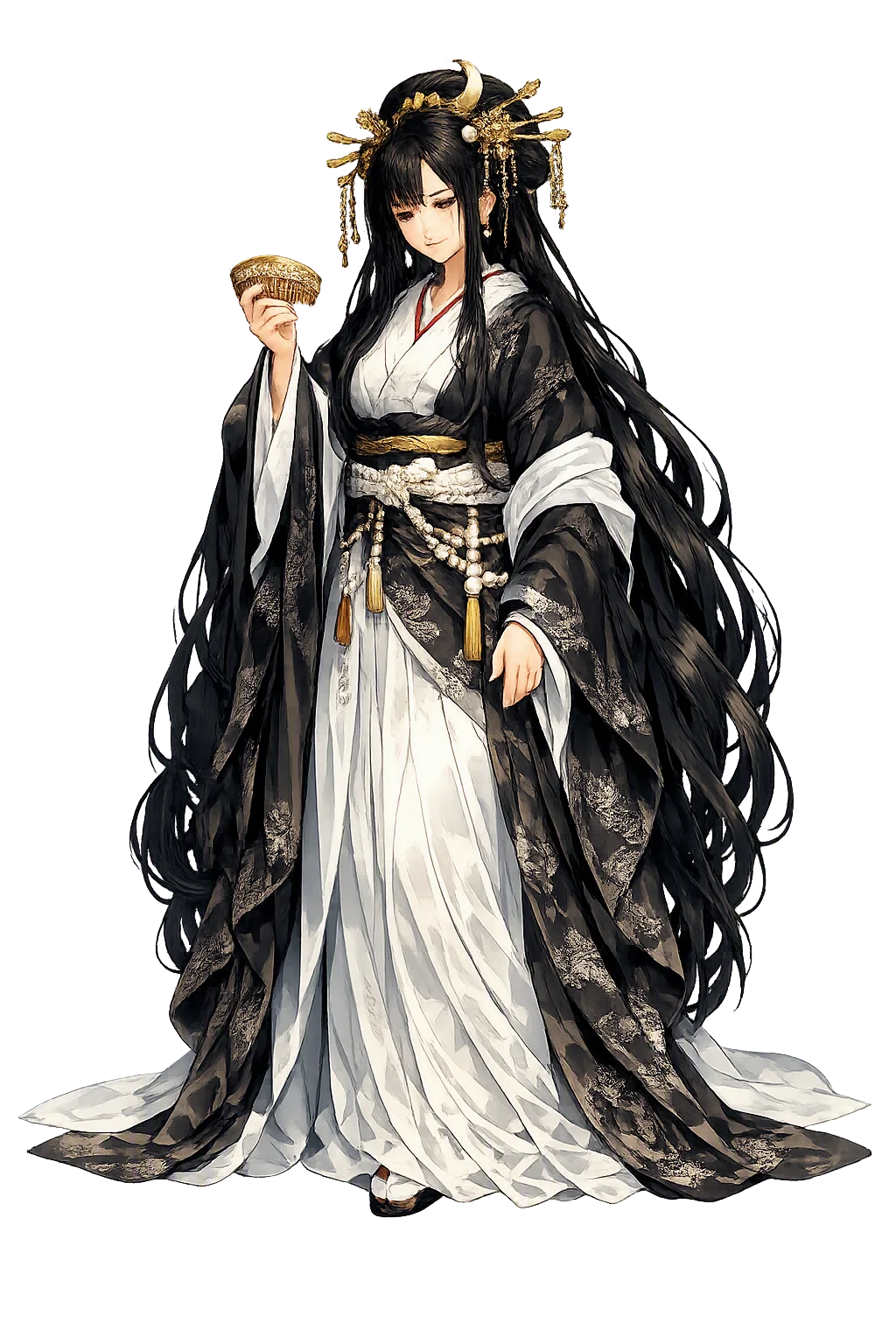
Stories of Izanami
Izanami's mythology is central to Japanese understandings of creation, death, and the boundary between the living and the dead — and it never forgives her for speaking first at the pillar.
The heavenly kami gave the command to the pair, but it was Izanami who set her hand on the spear. Standing upon the Floating Bridge of Heaven, she and Izanagi lowered the jeweled Ame-no-Nuboko into the formless ocean and stirred; the brine dripping from its tip congealed into Onogoroshima, and upon that first island the couple founded their union and their hall (Kojiki 1). The chronicles, even while making her the mother of everything, mark her as the one who stepped outside the ritual order — she spoke the first greeting at the pillar — and who suffered for it. Everything that follows, islands, gods, death, night, proceeds from her equal hand on the spear. The creation is a marriage as much as a manufacture: the world begins in a couple's shared labor, and its first law is how they address each other.
When the couple circled the heavenly pillar to greet each other and beget, Izanami spoke first; their firstborn, Hiruko, was a boneless child who could not stand even at the age of three, and they set him adrift in a reed boat (Kojiki 1). Consulting the heavenly kami, they learned the error — the man's voice must come first — and repeated the rite in the proper order; Izanami then bore the eight great islands and the gods of wind, river, sea, and mountain. Modern readers have reclaimed Hiruko as a poignant emblem, the 'sun-child' as the name can be parsed, the disabled firstborn of the gods; some traditions even drifted to connect the drifting child with Ebisu. But the chronicle records him only as the price of a word out of place. For Izanami the myth is a double wound: blamed for the error, she is then consumed bearing the children that redeem it.
Her last birth was Kagutsuchi, the fire god. The child burned her as he was born, and Izanami lay dying, her lower body seared. Even in death the creation did not stop: from her vomit came the mountain-smith Kanayamahiko, from her excrement the clay-god Haniyasu, from her urine the water-goddess Mitsuhanome — and from her head, breast, belly, loins, left and right hands and feet came the eight thunder deities, Yakusanoikazuchi, who would one day guard her in Yomi (Kojiki 1). She named the mountain of her burial before she died: Mount Hiba, in the land of Kibi. The passage is the Kojiki at its most elemental: the mother of everything dies of her most brilliant child, and her dying body, catalogued organ by organ, becomes the map of the underworld she is about to rule.
In Yomi, when Izanagi broke his promise and lit the comb, Izanami — maggot-crowned, thunder-fleshed — cried that he had shamed her, and sent the hags and the eight thunders after him. He escaped to the slope of Yomotsu-hirasaka and rolled the great boulder into the pass between them. Then the dead queen pronounced the verdict that still governs the world: each day, she said, I will strangle a thousand of the people of your land. From the other side of the stone Izanagi answered: then each day I will cause fifteen hundred to be born (Kojiki 1). Her curse is not repealed but outpaced — death legislated in daily arithmetic, answered by a larger birthrate. The exchange is Japan's theodicy in a single statistic: the grave wins every skirmish and loses the census.
Creator Goddess, Mother of Kami, Queen of Yomi
Izanami is the female half of the primordial creator pair and the first being to die. Her body became the landscape of the underworld, and her exchange of curses with Izanagi across the sealed slope set the arithmetic of mortality. She is both the mother of the gods and the fearsome queen of Yomi.
With Izanagi, she stirred the ocean with the jeweled spear and bore the eight great islands.
She gave birth to the elemental gods, the land, the sea, and the winds.
She died bearing the fire god Kagutsuchi; her dying body birthed the thunders.
Beyond the boulder she rules the dead and sends the thunders forth.
From the original script to the living URL
伊邪那美
The name in its original Japanese form. Izanami (伊邪那美) is attested in the source tradition — “She-who-invites”. Its original diacritics and script distinctions carry the full phonetic and orthographic weight of the source tradition.
izanami
The plain izanami form is identical to the Unicode restoration. Because this name is already written in Latin letters, no diacritics, stress, or script information were lost — only capitalization differs.
Izanami
The Unicode restoration does not need to recover lost marks for Izanami. Its value is canonical spelling and consistent cataloguing, not the reconstruction of erased orthography. The domain is readable as-is to both DNS and humanity.
Izanami.com
This restoration is written entirely in ASCII letters — no Punycode encoding stands between Izanami and the DNS. The domain reads identically to machines and to human eyes.
Owned, ideal, and ASCII forms of Izanami
Izanami
Restores 伊邪那美. The full Unicode restoration. izanami.com is not in the PuniCodex collection — it is watched for release; if it drops, this temple upgrades to an owned flagship.
How Izanami was spoken
How Izanami is preserved in writing
A bespoke provenance study for Izanami is being prepared by the PUNICODEX scholarly team.
Contribute scholarly provenance →The lore you have read is the living myth. Extended Lore opens the scholarly vault beneath it: the cult and its material remains, a history of the image, the name after antiquity, a meditation on what the name still means, and the full scholarly apparatus — etymology, orthography, sources.
Enter Extended Lore