PuniCodex

Extended Lore

伊邪那美 Izanami

Etymology · Orthography · Cult · Iconography · Reception · Sources

Tier 2 Izanami
Izanami — Creation, Death, Earth
01

Quick Facts

Essential information about Izanami, Creation, Death, Earth

Original Script伊邪那美
Unicode RestorationIzanami
Reconstructed Pronunciation/i.za.na.mi/
PantheonJapanese
DomainCreation, Death, Earth
MeaningShe-who-invites
ClassificationTier 2
Primary DomainIzanami
Sacred SymbolsThe comb, Boulder of Yomotsu-hirasaka, Fire (Kagutsuchi), The eight thunders, Mount Hiba
02

Etymology & Word Family

From original script to Unicode restoration

Original Script 伊邪那美 Izanami — "She-who-invites"
Unicode Restoration Izanami Canonical scholarly spelling — ASCII-identical
Modern ASCII izanami Plain-ASCII fallback

The name Izanami reaches the modern world through scholarly transliteration of the japanese tradition. Because the conventional spelling uses only Latin letters, its Unicode and ASCII forms coincide — the tradition it carries is in the name itself, not in diacritics.

03

Unicode Character Breakdown

Character-by-character philological analysis

CharacterUnicodeNameBlockPhonetic Role
IU+0049Latin Capital Letter IBasic LatinSame, capitalized
zU+007ALatin Small Letter ZBasic LatinSame
aU+0061Latin Small Letter ABasic LatinSame
nU+006ELatin Small Letter NBasic LatinSame
aU+0061Latin Small Letter ABasic LatinSame
mU+006DLatin Small Letter MBasic LatinSame
iU+0069Latin Small Letter IBasic LatinSame

The Tier 2 classification here reflects fidelity to the attested tradition, not recovered diacritics: every character of Izanami already survives in ASCII. What the restoration preserves is the canonical spelling itself — the form scholarship standardised.

04

Cult & Worship

How the sacred was kept — rites, sanctuaries, remains

The Cult

Izanami's cult is real but modest, and honest scholarship says so. No ancient festival calendar survives for her, and no classical shrine was built to her alone; the Engishiki of 927 lists her among the kami receiving state offerings, but she shares every altar she has. The greatest is Taga Taisha in Shiga Prefecture, which honors the creation pair together and draws pilgrims — above all women — who pray for safe childbirth, marriage, and long life. Westward, the geography of her death is itself the sanctuary: Mount Hiba on the old Kibi borderlands, where tradition places her burial; nearby a marker stands at Yomotsu-hirasaka, the underworld's own slope, walked and venerated as the myth's doorway. Awaji's Izanagi Jingū completes the map, venerating the couple at the island the chronicles make their first creation. Her cult was never an institution. It is a landscape, and the landscape is carefully tended.

In the Earth

Izanami's cult geography clusters where the myth's geography points. Taga Taisha (Shiga Prefecture) venerates the creation pair and preserves the medieval Taga-dera engi recounting her story. On Awaji Island, Izanagi Jingū serves the pair's legend at the traditional site of Onogoroshima. Mount Hiba in the Chūgoku region — named in the Kojiki as her burial place — anchors the myth in real landscape, and the ancient ritual sites around it have been linked to early underworld cult. The Engishiki lists shrines receiving state offerings for Izanami, confirming that by the tenth century the official cult acknowledged the dead goddess alongside the living one.

05

Iconography

How Izanami was imaged across the ages

The Image

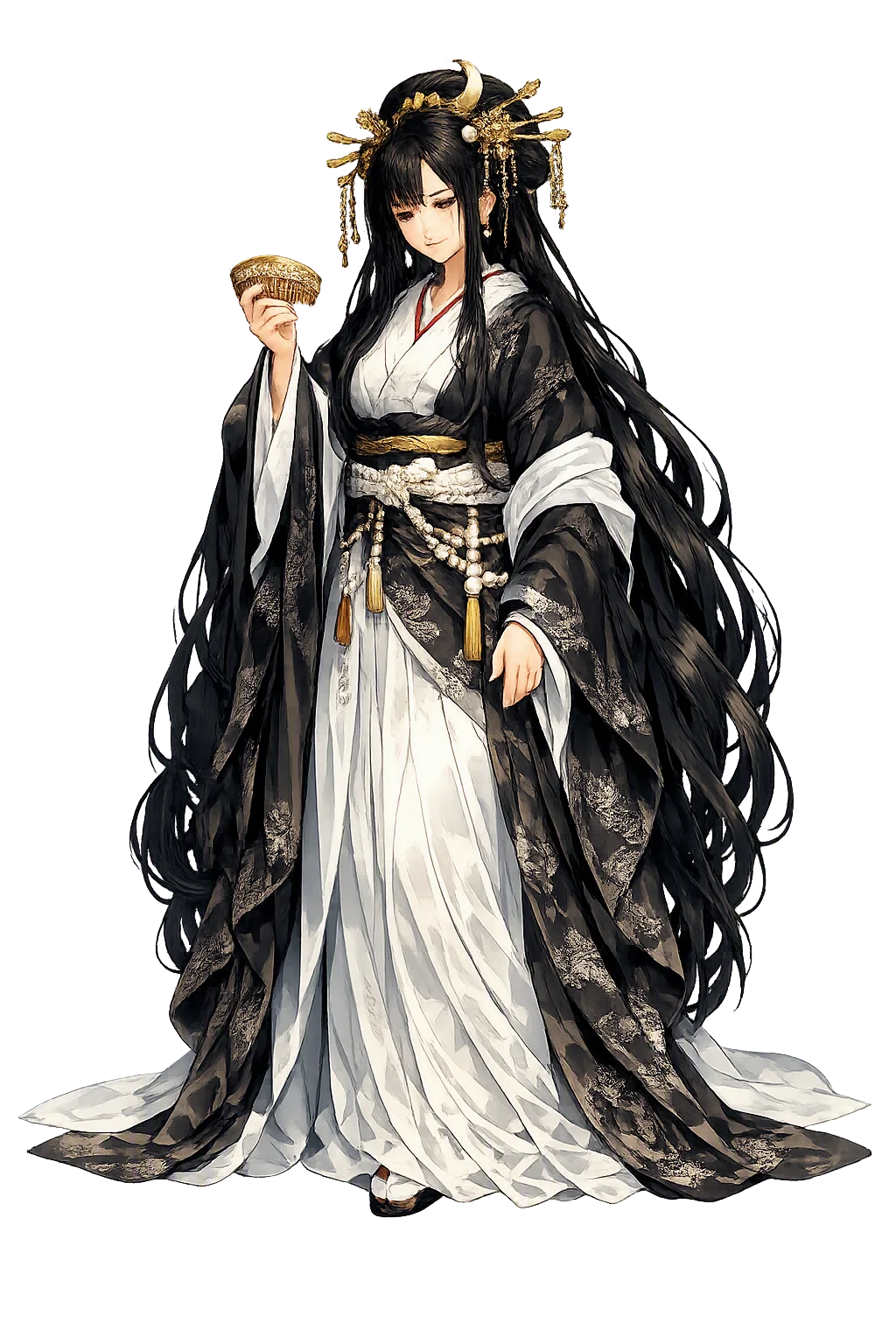
No statue of Izanami is older than the idea that kami could be statues. Her earliest images are medieval and early-modern manuscript and print illustrations of the stirring of the brine: the pair upon the Floating Bridge of Heaven, he raising the jeweled spear, she beside him — compositionally always the second figure, the myth's own verdict on her. Edo-period picture books fixed the formula: court robes, the Ame-no-Nuboko between them, cloud beneath. Underworld images are rarer and never became cult objects: the moment at Yomotsu-hirasaka — her ruined face glimpsed by the light of her own comb's tooth, the boulder rolling shut — was illustrated in retellings, but the chronicle itself forbids the sight of her, and Japanese art largely obeyed. Her folk attributes are objects, not figures: the comb, the thunder-drums of the eight lightnings born from her body, and the great stone, which every Japanese child knows as the door that must not be opened.

06

Reception & Transformation

The name after its own age — transmission, translation, survival

Afterlives

Izanami reached the present down a single thread. The Kojiki of 712 survived the middle ages in one fragile line of manuscripts — the oldest complete copy, the Shinpukuji-bon, is a Kamakura-period book five centuries younger than its text — and the medieval commentaries treated her story as genealogy to be puzzled over, not myth to be honored. Her great resurrection was Edo-period. Motoori Norinaga's Kojiki-den, the forty-four-book commentary finished in 1798, read her dying scene as the emotional summit of the national literature, and the kokugaku movement built on that reading made the Age of the Gods a living scholarly program. The West met her through translators: Chamberlain's Kojiki (1882) and Aston's Nihongi (1896) carried Yomotsu-hirasaka into comparative mythology, where scholars set her beside Orpheus' Eurydice — a parallel she now carries into every textbook. Manuscript, commentary, translation: three narrow bridges, and she crossed all of them.

Identifications Across Traditions

Izanami's Buddhist reception was quieter than her consort's: as queen of Yomi she was overlaid on images of the underworld's judges and on the earth deities of esoteric cosmology, and in some medieval systems Yomi itself was mapped onto the realm of hungry ghosts. Her gendered fate — the first mother, the first corpse — made her a natural figure for funerary reflection, though no stable buddhological identification took hold. In the Meiji restoration of 'pure' Shinto she was presented as the foremother of the nation; after 1945 her story returned to the libraries of myth. Folklore studies of the period found her scattered cult strongest in the San'in and Kibi regions, close to the geography the chronicles assign her.

Modern Legacy

Izanami is the most re-imagined figure of the Japanese pantheon: tragic mother in one reading, vengeful corpse-queen in another, and — in modern manga, anime, and games — a glamorous embodiment of death's authority. The drifting Hiruko of the chronicles was later rationalized as Ebisu, the laughing god of fishermen, giving her first failure a strange afterlife as another deity's fortune. Place-names and shrines anchor her legend around Awaji and the Kibi region, and Taga Taisha in Shiga honors the pair. The curse and counter-curse of Yomotsu-hirasaka remain the mythic charter for Japanese funeral grief: the dead take a thousand; the living answer with fifteen hundred.

07

The Meditation

What Izanami means — beyond the dictionary

Izanami is what the creation costs. The chronicle honors her in its way — organ by organ, her dying body is catalogued with the same care as the gods — but it never absolves her of the first error, and it lets her end as the enemy of the living. To read her fairly is to see a deity whom ritual order made the scapegoat: she spoke first, she died of brilliance, and her grief became monstrous only after it was witnessed.

The myth also encodes an unsentimental ecology of reproduction: births outnumber deaths fifteen hundred to a thousand, and the negotiation happens across a stone neither party can move. She is the great refusal at the heart of Japanese cosmology — the door that stays shut, the face that may not be looked upon, the love that must remain on its own side of the rock.

08

Screen & Culture

Where Izanami echoes through film, television, and games — and how

09

Frequently Asked Questions

Common questions about Izanami, Creation, Death, Earth, and Unicode restoration

01How do you pronounce Izanami?

In reconstructed pronunciation, Izanami is /i.za.na.mi/ — approximately 'EE-zah-nah-mee' — four even syllables, with a soft final vowel.

02What does Izanami mean?

Izanami means She-who-invites in the japanese tradition.

03What are the symbols of Izanami?

Izanami is associated with The comb (Her own comb's tooth, lit by Izanagi, revealed her decay — the light that ended their marriage), Boulder of Yomotsu-hirasaka (The stone she cannot cross; the sealed door between the living and the dead), Fire (Kagutsuchi) (The child that killed her — and the ancestor of every hearth), The eight thunders (Yakusanoikazuchi, born from her head, breast, belly, loins, hands, and feet — her honor guard in Yomi), Mount Hiba (Her burial place in the land of Kibi, where the myth touches real geography).

04Why restore Izanami in Unicode?

Izanami is written entirely in ASCII letters, so its restoration is about canonical fidelity rather than recovered diacritics: the temple fixes the name in its scholarly standard spelling, attested in the source tradition, instead of leaving it to drift.

05What is the most important myth about Izanami?

“She Who Stirred the Brine” — the The Stirring story that anchors the mythology of Izanami, told in full on the lore page.

10

Scholarly Sources

The philological foundations of this restoration

Every claim on this page is grounded in established scholarship. The orthographic restorations follow disciplinary convention. The etymological chain follows the best available reference works. This is not invention — it is resurrection through scholarship.

◈

Lexicography & Philology

  • Lexical and philological sources for Izanami.
◎

Primary Texts

  • Kojiki
  • Nihon Shoki
  • Kojiki 1 (creation, hiruko, death, Yomi, curse)
  • Nihon Shoki 1 (parallel creation accounts)
  • Philippi, Kojiki
◉

Archaeology & Art History

  • Material evidence — iconography, inscriptions, and temple archaeology — for Izanami and related cults.
✦

Religious Studies

  • Aston, Nihongi
Return

The Surface Awaits

You have traced the name from its earliest attestation to its Unicode restoration. Now return to the myth. The story is where the name lives.

Back to Lore
Izanami mascot