Stories of Ꜣst
Isis's mythology is the central drama of the Osirian cycle: love, murder, fragmentation, and restoration. It is also a handbook of magical power, because Isis does not accept loss as final — she out-searches the dismembered, out-waits the sun, and out-heals the poisoned, and does it all as a mother whose throne is the seat of kings.
When Set murdered Osiris, dismembered the body, and scattered the pieces across the nomes, Isis did what no other power in the cosmos would do: she went looking. The Pyramid Texts (Utterances 364 and 593) already picture her and Nephthys keening beside the bier at Busiris, and the Late Period ritual Lamentations of Isis and Nephthys (Berlin Papyrus 3008) expands the mourning into antiphonal liturgy. Plutarch (On Isis and Osiris 13–19) gives the fullest narrative: piece by piece, nome by nome, Isis recovered her husband — all but one member, lost to the Nile fish, which is why, his priests said, the river's flood itself is fertile. She reknit the body, anointed it, and by her magic conceived Horus upon it. The tradition's sources differ in detail — the number and locations of the pieces, the role of Anubis — but the core is constant across three thousand years. The myth means that Isis makes wholeness out of what was torn apart, and that the act of gathering, not any weapon, is the deepest magic in Egypt.
Pregnant and hunted by Set's agents, Isis fled to the marshes of Chemmis in the Delta, where she gave birth to Horus in secret (Plutarch, On Isis and Osiris 19; the tradition is far older, staged across the Horus-stelae of the first millennium BCE). She hid the child in the papyrus thickets, nursed him, and fought off scorpions, snakes, and sickness; the great Metternich Stela tells of her all-night vigil, reciting spells over the stricken child until the sun itself stood still in sympathy. From this refuge came the image that conquered the ancient world: Isis lactans, the goddess seated on her throne suckling the divine child — an icon so potent that early Christian artists borrowed its posture for Mary and the Christ child without changing a line. The myth means that Egypt's salvation begins not in battle but in a mother's successful secrecy: the throne hides its heir until he is strong enough to claim it.
The tale of the Secret Name of Re survives in its fullest copy on Papyrus Bremner-Rhind (British Museum EA 10188, fourth century BCE), though the story is older than the manuscript by a millennium. Isis, knowing that Re's hidden name is the source of his supremacy, fashions a serpent from the sun-god's own spittle and the earth he spurned, and sets it on his path. The bite is beyond any cure but hers, and she exacts the price: his true name, spoken into her ear alone. Re, writhing, surrenders it — and the narrative is careful to say that Isis then keeps her bargain, drawing the poison out. The tale is a theological thriller, and its doctrine is exact: knowledge of the true word outranks raw power, and even the supreme god is vulnerable to the one who knows it. The myth means that Isis's sovereignty is epistemic — she rules because she knows, and what she knows she learned by patience and craft.
Fleeing Set's wrath with the infant Horus, Isis traveled in the guise of a beggar-woman, accompanied by seven scorpions who carried her poison in their tails (the tale is carved across the so-called Horus-stelae, of which the Metternich Stela is the finest). At evening she begged shelter from a wealthy woman, who slammed the door; a poor fisherman's wife took her in. The scorpions, loyal and furious, crept into the rich woman's house and stung her child to the point of death. Isis, though wronged, did not gloat: she spoke the healing words, drew the venom, and restored the boy — and the myth is explicit that the rich woman's repentance, not the scorpion's justice, is what moves the goddess. The tale means that Isis's mercy outruns her vengeance; her maternal rage is real, but it answers to a pity older than anger.
Magic, Motherhood, and Kingship
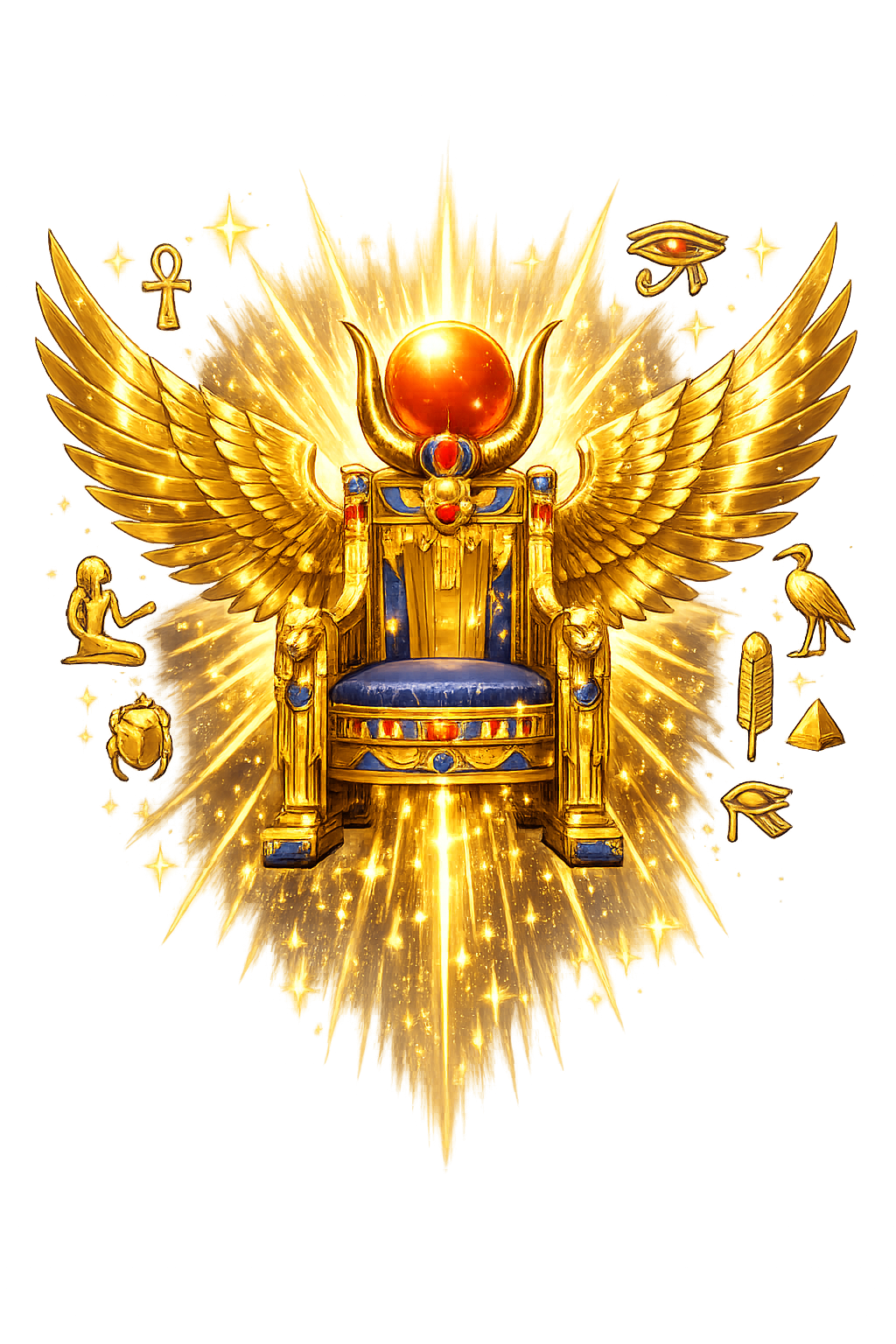
Ꜣst is the throne that walks. Her very name is written with the hieroglyph of a seat (O29), and the king sits on her lap as on the throne of Egypt itself. She is the sister-wife of Osiris, the mother of Horus, and the most formidable magician in the Egyptian cosmos — a goddess who knows the secret names of things and is not afraid to use them.
Where other gods rule by force or decree, Ꜣst rules by devotion, cunning, and love. She reassembles the murdered Osiris, hides her infant son from Set, and outwits the sun-god Re himself to extract his hidden name. Her story is the Egyptian closest approach to a gospel: a god who dies, a mother who saves, a child who inherits.
Her name and form are bound to the royal seat; every pharaoh is enthroned on Isis.
She commands heka, the force that animates ritual speech, and knows names that even Re keeps secret.
She conceives Horus after Osiris's death and nurses him in the papyrus thickets of Chemmis.
With outspread wings she shelters the living, the dead, and especially children and kings.
From the original script to the living URL
𓊨𓏏𓆇
The name in its original Egyptian form. Ꜣst (𓊨𓏏𓆇) is attested in the source tradition — “Throne (Egyptian ꜣst)”. Its original diacritics and script distinctions carry the full phonetic and orthographic weight of the source tradition.
isis
Reduced to plain isis, the name loses everything that made it specific: original diacritics and script distinctions. What remains is an ASCII string that machines can parse but that no longer speaks with its original voice.
Ꜣst
The Unicode restoration recovers what ASCII flattened. Ꜣst restores original diacritics and script distinctions, returning the name to its original written dignity. The domain encodes to Punycode, but the browser displays the truth.
Ꜣst.com → xn--st-rq8h.com
The non-ASCII characters in Ꜣst are encoded while the ASCII remains visible. To the DNS, it is Punycode. To humanity, it is Ꜣst.
Owned, ideal, and ASCII forms of Ꜣst
Ꜣst
Restores 𓊨𓏏𓆇. The live temple domain — ꜣst.com.
isis
Flattens 𓊨𓏏𓆇. The plain ASCII fallback — what DNS and legacy systems see.
How Ꜣst was spoken
How Ꜣst travels from ancient script to the modern URL
Egyptian Ꜣst; the original vocalisation is unknown. The name may be connected with ꜣs.t “throne", reflecting her role as the throne of kingship.
Magic, Motherhood, Throne
The Unicode restoration Ꜣst uses Egyptological characters registrable in .com; hieroglyphs are outside the .com IDN table.
The lore you have read is the living myth. Extended Lore opens the scholarly vault beneath it: the cult and its material remains, a history of the image, the name after antiquity, a meditation on what the name still means, and the full scholarly apparatus — etymology, orthography, sources.
Enter Extended Lore