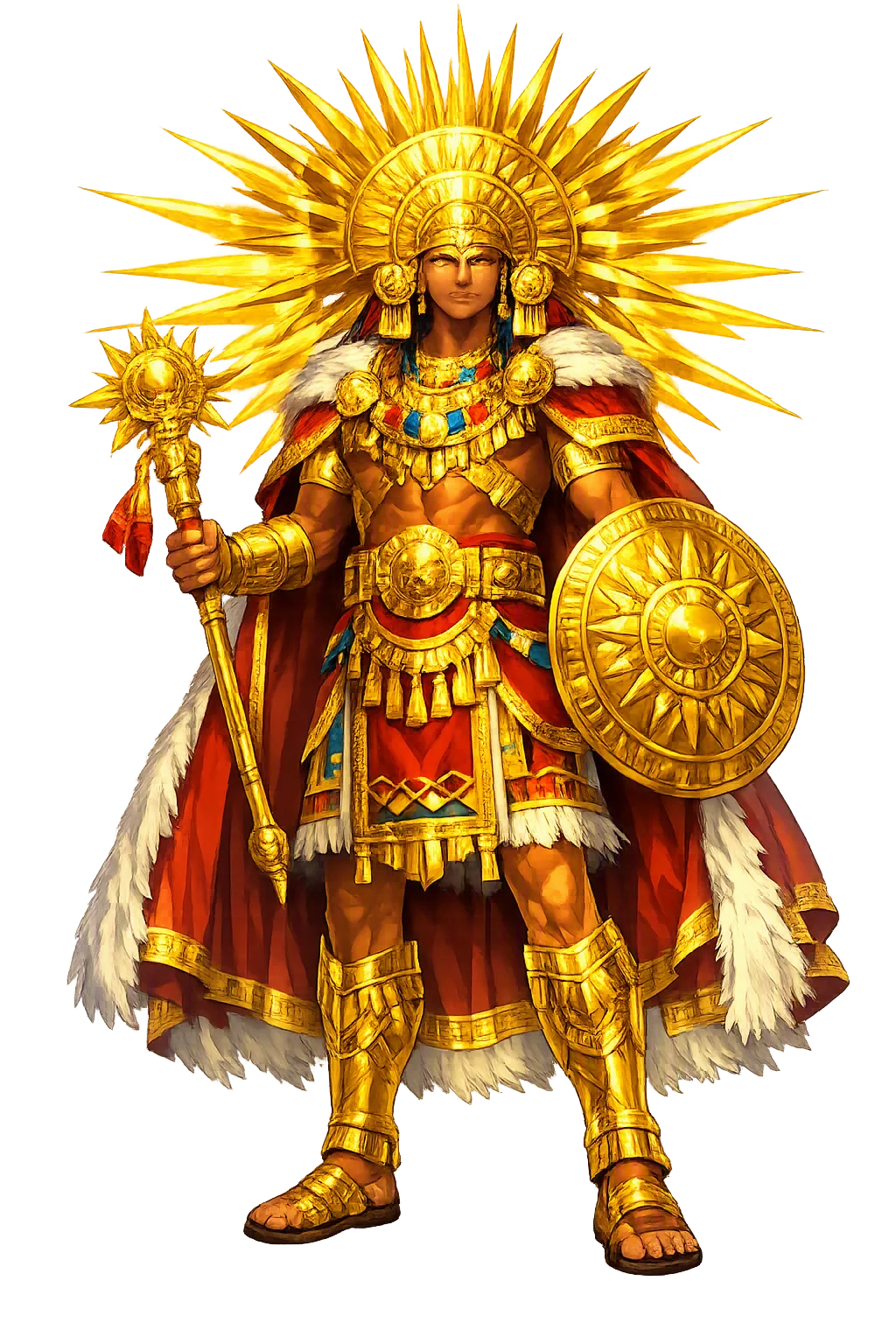
Stories of Inti
Inti's mythology is imperial theology. The sixteenth-century chroniclers — Betanzos, Sarmiento de Gamboa, Murúa, and later Cobo — preserve the state myths that made a mountain people the children of the sun: a creator who sired the daystar, a brother and sister sent to found Cuzco, and a solstice festival that renewed the world each year.
In the theology the Inca taught at Cuzco, Inti was not the first power. The creator Viracocha — the incomprehensible god behind the world, as the chroniclers struggled to render him — made the sun, the moon, and the stars and set them in heaven as lights for humankind. Inti and his sister-wife Mama Quilla were thus the children of the highest god, commissioned to govern the sky in their father's place (Sarmiento de Gamboa, Historia Indica 7; Betanzos, Suma y Narración 2). The genealogy is political architecture: by making Inti a son rather than a source, the Inca placed their own emperor — Inti's son — only two steps below creation itself. When the Sapa Inca stood before the people as the unique son of the Sun, the title carried a whole cosmology in four words. The myth means that empire, in the Andes, was a family business conducted in the language of the sky.
The founding myth of Cuzco is a solar errand. Inti and Mama Quilla, grieving that humankind lived without law, cloth, or maize, sent their children — a son, Manco Cápac, and a daughter, Mama Ocllo — from the Island of the Sun in Lake Titicaca, bearing a golden staff. Wherever the staff sank whole into the earth, there they were to raise the city. At the hill called Huanacauri, above the valley of Cuzco, the staff went down, and the siblings taught the gathered people to plough, to weave, and to live under rule (Sarmiento, Historia Indica 11–12; Betanzos 4; Murúa, Historia general del Piru). The myth makes the Inca capital literally planted in the ground by the sun's own metal: Cuzco was not built so much as sown. Every furrow of its terraces repeated the lesson — agriculture, the technology that let the mountains feed an empire, arrived as a gift from Inti's household, and the ruler in Cuzco ruled as the sun's eldest child.
Before he was Pachacuti — 'He Who Shakes the Earth' — the prince Yupanqui was an unlikely heir, and the Chanka confederation stood ready to erase Cuzco. In the account Sarmiento de Gamboa drew from Inca informants (Historia Indica 35–38), the young man took refuge at the spring of Susurpuquio, and there the Creator Viracocha came to him in a dream, and Inti promised that the sun himself would fight beside him. The Chanka attack failed; Yupanqui became the ninth Sapa Inca; and he answered the vision on an imperial scale. He rebuilt Cuzco as the navel of the world, re-founded the Coricancha — the Golden Enclosure — as his father Inti's house, and lined its courts with chambers of gold. The myth's logic is reciprocal and exact: a god gave a man a victory at a spring, and the man gave the god a temple of gold. Conquest and devotion were the same transaction, and the empire expanded, as its own theology said, because the sun willed it.
At the June solstice the sun stands still, and Cuzco held its breath. Bernabé Cobo, working from lost eyewitness sources, describes the Inti Raymi, the Festival of the Sun: a general fast; then the Sapa Inca, robed and wearing the Maskaypacha, processing to the great usnu platform of the main plaza, where the mummified dead emperors were set in order to drink with their father (Cobo, Historia del Nuevo Mundo 13.16–17). Chicha flowed, llamas were sacrificed, and dancers circled the night fire in the hides of pumas and condors, every hearth in the city rekindled from the sacred flame. The theology is in the geometry: the emperor faced the sun at the moment it turned, so that the whole state — dead rulers, living Inca, common households — formed a single circuit of light and obligation. The year did not merely pass; it was renewed by being witnessed, and the witness was Inti.
The heart of Inti's cult was the Punchao — 'Daytime' — a life-sized statue of the sun in solid gold, with a face, rays, and a fringe, kept in the Coricancha and tended each morning like a waking king (Cobo 13.14). Pizarro's men stripped the temple's gold from its walls in 1533 and carried the Punchao down to Lima; Murúa records that in 1559 the Spanish even exhumed the mummified bodies of dead emperors from their own shrines and shipped them to the viceregal capital, where the last witnesses lost track of them. Nothing survives of the statue but descriptions — the most eloquent archaeology in the Americas is an absence. The chroniclers' inventories mean that the empire's golden age is known exactly and lost exactly: Inti's temple is a cavity at the center of Cuzco, and the name restored here is the one thing the conquest could not melt down.
Sun
Inti is the sun as sovereign: father of the Inca dynasty, patron of Cuzco, and the divine ancestor whose rays fed the terraces that fed an empire. He is the unseen emperor of the Andean sky — never shown as a body, only as gold, light, and the crimson fringe on his son's forehead.
The life-sized golden statue of Inti — 'Daytime' — enthroned in the Coricancha, its face and rays of beaten gold, flanked by golden maize and llamas (Cobo, Historia 13.14).
Every reigning Inca was the Sun's son; the empire's genealogy, law, and war were obligations owed to a father in the sky.
The June festival at Cuzco — fasting, night dancing, and offerings on the usnu, when the Sapa Inca drank with his father at the standing sun (Cobo 13.16–17).
Terraces, planting calendars, and frost-shrines along the equator — the sun made harvest, and harvest made the empire.
From the original script to the living URL
Inti
The name survives in scholarly transliteration. Inti is the standard Incan romanisation, documented in academic sources — “Sun”. Because the spelling uses only Latin letters, the form is the same in both ASCII and Unicode.
No indigenous writing system is securely attested for individual incan names. The form shown is a modern scholarly transliteration.
inti
The plain inti form is identical to the Unicode restoration. Because this name is already written in Latin letters, no diacritics, stress, or script information were lost — only capitalization differs.
Inti
The Unicode restoration does not need to recover lost marks for Inti. Its value is canonical spelling and consistent cataloguing, not the reconstruction of erased orthography. The domain is readable as-is to both DNS and humanity.
Inti.com
This restoration is written entirely in ASCII letters — no Punycode encoding stands between Inti and the DNS. The domain reads identically to machines and to human eyes.
Owned, ideal, and ASCII forms of Inti
Inti
The full Unicode restoration. inti.com is not in the PuniCodex collection — it is watched for release; if it drops, this temple upgrades to an owned flagship.
How Inti was spoken
How Inti is preserved in writing
No indigenous writing system is securely attested for individual incan names. The form shown is a modern scholarly transliteration.
Contribute scholarly provenance →The lore you have read is the living myth. Extended Lore opens the scholarly vault beneath it: the cult and its material remains, a history of the image, the name after antiquity, a meditation on what the name still means, and the full scholarly apparatus — etymology, orthography, sources.
Enter Extended Lore