
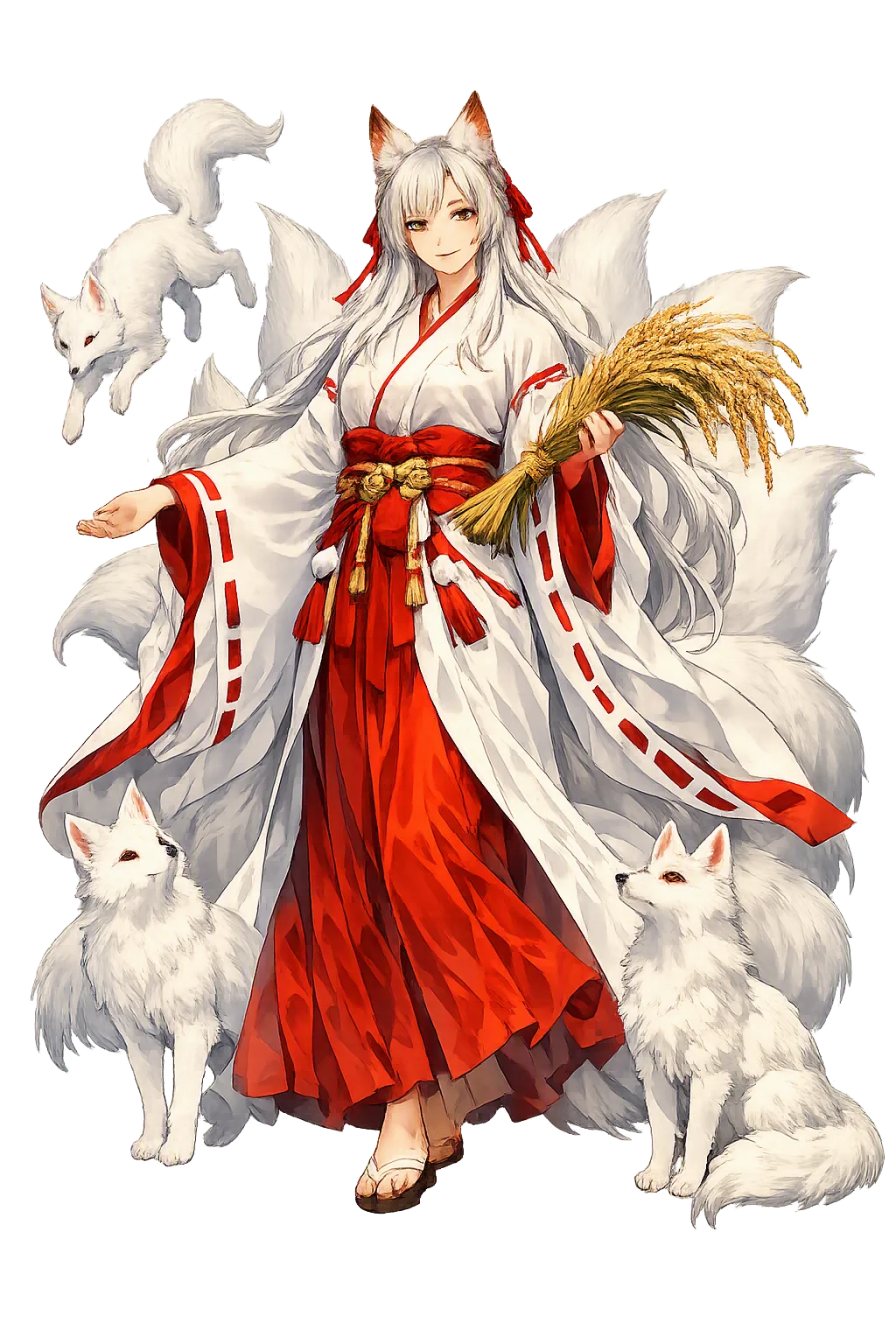
Inari at work: agriculture, food & harvest, finance, wealth & commerce, and the myths that got there first
The myths did not retire. They moved offices. This is the file on where Inari works now.
Inari has no single canonical myth cycle in the Kojiki manner. The kami's identity is distributed across a charter legend, a shifting triad of enshrined gods, the fox lore of the medieval period, and the craft legends of the cities — a biography written by worshippers rather than scribes.
The pattern atlas — which maps every flagship temple to the industries its archetype demonstrably resonates with, each match argued and open to challenge — seats this temple in 3 industries. This file reads those seats the way they were earned: through the myths.
At a Glance
- Temple: Inari
- Pantheon: Japanese
- Domain of influence: Rice, Fertility, Foxes
- Pattern seats: 3
- Sectors touched: Energy & Natural World · Commerce & Governance · Home & Lifestyle
- Strongest seat: Agriculture, Food & Harvest
- Series: The Resonance Files, No. 233 of 548
The Myth at Work
The Rice-Cake That Flew. The Nihon Shoki (Wadō 4, 711 CE) tells how Hata no Irogu, a leader of the immigrant Hata clan, practiced archery on a mountain by setting up a rice-cake as a target. When his arrow struck it, the cake rose into the air as a white bird and flew to the summit, where a radiance appeared. — remember the shape of that act. You will see it again, wearing a logo.
Three Gods, One Kami. At its head shrine, Inari is not one deity but three: Uka-no-mitama, the spirit of the rice plant; Satahiko; and Ōmiyanome, the ancestral weaver and food-goddess. Other Inari shrines substitute Toyouke, the goddess of the Ise Grand Shrine's outer precinct, who prepares the food of the gods. — that is not just a story. It is a business model, four thousand years early.
The Seats
Each of these is argued in the atlas with a weight and a why-line. What the atlas cannot fit in one line is the whole myth — so here is each seat with its story restored.
Agriculture, Food & Harvest
Farming, grain, food production, and agtech. (Sector: Energy & Natural World)
The kami of rice, fertility, and foxes; the harvest itself is shaped like their tails. Swap the costume and the sentence is indistinguishable from the myth. That is what a resonance seat means.
Finance, Wealth & Commerce
Banking, investment, and commercial enterprise. (Sector: Commerce & Governance)
Rice, fertility, and fox-shaped fortune; the merchant's prayer is offered at their gates. Swap the costume and the sentence is indistinguishable from the myth. That is what a resonance seat means.
Food & Hospitality
Restaurants, food service, and the table as an institution. (Sector: Home & Lifestyle)
The why-line says it in one breath: Rice, sake, and fox; the Inari-zushi roll carries their name to every table. That is not a resemblance; it is the same act, performed in a newer building.
The Long Employment
Fushimi Inari Taisha, rebuilt after the Ōnin War and crowned with its endless gates, is among the most visited religious sites on earth, and the estimates of thirty thousand Inari shrines across Japan exceed any other deity's. The kami guards restaurants, rice merchants, and corporate headquarters; the sushi named for the fox, inari-zushi, is sold in every convenience store; and the fox-mask of festival stalls is recognizably Inari's. The age changed. The work did not.
The Method, Stated Plainly
Skeptical? Good — the system is built for you. Every seat in this file carries its why-line and its weight, the full derivation is public at the methodology page, and the challenge process is part of the design. Falsifiable is not a posture here; it is the mechanism.
For the Ones Who Work There
If you work in agriculture, food & harvest, finance, wealth & commerce, or any trade this temple holds a seat in, this is the honest version of what a placement means: your industry beside the story it has been re-telling all along — on the temple floor itself, before an audience that came specifically to read it. The patron tier and the advertising terms describe the mechanics; the resonance above describes the fit.
The File Continues
One of 548 Resonance Files — the series where the pantheon goes to work. Read the founding dispatch for the name, the Restoration File for the spelling, or the whole archive end to end.
Continue the series — previous: Inaras (read it) · next: Inti (read it).
The Resonance Files are argued from the same canonical record as the pattern atlas itself: the lexicon, the lore catalog, and the cited sources. Every seat can be challenged at the methodology page — and the challenge is the point.