PuniCodex

Extended Lore

Inari — The Deeper Record

Etymology · Orthography · Cult · Iconography · Reception · Sources

ASCII-equivalent form Inari
Inari — Rice, Fertility, Commerce
01

At a Glance

Inari — every fact links to its home

PantheonJapanese
DomainRice, Fertility, Commerce
Attested711 CE
Original Script稲荷 →
Primary Sources3 cited →
02

Etymology & Word Family

From original script to canonical restoration — the full etymology page →

Original Script 稲荷 Inari — "Rice load"
Canonical Restoration Inari Canonical scholarly spelling — ASCII-identical
Modern ASCII inari Plain-ASCII fallback

The name Inari reaches the modern world through scholarly transliteration of the japanese tradition. Because the conventional spelling uses only Latin letters, its canonical and ASCII forms coincide — the tradition it carries is in the name itself, not in diacritics.

03

Character breakdown

Character-by-character philological analysis

CharacterUnicodeNameBlockPhonetic Role
IU+0049Latin Capital Letter IBasic LatinSame
nU+006ELatin Small Letter NBasic LatinSame
aU+0061Latin Small Letter ABasic LatinSame
rU+0072Latin Small Letter RBasic LatinSame
iU+0069Latin Small Letter IBasic LatinSame

This restoration reflects fidelity to the attested tradition, not recovered diacritics: every character of Inari already survives in ASCII. What the restoration preserves is the canonical spelling itself — the form scholarship standardised.

04

Cult & Worship

How the sacred was kept — rites, sanctuaries, remains

The Cult

Inari's cult is one of the largest in Japan — estimates count thirty thousand Inari shrines or more, from head shrine to kitchen nook — and its calendar is ancient. The great festival is Hatsu-uma, the first horse-day of the second month, when Fushimi Inari Taisha mounts its grand rites and Inari shrines nationwide serve the kami's first feast of the year; monthly Inari-kō confraternities, once the backbone of merchant and artisan devotion, still meet in towns and companies. Offerings run to what the fox loves: fried tofu (abura-age), sake, rice, and at smithies, old tools. The famous vermillion tunnels are a votive technology: worshippers whose prayers succeeded donate a torii, painted with the donor's name and the date — thousands climb the mountain at Fushimi, each gate an invoice of a fulfilled prayer. Pilgrims once measured devotion in circuits of Fushimi's three peaks, and businesses still send their first offerings of the year to the local Inari-san.

In the Earth

Fushimi Inari Taisha in southern Kyōto has been Inari's head shrine since 711 CE. Burned in the Ōnin War (1468) and rebuilt by the late fifteenth century, its main halls, its tunnel-paths of donated torii — over ten thousand strong, dating chiefly from the Edo period onward — and the mountain-top okusha shrines form one of Japan's best-documented cult landscapes. Excavations and shrine records trace the cult's growth from a Hata-clan agricultural shrine to the devotional center of a national commercial network, and the thousands of subsidiary Inari shrines preserve medieval siting patterns at field boundaries and village entrances.

05

Iconography

How Inari was imaged across the ages

The Image

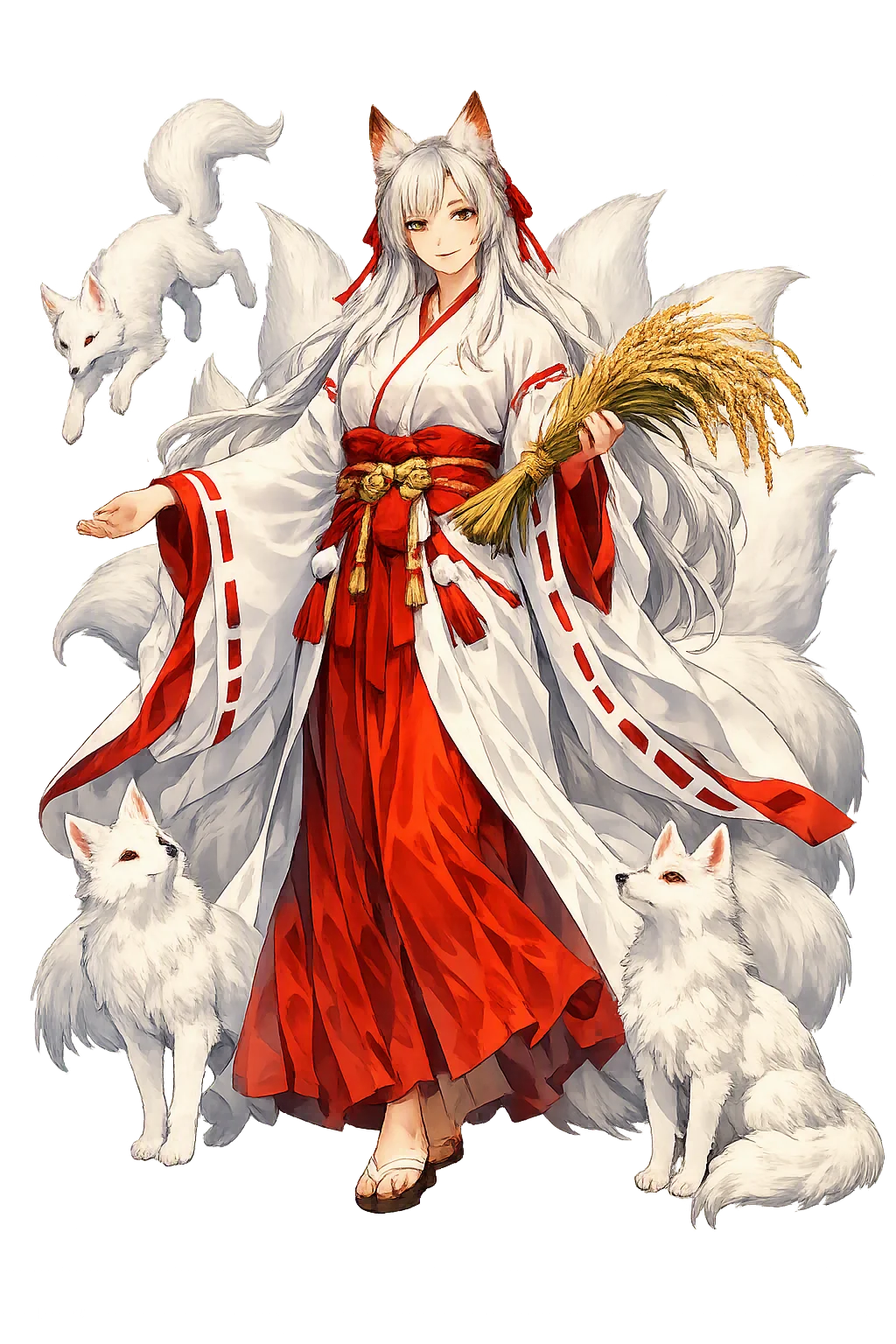
Inari has no single sacred face — the kami rides the fox. The paired foxes (koma-kitsune) flanking every Inari shrine are the effective icon: one holds the granary key, one the wish-granting jewel, and red votive bibs testify to generations of petitioners. In esoteric Buddhist imagery, where medieval Tendai read Inari through the fox-riding Dakiniten, the kami takes anthropomorphic form — sword and jewel in hand, a white fox beneath — and Heian-to-Kamakura mandalas transmit that type. Popular Edo art fixed the alternatives still sold today: Inari as a gracious woman, or as an old man shouldering a sheaf of rice. The fox's own iconography is strict: upright, attentive, mouth closed on key or jewel, never playful. Of the major Japanese deities, Inari is imaged least by a body and most by a messenger.

06

Reception & Transformation

The name after its own age — transmission, translation, survival

Afterlives

Inari's afterlife is a study in graceful adaptation. The Nihon Shoki's entry for 711 records the founding sign at Fushimi, and in the Heian period the shrine was enrolled among the twenty-two shrines (Nijūnisha) receiving imperial offerings — a kami of immigrant lineage at the center of the court's cult. Medieval shrine engi turned omens and possessions into narratives, and setsuwa literature made the messenger as famous as the god. Edo popular art ran with both: Hiroshige's One Hundred Famous Views of Edo closes its sequence with the fox-fire gathering at the Ōji Inari shrine on New Year's Eve (1857), and Yoshitoshi's Dream of Wake no Mitsunaka (c. 1890) shows Inari's foxes descending on a courtier with burning torches — the kami's suite rendered unforgettable. Western readers met the god through Lafcadio Hearn's essays of the 1890s, and twentieth-century fieldwork, above all Karen Smyers' ethnography of contemporary Inari worship, made this most local of kami an academic classic: the deity that best shows how Japanese religion actually works.

Identifications Across Traditions

Inari is the great syncret of Japanese religion. Medieval Tendai identified the kami with Dakiniten, the fox-riding deva absorbed from Indian tantra, and esoteric lineages placed Inari within mandala systems of the five grains. The Muromachi and Edo periods saw Inari conflated with Benzaiten and with Uka-no-mitama's Buddhist guises; fox-possession cults and Inari mediums blurred the shrine and the street. No figure in Japan tolerated layered identity more gracefully — male or female, one or three, kami or buddha. When the Meiji state ordered the separation of Shinto and Buddhism, Inari shrines quietly stored their Buddhist statuary away; most of it returned within a generation.

The foxes are a latecomer, and the record says so. Nothing in the early documents assigns Inari an animal familiar; the association grew in the medieval period when esoteric Buddhism identified Inari with the ḍākinī — Japanese Dakiniten — a goddess whose mounts were foxes. Under that identification the spirit-messengers multiplied, and by the early modern period whole shrine precincts were lined with their statues, red bibs and all. The Meiji separation of Shinto and Buddhism removed the Buddhist overlay administratively, but the foxes stayed — a medieval Buddhist idea so thoroughly naturalized that most visitors now assume it was always part of the cult.

Modern Legacy

Fushimi Inari Taisha, rebuilt after the Ōnin War and crowned with its endless gates, is among the most visited religious sites on earth, and the estimates of thirty thousand Inari shrines across Japan exceed any other deity's. The kami guards restaurants, rice merchants, and corporate headquarters; the sushi named for the fox, inari-zushi, is sold in every convenience store; and the fox-mask of festival stalls is recognizably Inari's. In a secular age, Inari prospers as the most pragmatic divinity in the pantheon: pray, work, and share the result — the god of the harvest became the god of the hustle.

09

The Original Script Note

What the written record preserves — and what it does not

Original Script

The name is written 稲荷 — 稲 'rice plant' + 荷 'load, burden' — a logographic spelling reading 'carrying rice', the very function of the cult. It first enters the secure documentary record in the early tenth century, in the court history Ruijū Kokushi (compiled c. 892), which lists the Inari shrine among Heian institutions; shrine tradition dates the founding to 711 on Mount Inari in Fushimi, tied to the immigrant Hata clan. Nothing earlier survives. The characters fix the god's gift, not a personal name.

10

The Meditation

What Inari means — beyond the dictionary

Inari teaches that the sacred is not separate from the everyday. The rice in the bowl, the sake in the cup, the ledger of the shop, the contract of the marriage — all flow through one deity who declines to be a single person.

The fox is the perfect emblem of this theology: it crosses the boundary between field and village, animal and ancestor, omen and blessing, exactly as rice crosses from seed to wealth. To modern eyes Inari looks like a god of capitalism, and there is truth in it — Inari protected merchants when merchants were new, and prosperity cults follow prosperity. But the older lesson stands underneath: abundance is relational. The granary key is entrusted to a messenger, not a master, and the ten thousand gates are not a wall but an invitation.

11

Screen & Culture

Where Inari echoes through film, television, and games — and how

12

Frequently Asked Questions

Deep-dives into the cult, attestation, reception, and sources of Inari

01How do we know how Inari was worshipped?

Fushimi Inari Taisha in southern Kyōto has been Inari's head shrine since 711 CE. The full cult record →

02Where do the earliest attestations of Inari come from?

The record rests on Nihon Shoki (foundation of the Inari shrine, 711 CE), Kojiki (rice-kami genealogies), Smyers, The Fox and the Jewel: Shared and Private Meanings in Contemporary Japanese Inari Worship, among 4 cited works. The full source apparatus →

03How did later traditions reinterpret Inari?

Inari's afterlife is a study in graceful adaptation. Reception & transformation →

04What do the surviving images of Inari actually show?

Inari has no single sacred face — the kami rides the fox. The iconography →

05What does the written record of Inari actually preserve?

The name is written 稲荷 — 稲 'rice plant' + 荷 'load, burden' — a logographic spelling reading 'carrying rice', the very function of the cult. The Original Script note →

13

Scholarly Sources

The philological foundations of the record

Every claim on this page is grounded in established scholarship. The orthographic restorations follow disciplinary convention. The etymological chain follows the best available reference works. This is not invention — it is resurrection through scholarship.

◈

Lexicography & Philology

  • Hepburn
◎

Primary Texts

  • Kojiki
  • Nihon Shoki (foundation of the Inari shrine, 711 CE)
  • Kojiki (rice-kami genealogies)
◉

Archaeology & Art History

  • Guth, C. Art of Edo Japan; Kidder, J. E. Early Japanese Art.
✦

Religious Studies

  • Smyers, The Fox and the Jewel: Shared and Private Meanings in Contemporary Japanese Inari Worship
  • Teeuwen and Breen, A New History of Shinto
Return

The Surface Awaits

You have traced the name from its earliest attestation to its canonical restoration. Now return to the myth. The story is where the name lives.

Back to Lore
Inari mascot