PuniCodex

Extended Lore

Ἰάσων Iásōn

Etymology · Orthography · Cult · Iconography · Reception · Sources

Tier 1 Iásōn.com
Iásōn — Heroism, the Golden Fleece
01

Quick Facts

Essential information about Iásōn, Heroism, the Golden Fleece

Original ScriptἸάσων
Unicode RestorationIásōn
Reconstructed Pronunciation/i.áː.sɔːn/
PantheonGreek
DomainHeroism, the Golden Fleece
MeaningHealer
ClassificationTier 1
Primary DomainIásōn.com
Sacred SymbolsGolden Fleece, The Argo, The single sandal, Dragon's teeth, The dove
02

Etymology & Word Family

From original script to Unicode restoration

Original Script Ἰάσων Iásōn — "Healer"
Unicode Restoration Iásōn Restored stress, length, and script
Modern ASCII iason Plain-ASCII fallback

The name Iásōn carries the orthographic signature of the greek tradition: Ἰάσων. Unicode restoration recovers what ASCII flattens.

03

Unicode Character Breakdown

Character-by-character philological analysis

CharacterUnicodeNameBlockPhonetic Role
IU+0049Latin Capital Letter IBasic LatinI uppercase
áU+00E1Latin Small Letter A with AcuteLatin-1 SupplementAcute on a
sU+0073Latin Small Letter SBasic Latins same
ōU+014DLatin Small Letter O with MacronLatin Extended-AMacron: long vowel
nU+006ELatin Small Letter NBasic Latinn same

The Tier 1 classification reflects how much of the original phonology this restoration preserves — stress and vowel length for Greek names, distinctive letters and diacritics for every other tradition.

04

Cult & Worship

How the sacred was kept — rites, sanctuaries, remains

The Cult

Hero-cult for Iásōn is thinly attested but anchored in Iolkos and the Magnesian coast. Pindar's Fourth Pythian ode preserves the outline of a Thessalian hero-cult that honored the Argo's voyage, and the city's harbor at Pagasai remained a meaningful landmark. No major panhellenic sanctuary is known, but local rites likely marked the departure and return of the ship, with athletic or nautical commemorations at Iolkos. The absence of a large temple corpus is characteristic of epic heroes whose worship was eclipsed by city-cults of Apollo, Athena, and the Dioscuri.

In the Earth

Iolkos, the city Iásōn was born to rule, lies beside modern Volos: Mycenaean remains at Dimini and at the palace-site of ancient Iolkos keep the legend anchored, and the bay of Pagasai, the Argo's port, is the bay of Volos itself. Across the Black Sea, Colchis is historical Georgia, where the site of Vani has yielded astonishing gold-work of the fifth–fourth centuries BCE; the geographer Strabo reports that Colchian miners washed gold from mountain streams with fleeces — the rationalist's explanation for the Fleece. No temple or cult of Iásōn is securely attested; his monument was a story.

05

Iconography

How Iásōn was imaged across the ages

The Image

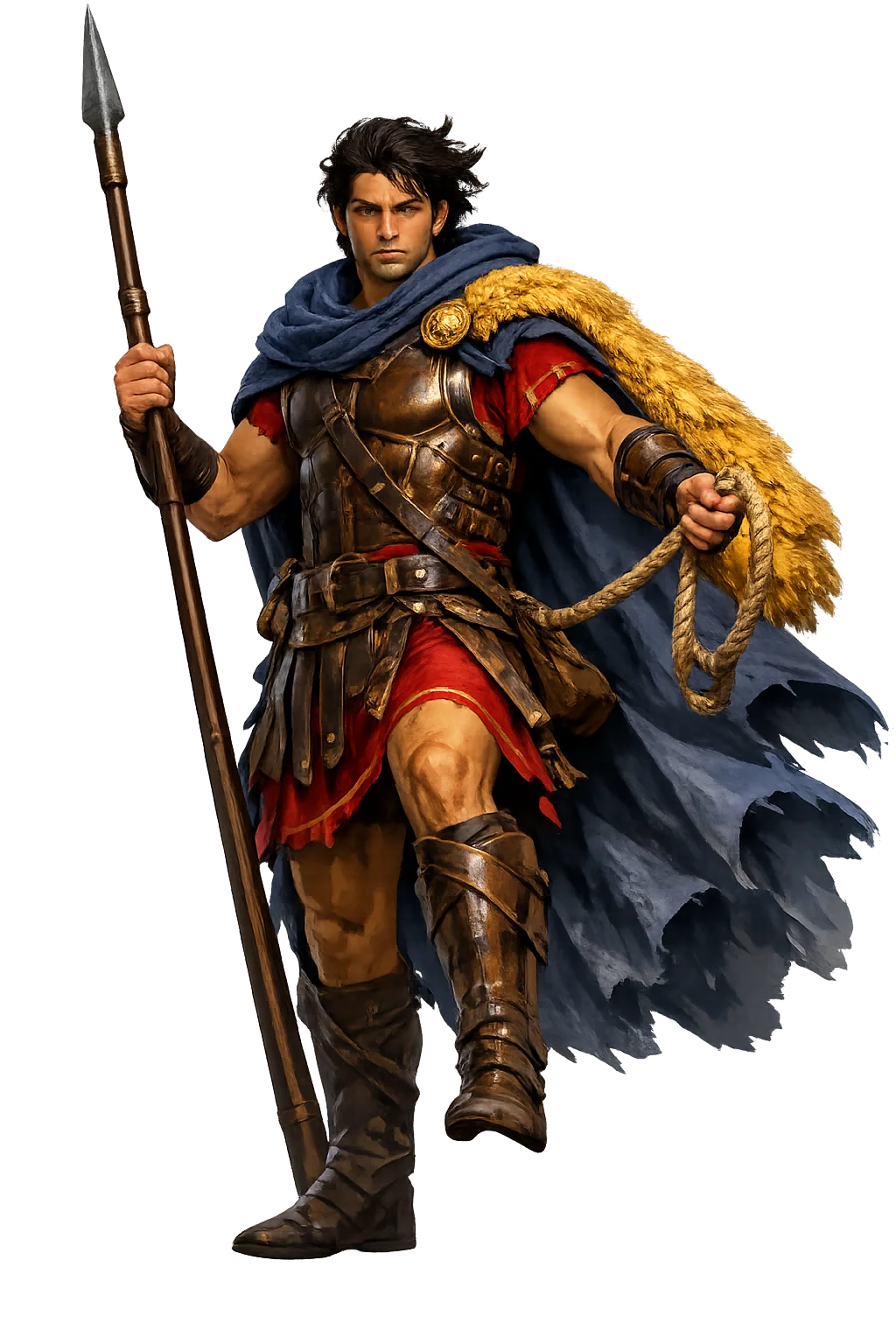
Iásōn appears in Greek vase painting as the youthful hero beside the Argo, armed and sometimes wrestling the fire-breathing bulls or the guardian serpent of the Golden Fleece. South Italian vases of the fourth century BCE dramatize Medea's magic and the fleece hung on a tree. Later Roman and Renaissance images prefer the scenes of betrayal and abandonment over the quest itself, with Medea often dominating the visual narrative. Modern book illustration and film have fixed Iásōn as the archetypal questing hero, usually accompanied by the ship and the fleece.

06

Reception & Transformation

The name after its own age — transmission, translation, survival

Afterlives

Iásōn's myth was transmitted through Pindar's victory ode, Apollonius Rhodius's learned epic, and Apollodorus's handbook, becoming a template for the quest romance in the Hellenistic and Roman worlds. His name and story entered Latin literature through Valerius Flaccus and Ovid, and the Argo became a symbol of maritime exploration and dangerous ambition. The Renaissance rediscovered the Argonautica as a model for heroic voyage, influencing epic from Ariosto to the Baroque. In modern scholarship Iásōn is read as a study in heroic failure and erotic betrayal, while popular reception has reduced him to the leader of the Argonauts and the unfaithful husband of Medea.

Identifications Across Traditions

A mortal hero drew no foreign cult identifications of the sort the Olympians attracted; Iásōn's syncretism is literary and linguistic. Rome made him Iāsōn in epic (Valerius Flaccus) and elegy (Ovid's Heroides), and through Latin his name passed into every European language. More strikingly, Hellenistic Jews adopted Ἰάσων as the Greek equivalent of the Hebrew Yehōšūaʿ (Joshua): a Jason appears among the high priests of Jerusalem in the books of Maccabees, and a Jason of Thessalonica shelters Paul in the Acts of the Apostles. The healer's name, born in Thessaly, ended as one of the bridge-names between the Greek and Hebrew worlds.

Modern Legacy

Iásōn founded a genre: every quest narrative, from the medieval grail romances to the modern space voyage, retraces the Argo's wake. The very word 'argonaut' became the common noun for the far-sailing adventurer — and, by derivation, 'astronaut' and 'aquanaut'. William Morris retold the whole myth in The Life and Death of Jason (1867); Ray Harryhausen's film Jason and the Argonauts (1963) fixed the image for a century of cinema. As a given name, Jason ranked among the most popular in the English-speaking world of the late twentieth century. The restoration Iásōn returns to the familiar name its forgotten meaning: the healer who sailed.

07

The Meditation

What Iásōn means — beyond the dictionary

Iásōn is the strangest of the great Greek heroes, because he is the least heroic by the usual measures. He slays no monster unaided; the fire-breathing bulls are mastered through an ointment, the dragon through a lullaby, the Fleece itself through a princess's love. His one distinctive gift is the gift of gathering — the summons that brought fifty heroes to one beach, and the charm that won Medea. The Greeks half-noticed this: Pindar treats him as the gentle answer to his homeland's sickness, and the tragedians show a man perpetually outmatched by the powers he sets in motion.

That is why his ending is so quietly terrible. There is no grand hubris, no defiance of the gods — only drift. He owes everything to a woman and trades her for a useful marriage, and the universe answers in kind. The man named 'healer' leaves behind him a trail of the cut and the broken: Apsyrtos, Pelias, his own children. Perhaps that is the lesson the myth keeps: a name is a task, not a possession. Iásōn never healed anyone. The name waited, and in another tongue, on another shore, it was carried by healers again.

08

Frequently Asked Questions

Common questions about Iásōn, Heroism, the Golden Fleece, and Unicode restoration

01How do you pronounce Iásōn?

In reconstructed pronunciation, Iásōn is /i.áː.sɔːn/ — approximately 'ih-AH-sone' — the second syllable is pitched higher and held; the final 'ō' is long and closed, nothing like the English 'sun'.

02What does Iásōn mean?

Iásōn means Healer in the greek tradition.

03What are the symbols of Iásōn?

Iásōn is associated with Golden Fleece (The object of the quest, token of the kingship to be restored), The Argo (The first ship; its name, 'swift', shares the shining root ἀργός), The single sandal (The sign of the oracle — the one-sandaled man who would undo Pelias), Dragon's teeth (Sown in Colchis, they sprouted armed men — the trial Aietēs set him), The dove (Loosed at the Clashing Rocks on Phineus's counsel; its safe passage showed the way).

04Why are there different spellings of Iásōn?

Each form is a historically attested restoration rather than a mistake: Iāsōn is the macron-only form (Macron-only scholarly form (LSJ convention); the temple carries the full stress-marked restoration.). PUNICODEX registers the full set so the tradition is preserved under every defensible spelling.

05Why restore Iásōn in Unicode?

Plain ASCII iason strips the stress, length, and script that make the name specific. Unicode restoration returns the name to its original written dignity.

06What is the most important myth about Iásōn?

“The Man with One Sandal” — the The Oracle story that anchors the mythology of Iásōn, told in full on the lore page.

09

Scholarly Sources

The philological foundations of this restoration

Every claim on this page is grounded in established scholarship. The orthographic restorations follow disciplinary convention. The etymological chain follows the best available reference works. This is not invention — it is resurrection through scholarship.

◈

Lexicography & Philology

  • Apollonius
◎

Primary Texts

  • Pindar
  • Pindar, Pythian 4 (the Argonaut ode)
  • Apollodorus, Bibliotheca 1.9.1–28
  • Euripides, Medea
  • Ovid, Heroides 12; Metamorphoses 7.1–424
◉

Archaeology & Art History

  • Material evidence — iconography, inscriptions, and temple archaeology — for Iásōn and related cults.
✦

Religious Studies

  • Apollonius Rhodius, Argonautica 1–4
  • Liddell–Scott–Jones, A Greek–English Lexicon, s.v. Ἰάσων
  • Beekes, Etymological Dictionary of Greek, s.v. Ἰάσων
Return

The Surface Awaits

You have traced the name from its earliest attestation to its Unicode restoration. Now return to the myth. The story is where the name lives.

Back to Lore
Iásōn mascot