
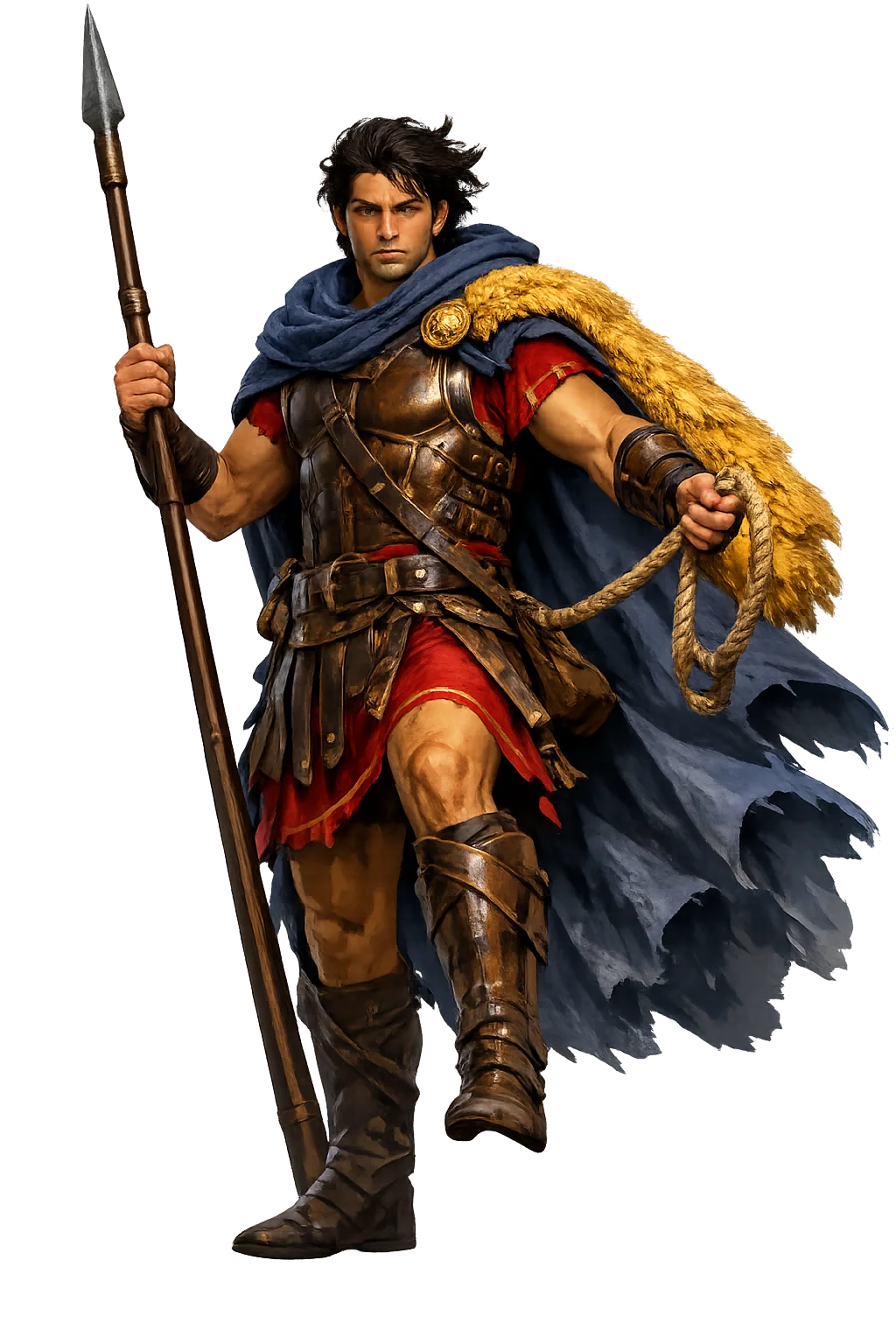
The name Iásōn and the world it opens
A name is a door. Iásōn opens onto an entire world: the domain of heroism, the golden fleece, a Greek tradition, and centuries of storytelling, worship, and scholarship. This post walks through that world room by room — the name and its roots, the original script, the sound of it, the myths, the symbols, the sites, the afterlife across cultures — and ends at the newest room of all: a Unicode domain that makes the whole structure addressable. iason gets you to the same building, but only the restored form tells you why it was built.
At a Glance
- Restored name: Iásōn
- ASCII form: iason
- Meaning: "Healer"
- Domain of influence: Heroism, the Golden Fleece
- Pantheon: Greek
- Classification: Tier 1
- Original script: Ἰάσων (Greek)
- Live domain: iásōn.com
Overview
Iásōn (iason) — Captain of the Argo · Seeker of the Golden Fleece — belongs to the Greek tradition, where it is catalogued under the domain "Heroism, the Golden Fleece". The name means "Healer".
Iásōn is the captain of the first great sea-quest of Greek myth: the voyage of the Argo to Colchis for the Golden Fleece. His name comes from ἰάομαι, 'to heal' — yet his story is less about curing than about gathering: he is the hero whose greatest power is to summon other heroes, and to win the love of a princess whose magic does the work.
PuniCodex restores the name as Iásōn and serves its temple at iásōn.com. The original carries both stress and vowel length, and exactly one historically valid Unicode restoration exists, which places the name in Tier 1. The plain ASCII form iason survives as a modern convenience imposed by the early domain-name system; the restoration, not the fallback, is the form the project defends as philologically complete.
The Name
The name is attested in Greek as Ἰάσων. Etymologically it means "Healer".
The ASCII form iason survives only because the early domain-name system could not carry diacritics; it is a technological compromise, not an ancient spelling. The Unicode restoration Iásōn recovers both the stress accent and the vowel length of the original directly in the address bar. The original carries both stress and vowel length, and exactly one historically valid Unicode restoration exists, which places the name in Tier 1.
The letter-by-letter transformation runs:
- i → I — I uppercase
- a → á — Acute on a
- s → s — s same
- o → ō — Macron: long vowel
- n → n — n same
The project holds the domain iásōn.com (xn--isn-ela55c.com) as the canonical home of this name.
The Original Script
The name is written in Greek as Ἰάσων. This original script is the form against which the ASCII fallback iason and the PuniCodex restoration Iásōn are measured: the restoration preserves both its pitch accent and its vowel quantity of the written form, so that a reader typing the modern address still speaks the ancient name.
Pronunciation
The reconstructed pronunciation of the name is /i.áː.sɔːn/ — Attic Greek Reconstruction.
Phoneme by phoneme:
- I- — Short iota with smooth breathing — the name opens light and quick, without roughness.
- -á- — Long alpha with acute pitch [áː] — the stressed peak of the name; the Ionic form Ἰήσων, with long eta, proves the vowel's length.
- -sōn — Sigma followed by long omega [sɔːn] — the drawn-out final syllable that marks the name as long-voweled.
For the modern speaker, the closest approximation is: 'ih-AH-sone' — the second syllable is pitched higher and held; the final 'ō' is long and closed, nothing like the English 'sun'.
Kindred and historical forms of the name:
- Greek verb — ἰάομαι, 'to heal, to cure' — the root of the name
- Greek noun — ἰατρός, 'physician', built on the same root
- Ionic Greek — Ἰήσων (Iḗsōn), the Ionic form with long eta standing for Attic long alpha
- Latin — Iāsōn, whence English 'Jason'
Iásōn is Tier 1 because the Greek Ἰάσων contains both stress (acute on the long alpha) and length (the long ᾱ and the final ω). The restoration keeps both: the acute on á and the macron on ō. The name means 'healer' — a fact the quest story tends to forget.
Mythology
The myth of Iásōn is the myth of the quest itself: an unjust king, an impossible errand, a band of heroes, and a prize won by cunning and love rather than by strength alone. Pindar sang it; Apollonius made it an epic; Euripides gave it its dark ending.
The Man with One Sandal (The Oracle)
Pelias, who had seized the throne of Iolkos from Iásōn's father Aisōn, was warned by an oracle to beware the man wearing one sandal. Iásōn came down from Mount Pelion, where the centaur Cheirōn had reared him, and lost a sandal fording the river Anauros — carrying, Apollodorus says, an old woman who was Hera in disguise. Pelias saw the sign and set the errand he thought would kill him: fetch the Golden Fleece from the edge of the world.
The Argo and the Clashing Rocks (The Voyage)
The greatest heroes of the age answered the summons. The Argo sailed from Pagasai through wonders and losses — Lemnos, the land of women; the death of Hylas, which cost them Heraklēs; the boxing of Polydeukēs with Amykos — until Phineus, the blind seer, told them how to pass the Symplegades, the rocks that clashed together. A dove was loosed first; when it lost only its tail-feathers, the Argonauts rowed through on the rebound, and the rocks stood still forever.
Medea and the Tasks of Aietēs (The Trial)
In Colchis, King Aietēs set three labors: yoke the fire-breathing bulls, plow the field of Árēs, and slay the armed men sprung from a dragon's teeth. Hera and Athena persuaded Aphrodite to send Eros, and Medea, the king's daughter and a priestess of Hekate, fell in love with the stranger. Her ointment made Iásōn proof against fire and iron for a day; her counsel felled the dragon's brood; her charm sang the sleepless guardian to sleep, and the Fleece was taken in the night.
The Betrayal at Corinth (The Return)
The homecoming was shadowed from the start: in Apollodorus's telling Medea had dismembered her brother Apsyrtos to slow the pursuit, and at Iolkos she tricked Pelias's daughters into cutting their father to pieces in a false rite of renewal. Exiled to Corinth, Iásōn put Medea aside to marry the princess Glaukē. Euripides tells the rest — the poisoned robe, the murdered children, the chariot of the Sun. Iásōn died as he had lived, by the Argo: struck in old age by a beam of the rotting ship as he slept beneath it.
Symbols & Iconography
The iconography associated with Iásōn concentrates in a small set of recurring attributes, each a compressed statement about the name:
- Golden Fleece — The object of the quest, token of the kingship to be restored
- The Argo — The first ship; its name, 'swift', shares the shining root ἀργός
- The single sandal — The sign of the oracle — the one-sandaled man who would undo Pelias
- Dragon's teeth — Sown in Colchis, they sprouted armed men — the trial Aietēs set him
- The dove — Loosed at the Clashing Rocks on Phineus's counsel; its safe passage showed the way
Ancient art gave Iásōn one unforgettable image and a handful of stock scenes. The unforgettable one is on an Attic red-figure cup painted by Douris around 480 BCE, now in the Vatican: the hero half-swallowed by the Colchian dragon, hanging limp from its jaws while Athena stands by and the Fleece hangs on its tree — the single most daring rendering of the fleece-taking, read by some as the hero disgorged, by others as his plunge into the guardian's mouth. The stock scenes are the muster and departure of the Argo, the one-sandaled stranger before Pelias, the contest with the fire-breathing bulls, and — above all in later and Roman art — the Medea cycle: the oath before the dragon, the drugged guardian, the flight with the Fleece. His attributes are few and stable: the single sandal, the traveler's cloak and broad hat of a wayfarer, and the Fleece itself, which the painters hang on a branch like a second sun.
Epithets & Cult Titles
- Αἰσονίδης (Aisonídēs) — 'son of Aisōn' — the standing patronymic of the Argonautica, where the bare name Iásōn is often withheld for lines at a time.
- μονόκρηπις / μονοσάνδαλος (monókrēpis, monosándalos) — 'the one-sandaled man' — the oracle's designation of him, in Pindar's word and Apollodorus's; the lost sandal is his passport.
- ἀρχὸς Ἀργοναυτῶν — 'captain of the Argonauts' — the functional title later tradition fixed on him; the muster at Pagasai offered the command to Heraklēs, who refused it in his favor.
- ὁ ἰατήρ — 'the healer' — not an epithet but the name's own gloss, from ἰάομαι; antiquity heard his calling in his name.
The stock is thin beside the gods' formulaic titles, and honest scholarship says so: Iásōn is the hero of one story, not a figure of cult, and epic gave him a role rather than a liturgy of epithets.
The Homeric Hymns
The Homeric Hymns are silent about Iásōn, and the silence is generic rather than evidential: the corpus hymns gods, not mortal heroes, and no hero of the quest generation — neither Hēraklēs nor Thēseus nor Achilleus — received a hymn of his own. The oldest surviving witness to the myth is instead a single passage of the Odyssey: the Argo, 'known to all' (πᾶσι μέλουσα), sailing home from Aietēs past the Planctae, which would have been dashed to pieces 'had not Hera passed her through, since Iásōn was dear to her' (Od. 12.69–72). Already in Homer the story needs no telling. What the genre of hymn could not give him, the genre of praise did: Pindar's fourth Pythian ode, composed for King Arcesilas of Cyrene in 462 BCE, is the oldest substantial narrative of the voyage and the nearest thing to a hymn Iásōn ever received. Apollonius's epic followed three centuries later.
Oracle Sites & Sanctuaries
No oracle ever spoke in Iásōn's name; his story runs on other people's consultations. The founding one is Delphi's: Pelias, the usurper of Iolkos, was warned by the god to beware the one-sandaled man, and Pindar preserves the oracle's terms — the man of one sandal, whenever he should come down from the highlands to the plain of famous Iolkos. The voyage itself began under an oracular sign: at Pagasai the Argonauts sacrificed to Apóllōn Embasios, 'of Embarkation', whose altar the company's own seer, Idmon, read for omens of the way. And the ship carried its own oracle in its timbers: a beam cut from the speaking oak of Dodona, set in the Argo's prow by Athena, which spoke to the crew at the journey's turns — most memorably when it declared, on the return, that the murder of Apsyrtos must first be purified by Kirke. Iásōn received no shrine and no seat of prophecy; the Greeks put oracles in his story, not at his tomb.
Archaeology & Evidence
Iolkos, the city Iásōn was born to rule, lies beside modern Volos: Mycenaean remains at Dimini and at the palace-site of ancient Iolkos keep the legend anchored, and the bay of Pagasai, the Argo's port, is the bay of Volos itself. Across the Black Sea, Colchis is historical Georgia, where the site of Vani has yielded astonishing gold-work of the fifth–fourth centuries BCE; the geographer Strabo reports that Colchian miners washed gold from mountain streams with fleeces — the rationalist's explanation for the Fleece. No temple or cult of Iásōn is securely attested; his monument was a story.
Realm & Domain
Iásōn is the captain of the first great sea-quest of Greek myth: the voyage of the Argo to Colchis for the Golden Fleece. His name comes from ἰάομαι, 'to heal' — yet his story is less about curing than about gathering: he is the hero whose greatest power is to summon other heroes, and to win the love of a princess whose magic does the work.
The Argo
The first true ship, built by Argos the shipwright under Athena's direction; its prow held a beam from the speaking oak of Dodona.
The Golden Fleece
The fleece of the flying ram that carried Phrixos to Colchis, hung in a grove of Árēs and guarded by a sleepless dragon.
The Argonauts
Some fifty heroes — Heraklēs, Orpheus, the Dioskouroi, Atalanta in some tellings — the greatest muster before Troy.
The Healer's Name
From ἰάομαι, 'to heal' — the ironic name of a hero whose cures are worked by Medea's pharmaka, not his own hands.
Across Cultures
A mortal hero drew no foreign cult identifications of the sort the Olympians attracted; Iásōn's syncretism is literary and linguistic. Rome made him Iāsōn in epic (Valerius Flaccus) and elegy (Ovid's Heroides), and through Latin his name passed into every European language. More strikingly, Hellenistic Jews adopted Ἰάσων as the Greek equivalent of the Hebrew Yehōšūaʿ (Joshua): a Jason appears among the high priests of Jerusalem in the books of Maccabees, and a Jason of Thessalonica shelters Paul in the Acts of the Apostles. The healer's name, born in Thessaly, ended as one of the bridge-names between the Greek and Hebrew worlds.
Within the Greek tradition, closely related names in the corpus include Achérōn, Achilleús, Adámas, Aḗr, Aithḗr, and Anánkē.
Cultural Legacy
Iásōn founded a genre: every quest narrative, from the medieval grail romances to the modern space voyage, retraces the Argo's wake. The very word 'argonaut' became the common noun for the far-sailing adventurer — and, by derivation, 'astronaut' and 'aquanaut'. William Morris retold the whole myth in The Life and Death of Jason (1867); Ray Harryhausen's film Jason and the Argonauts (1963) fixed the image for a century of cinema. As a given name, Jason ranked among the most popular in the English-speaking world of the late twentieth century. The restoration Iásōn returns to the familiar name its forgotten meaning: the healer who sailed.
The Scholarly Record
The account of Iásōn given in this edition rests on the witnesses and reference works listed below. Lexica and etymological dictionaries secure the form and meaning of the name; the literary and religious texts supply the narrative evidence.
- Liddell-Scott-Jones Greek-English Lexicon, 9th ed. with 1996 supplement, 1940. Full text
- Etymological Dictionary of Greek, 2 vols., Brill, 2010. Full text
- Apollonius Rhodius, Argonautica, Loeb Classical Library, 200 BCE. Full text
- Pindar, Victory Odes (Olympian, Pythian, Nemean, Isthmian), Loeb Classical Library, 438 BCE. Full text
- Apollodorus, Bibliotheca, Loeb Classical Library (Frazer), 150.
- Euripides, Tragedies, Loeb Classical Library / Oxford Classical Texts, 406 BCE. Full text
- Ovid (Publius Ovidius Naso), Metamorphoses / Fasti / Heroides, Loeb Classical Library, 17. Full text
- Hesiod, Theogony, Loeb Classical Library No. 57, 700 BCE. Full text
A Meditation
Iásōn is the strangest of the great Greek heroes, because he is the least heroic by the usual measures. He slays no monster unaided; the fire-breathing bulls are mastered through an ointment, the dragon through a lullaby, the Fleece itself through a princess's love. His one distinctive gift is the gift of gathering — the summons that brought fifty heroes to one beach, and the charm that won Medea. The Greeks half-noticed this: Pindar treats him as the gentle answer to his homeland's sickness, and the tragedians show a man perpetually outmatched by the powers he sets in motion.
That is why his ending is so quietly terrible. There is no grand hubris, no defiance of the gods — only drift. He owes everything to a woman and trades her for a useful marriage, and the universe answers in kind. The man named 'healer' leaves behind him a trail of the cut and the broken: Apsyrtos, Pelias, his own children. Perhaps that is the lesson the myth keeps: a name is a task, not a possession. Iásōn never healed anyone. The name waited, and in another tongue, on another shore, it was carried by healers again.
The Unicode Restoration
Iásōn is classified as Tier 1: the original carries both stress and length, and only one valid Unicode restoration exists. The ASCII fallback iason still resolves everywhere, but it is the restored form that carries the name's full information. Across the 5 characters of the name, the restoration adjusts 2: 1 mark of stress (á); 1 mark of length (ō). That is the whole thesis of this temple: the marks are the message.
The Domain Name
The restored name is live as a working domain: iásōn.com, which the DNS carries in punycode form as xn--isn-ela55c.com — an ASCII-compatible encoding that lets a non-ASCII name travel the global network without breaking older infrastructure. The visitor sees Iásōn; the machines see the encoding. That duality is the engineering compromise on which the entire restoration rests, and it is why a name written the way its own tradition wrote it in Greek can now be typed into any browser on earth.
Why This Restoration Matters
A door only matters if people walk through it. iásōn.com is open, and everything behind it — the myths, the scholarship, the canvas, the patrons — hangs on the restored spelling. The PuniCodex project bets that the web will make room for names as they were actually written, and Iásōn is one of its standing proofs. Visit, share, cite, type it yourself: each use is a small rehearsal for a web where no name has to hide its marks to be found.
Explore Further
This post is one doorway into the temple. The home page carries the full character breakdown and the ambient canvas; the lore page tells the myths in long form; the Scholarly Edition preserves the sources, pronunciation data, and revision history; and the patron wall supports the restoration directly. For the wider map, browse the Lexicon, explore the Pantheon, or return to the PuniCodex blog.
Related Names
Sources
The full scholarly apparatus — every citation, revision, and review — lives in the Scholarly Edition. Key references for this post:
- Liddell-Scott-Jones Greek-English Lexicon, 9th ed. with 1996 supplement, 1940.
- Etymological Dictionary of Greek, 2 vols., Brill, 2010.
- Apollonius Rhodius, Argonautica, Loeb Classical Library, 200 BCE.
- Pindar, Victory Odes (Olympian, Pythian, Nemean, Isthmian), Loeb Classical Library, 438 BCE.
- Euripides, Tragedies, Loeb Classical Library / Oxford Classical Texts, 406 BCE.
- Ovid (Publius Ovidius Naso), Metamorphoses / Fasti / Heroides, Loeb Classical Library, 17.
- Apollodorus, Bibliotheca, Loeb Classical Library (Frazer), 150.
- Homer, Odyssey 12.69–72 (the Argo, 'known to all').
- Pindar, Pythian Ode 4.
- Apollonius of Rhodes, Argonautica.
- Lexicon authorities for this entry: Apollonius, Pindar.