The Living Myth
Heroism, the Golden Fleece · Captain of the Argo · Seeker of the Golden Fleece
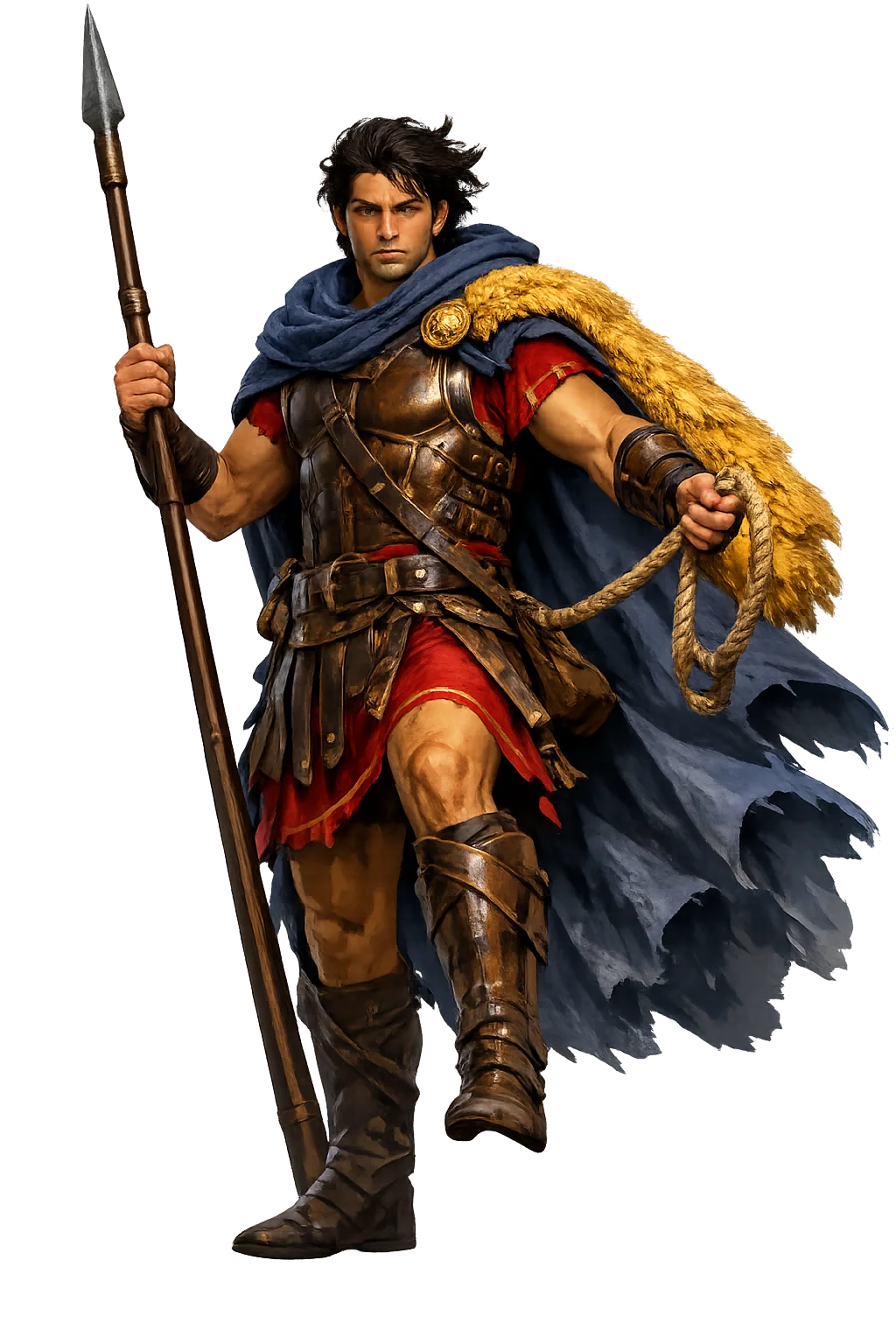
Stories of Iásōn
The myth of Iásōn is the myth of the quest itself: an unjust king, an impossible errand, a band of heroes, and a prize won by cunning and love rather than by strength alone. Pindar sang it; Apollonius made it an epic; Euripides gave it its dark ending.
Pelias, who had seized the throne of Iolkos from Iásōn's father Aisōn, was warned by an oracle to beware the man wearing one sandal (Apollodorus, Bibliotheca 1.9.2). Iásōn came down from Mount Pelion, where the centaur Cheirōn had reared him, and fording the river Anauros he helped an old woman across — losing a sandal in the mud. The old woman was Hera in disguise, and her gratitude would shape the whole voyage to come. Pelias saw the sign and understood it: he could not kill the son of Aisōn outright, so he set the errand he thought would kill him instead — fetch the Golden Fleece from the edge of the world. 'Fetch the fleece' is thus not an adventure but an execution postponed, a death sentence disguised as a commission: the quest opens, as Greek quests do, with a usurper's fear wearing the mask of a king's command.
The greatest heroes of the age answered the summons — Heraklēs, Orpheus, the Dioskouroi, and some fifty more — and the Argo, first of all ships, carried them out from Pagasai (Apollonius, Argonautica 1–2). The coasts of the voyage are a map of wonders and losses: Lemnos, the island of women; the spring of Hylas, where Heraklēs was lost to the expedition; the boxing of Polydeukēs with the brute Amykos. At the Bosphoros the blind seer Phineus, himself tormented by the Harpies, repaid his rescue with the passage every sailor dreaded: the Symplegades, the Clashing Rocks that crushed whatever sailed between. His counsel: loose a dove first. The bird slipped through and lost only its tail-feathers; the Argonauts rowed on the rebound, and the rocks, having missed, stood rooted forever — or so the grateful sea allowed (Argonautica 2.549–610). The myth's mechanism is faith tested at the narrowest point: no one passes the gates of the unknown intact, only minus a tail-feather.
In Colchis, King Aietēs set three labors: yoke the fire-breathing bulls, plow the field of Árēs, and destroy the armed men sprung from a dragon's teeth (Apollodorus 1.9.23). Iásōn could no more do these than plow the sea — so the gods moved the other lever. Hera and Athena persuaded Aphrodite to send Eros, and Medea, the king's daughter, a mistress of pharmaka devoted to Hekate (Diodorus 4.45), fell in love with the stranger and put her art at his service (Apollonius 3.26–4). Her ointment made Iásōn proof against fire and iron for a single day; her counsel felled the dragon's brood by the stone-throwing trick Cadmus had used; her charm sang the sleepless guardian serpent to sleep, and the Fleece was lifted in the night. The myth never lets us forget the true agent: every labor is Medea's, and Iásōn's role is to be loved by the right person at the right hour — the hero as beneficiary, not performer.
The homecoming was shadowed from the start. At the river Ister, Medea lured her brother Apsyrtos into an ambush; in Apollonius's telling Iásōn struck the blow she had arranged (Argonautica 4.450–481), while the older tradition preserved in the scholia — citing Pherecydes — makes the dismemberment of the body and its scattering for the pursuing Colchians her own handiwork. At Iolkos she boiled an old ram and produced a lamb, then bade Pelias's daughters do the same for their father: the false rite of renewal cut the usurper to pieces (Apollodorus 1.9.27). Exiled to Corinth, Iásōn set Medea aside to marry the princess Glaukē — and Euripides' Medea tells the rest: the poisoned robe, the murdered children, the chariot of the Sun. Iásōn died as he had lived, by the Argo: as an old man he slept beneath the rotting hull, and its stern-beam fell and killed him (Apollodorus 1.9.28). The healer's name closes on the story's own diagnosis: everything he touched was cured except himself.
Heroism, the Golden Fleece, and the First Great Voyage
Iásōn is the captain of the first great sea-quest of Greek myth: the voyage of the Argo to Colchis for the Golden Fleece. His name comes from ἰάομαι, 'to heal' — yet his story is less about curing than about gathering: he is the hero whose greatest power is to summon other heroes, and to win the love of a princess whose magic does the work.
The first true ship, built by Argos the shipwright under Athena's direction; its prow held a beam from the speaking oak of Dodona.
The fleece of the flying ram that carried Phrixos to Colchis, hung in a grove of Árēs and guarded by a sleepless dragon.
Some fifty heroes — Heraklēs, Orpheus, the Dioskouroi, Atalanta in some tellings — the greatest muster before Troy.
From ἰάομαι, 'to heal' — the ironic name of a hero whose cures are worked by Medea's pharmaka, not his own hands.
From the original script to the living URL
Ἰάσων
The name in its original Greek form. Iásōn (Ἰάσων) is attested in the source tradition — “Healer”. Its long vowels and acute accents carry the full phonetic and orthographic weight of the source tradition.
iason
Reduced to plain iason, the name loses everything that made it specific: long vowels and acute accents. What remains is an ASCII string that machines can parse but that no longer speaks with its original voice.
Iásōn
The Unicode restoration recovers what ASCII flattened. Iásōn restores long vowels and acute accents, returning the name to its original written dignity. The domain encodes to Punycode, but the browser displays the truth.
Iásōn.com → xn--isn-ela55c.com
The non-ASCII characters in Iásōn are encoded while the ASCII remains visible. To the DNS, it is Punycode. To humanity, it is Iásōn.
Owned, ideal, and ASCII forms of Iásōn
Iásōn
Restores Ἰάσων. The live temple domain — iásōn.com.
Iāsōn
Restores Ἰάσων. Macron-only scholarly form (LSJ convention); the temple carries the full stress-marked restoration..
iason
Flattens Ἰάσων. The plain ASCII fallback — what DNS and legacy systems see.
How Iásōn was spoken
How Iásōn is preserved in writing
A bespoke provenance study for Iásōn is being prepared by the PUNICODEX scholarly team.
Contribute scholarly provenance →The lore you have read is the living myth. Extended Lore opens the scholarly vault beneath it: the cult and its material remains, a history of the image, the name after antiquity, a meditation on what the name still means, and the full scholarly apparatus — etymology, orthography, sources.
Enter Extended Lore