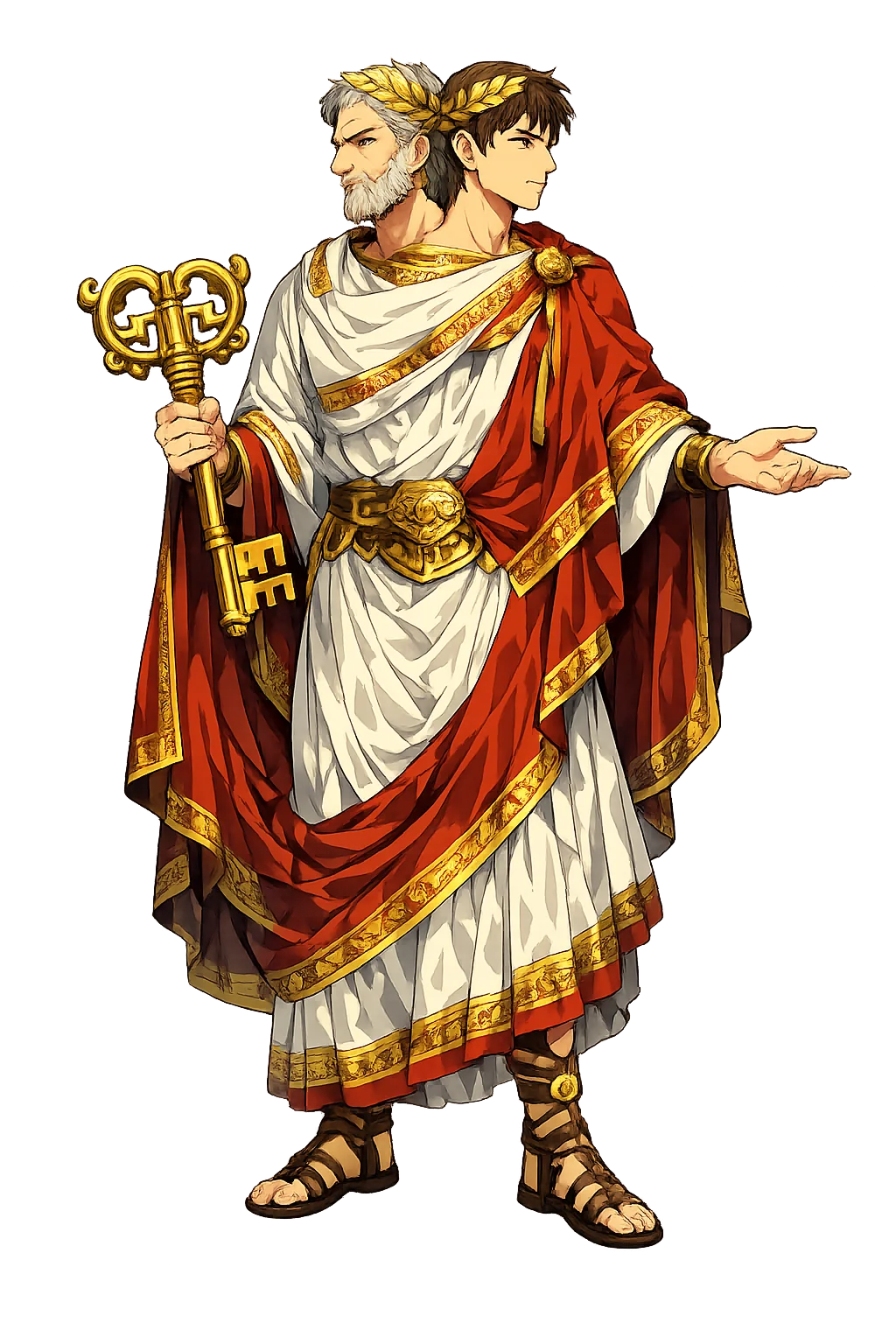
Stories of Iānus
Ovid's Fasti gives him the one great scene: the poet asks the two-faced god why he looks both ways, and Iānus answers for himself — the only extended self-explanation any Roman god gets in verse. Around it stand the war gates, the threshold nymph, and the oldest Roman 'history' of all: Saturn's flight to his kingdom.
Ovid opens his calendar with the boldest interview in Roman poetry: he asks Iānus why, alone among the gods, he sees both behind and before (Fasti 1.63–288). The god answers at length. Whatever you see — sky, sea, earth — all things are closed and opened by my hand; I preside over the gates of heaven with the gentle Seasons; I was called Chaos once, for I am the ancient confusion out of which order came. Then he teaches the poet why the year begins in winter: December's fires end, the sun turns, and the new year opens with the returning light — a beginning honored at the threshold, at the first word spoken across a door. No other Roman god narrates himself in verse; the door, characteristically, speaks for itself. The myth's quiet claim is that beginnings are not a moment in time but a power over time — the hinge on which the year itself swings.
Numa, the peace-king who followed Romulus, founded the rite that made the god a barometer of war: the double gates of the Ianus Geminus in the Forum stood open while Rome was at war and closed only in peace (Livy 1.19). Livy records that in the four centuries after Numa they had been shut exactly twice before Augustus — once in 235 BCE in the consulship of Titus Manlius — and Augustus boasted in his Res Gestae (13) of closing them three times. Later sources credited Nero with a closure after the Armenian settlement, and emperors of the third century repeated the gesture; Procopius saw the gates still standing in the sixth century. The arithmetic is the myth: an open temple as the default, peace so rare it needed a ceremony to announce. The god of beginnings watched a state for whom war was the standing condition — and held the door open accordingly.
Ovid's second January of folklore concerns the goddess of the hinge (Fasti 6.101–168). Carna had spent her youth outwitting her suitors — promising to meet each in a dark grove, then never coming — until she tried the trick on Iānus. The two-faced god, who cannot be crept up on, simply looked backward and saw her behind him; caught, she yielded, and the marriage made her mistress of the door's moving parts. Carna became the guardian of hinges and the health of children, honored on the Kalends of June with emmer porridge and lard set out at midnight to keep the night-hags from the cradles. It is Rome's most domestic theology: a marriage between the god of the threshold and the goddess of the hinge, celebrated in bean-and-bacon at the kitchen door. The myth makes the household's smallest mechanism — the swinging door — a point of contact with the highest cosmic one, and both of them need a woman to keep them true.
The oldest Roman 'history' makes Janus a king before he was a door. When Jupiter drove his father Saturn from Olympus, the exile fled west and was received in Italy by Janus, who then ruled over Latium — so Ovid tells it (Fasti 1.233–254), and Virgil before him (Aeneid 8.319–325). Janus shared his kingdom with the refugee, and under their joint rule the people lived in the Saturnia regna: no walls, no laws, no war, the earth giving fruit without labor. Saturn taught the planting of vines and grain; when he departed, the memory remained in his hill, his feast, and his month of plenty, while Macrobius (Saturnalia 1.7–8) collects the rites that kept the partnership warm each December. The myth makes Janus the host of history itself: every arrival from elsewhere — god, refugee, year — enters the world through his doorway, and he receives them all with the same two faces, one grieving the home lost, one greeting the home found.
Beginnings, Gates, and the Two Faces
Iānus has no Greek equivalent and no mythology of adventure: he is Rome's god of passages themselves — doors, bridges, beginnings, the month that opens the year. His two faces look both ways because every threshold faces two worlds.
The Ianus Geminus, open while Rome fought, closed in peace — shut only a handful of times in seven centuries.
The two-faced one: past and future, entrance and exit, watched simultaneously.
Iānuārius — his month still opens the civil year of half the world.
His double face stamped the earliest Roman bronze coinage, with the prow of a ship on the reverse.
From the original script to the living URL
IANVS
The name in its original Roman form. Iānus (IANVS) is attested in the source tradition — “'Passage, arched door' (from ianua)”. Its macron-length vowels carry the full phonetic and orthographic weight of the source tradition.
ianus
Reduced to plain ianus, the name loses everything that made it specific: macron-length vowels. What remains is an ASCII string that machines can parse but that no longer speaks with its original voice.
Iānus
The Unicode restoration recovers what ASCII flattened. Iānus restores macron-length vowels, returning the name to its original written dignity. The domain encodes to Punycode, but the browser displays the truth.
Iānus.com → xn--inus-qsa.com
The non-ASCII characters in Iānus are encoded while the ASCII remains visible. To the DNS, it is Punycode. To humanity, it is Iānus.
Owned, ideal, and ASCII forms of Iānus
Iānus
Restores IANVS. The live temple domain — iānus.com.
ianus
Flattens IANVS. The plain ASCII fallback — what DNS and legacy systems see.
How Iānus was spoken
How Iānus travels from ancient script to the modern URL
The lore you have read is the living myth. Extended Lore opens the scholarly vault beneath it: the cult and its material remains, a history of the image, the name after antiquity, a meditation on what the name still means, and the full scholarly apparatus — etymology, orthography, sources.
Enter Extended Lore