PuniCodex

Extended Lore

IANVS Iānus

Etymology · Orthography · Cult · Iconography · Reception · Sources

Tier 1 Iānus.com
Iānus — Beginnings, Doors, Transitions
01

Quick Facts

Essential information about Iānus, Beginnings, Doors, Transitions

Original ScriptIANVS
Unicode RestorationIānus
Reconstructed Pronunciation/ˈjaː.nus/
PantheonRoman
DomainBeginnings, Doors, Transitions
Meaning'Passage, arched door' (from ianua)
ClassificationTier 1
Primary DomainIānus.com
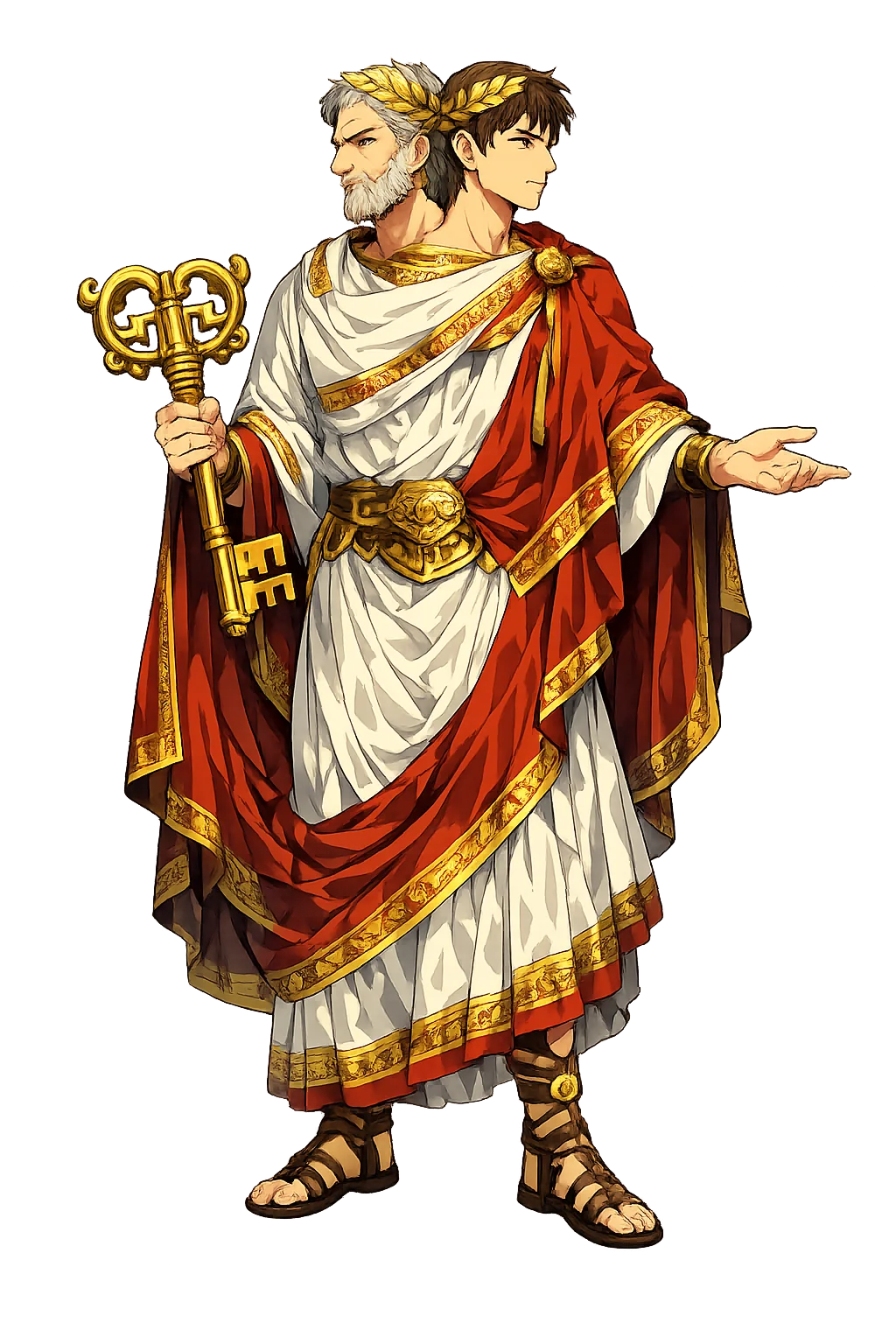
Sacred SymbolsThe key, The staff, The double face, The archway, The ship's prow
02

Etymology & Word Family

From original script to Unicode restoration

Original Script IANVS Iānus — "'Passage, arched door' (from ianua)"
Unicode Restoration Iānus Restored stress, length, and script
Modern ASCII ianus Plain-ASCII fallback

The name Iānus carries the orthographic signature of the roman tradition: IANVS. Unicode restoration recovers what ASCII flattens.

03

Unicode Character Breakdown

Character-by-character philological analysis

CharacterUnicodeNameBlockPhonetic Role
IU+0049Latin Capital Letter IBasic LatinSame letter
āU+0101Latin Small Letter A with MacronLatin Extended-AMacron marks the long vowel
nU+006ELatin Small Letter NBasic LatinSame letter
uU+0075Latin Small Letter UBasic LatinSame letter
sU+0073Latin Small Letter SBasic LatinSame letter

The Tier 1 classification reflects how much of the original phonology this restoration preserves — stress and vowel length for Greek names, distinctive letters and diacritics for every other tradition.

04

Cult & Worship

How the sacred was kept — rites, sanctuaries, remains

The Cult

Ianus had no flamen of his own, yet he opened every public sacrifice: prayers and libations were offered to him first, and to Vesta last. His central shrine, the Ianus Geminus in the Forum, was a small arched structure with bronze doors that stood open in war and closed in peace; Augustus's triple closing of the gates was recorded as a turning point in Roman history. The month of January bears his name, and the kalends of January were celebrated with emmer, salt, and wine. He was also invoked at marriages, births, and departures, and his association with doorways made the ianitor and the threshold part of his cult in daily Roman life.

In the Earth

The Ianus Geminus stood in the Forum near the Curia; its bronze gates survived into late antiquity (Procopius describes them), though the structure's exact footprint is debated. His most durable monument is numismatic: the heavy cast bronze aes grave of the 3rd century BCE bears the double-faced head — one of the earliest portrait-types of Roman coinage — and the denarius tradition continued it. A small shrine of Ianus on the Janiculum, the hill that probably bears his name, tied the god to Rome's western gate.

05

Iconography

How Iānus was imaged across the ages

The Image

The god's defining image is the double-faced head, one bearded and one beardless, gazing simultaneously forward and back. This type appears on the heavy aes grave bronze coinage of the early Republic and remained a staple of the denarius for centuries, often paired with a ship's prow to mark Roman beginnings. In the Forum Transitorium, Domitian erected a four-faced Ianus Quadrifrons, looking toward the four corners of the empire. Artists give him keys, a staff, and sometimes a caduceus, but the two faces are sufficient identification: Janus is the god who sees both ends of time.

06

Reception & Transformation

The name after its own age — transmission, translation, survival

Afterlives

Ianus survived the fall of Roman religion chiefly as a calendrical name and a metaphor. The month Januarius entered every European language derived from Latin, fixing him at the threshold of the year. Medieval and Renaissance humanists returned to Ovid's interview with the god in the Fasti, and the double face became an emblem of prudence, diplomacy, and the passage of time. Baroque emblems and frontispieces used Janus to frame the contrast between past and future. In modern scholarship Freud borrowed the two-faced image, and the adjective 'Janus-faced' entered ordinary English as a description of contradiction. No ancient temple now stands, but the god of beginnings remains embedded in how the West begins its year.

Identifications Across Traditions

The Etruscans knew a two-faced gate-spirit (Culsans, paired with the one-faced Culsu), and Iānus absorbed that numinous door-power early. Having no Greek twin, he puzzled the mythographers: some aligned him with the sky, some with Chaos itself — Ovid reports both. Medieval Europe kept him as the face of January in calendar art, and the Renaissance restored him on coins and doorways. Modern science borrowed him wholesale: "Janus particles" (two-faced colloids), the Janus kinase (JAK) enzymes that open two signaling paths at once, and "Janus-faced" as the standard diagnosis of ambivalence — the god of two ways of seeing became the name for the condition itself.

Modern Legacy

January keeps his name on every calendar; the janitor keeps his keys in every school; 'Janus-faced' remains the standard charge in diplomacy and the standard diagnosis in literature. The Roman habit of naming him first — at marriages, departures, consulates, and the first word of every prayer — survives in the New Year's toast, the doorstep superstition, and the instinct to look back before stepping forward. Historians read the rarity of his closed gates as Rome's autobiography: a republic that could count its years of peace on one hand, and a god whose open temple was the weather of empire. Every doorway ritual ever performed is, knowingly or not, his small surviving liturgy.

07

The Meditation

What Iānus means — beyond the dictionary

Iānus is the god of the door you are standing in. Every beginning contains its end; every entrance is also an exit watched from the other side. He does not judge the passage — he is the passage. To honour him is to pause at thresholds: to look back once, look forward once, and only then walk through.

Modernity made him its secret patron: every pivot, every launch, every new year, every door held open for a stranger is his small liturgy. The Romans began everything — journeys, marriages, consulates, the year itself — by naming him first, on the principle that a beginning honoured is half accomplished. His two faces are the correct posture for any threshold: gratitude backward, attention forward, and then — the god's whole point — through.

It is no accident that Rome's rarest public celebration was his closed gates: peace was so unusual it needed a god's doorway to mark it. The open gates were the default, the ordinary weather of a martial state — and the god watched both conditions with the same two faces, praising neither. His neutrality is the lesson: thresholds do not judge what passes through them; they only insist that passing is a choice, and that someone remember to look both ways first.

08

Frequently Asked Questions

Common questions about Iānus, Beginnings, Doors, Transitions, and Unicode restoration

01How do you pronounce Iānus?

In reconstructed pronunciation, Iānus is /ˈjaː.nus/ — approximately YAH-nus, long ā on the first syllable.

02What does Iānus mean?

Iānus means 'Passage, arched door' (from ianua) in the roman tradition.

03What are the symbols of Iānus?

Iānus is associated with The key (The opener and shutter — claviger, the key-bearer), The staff (The doorkeeper's rod of admission), The double face (Simultaneous sight of before and after), The archway (The ianus itself — the arched passage through which army, bride, and magistrate alike must pass), The ship's prow (The reverse of his earliest coins — passage by water as well as by land).

04Why restore Iānus in Unicode?

Plain ASCII ianus strips the stress, length, and script that make the name specific. Unicode restoration returns the name to its original written dignity.

05What is the most important myth about Iānus?

“Fasti 1: The God Explains Himself” — the The Interview story that anchors the mythology of Iānus, told in full on the lore page.

09

Scholarly Sources

The philological foundations of this restoration

Every claim on this page is grounded in established scholarship. The orthographic restorations follow disciplinary convention. The etymological chain follows the best available reference works. This is not invention — it is resurrection through scholarship.

◈

Lexicography & Philology

  • Lewis & Short
  • Macrobius
◎

Primary Texts

  • Ovid
  • Ovid, Fasti 1.63–288 (the interview); 6.101–168 (Carna)
  • Virgil, Aeneid 8.319–325 (Saturn received by Janus)
  • Varro, De lingua Latina 5.165; Cicero, De natura deorum 2.67 (the folk etymologies)
◉

Archaeology & Art History

  • Material evidence — iconography, inscriptions, and temple archaeology — for Iānus and related cults.
✦

Religious Studies

  • Livy 1.19 (Numa and the gates); Augustus, Res Gestae 13
  • Macrobius, Saturnalia 1.7–9 (the Janus–Saturn partnership)
  • Procopius, Gothic War 1.25 (the gates in late antiquity)
Return

The Surface Awaits

You have traced the name from its earliest attestation to its Unicode restoration. Now return to the myth. The story is where the name lives.

Back to Lore
Iānus mascot